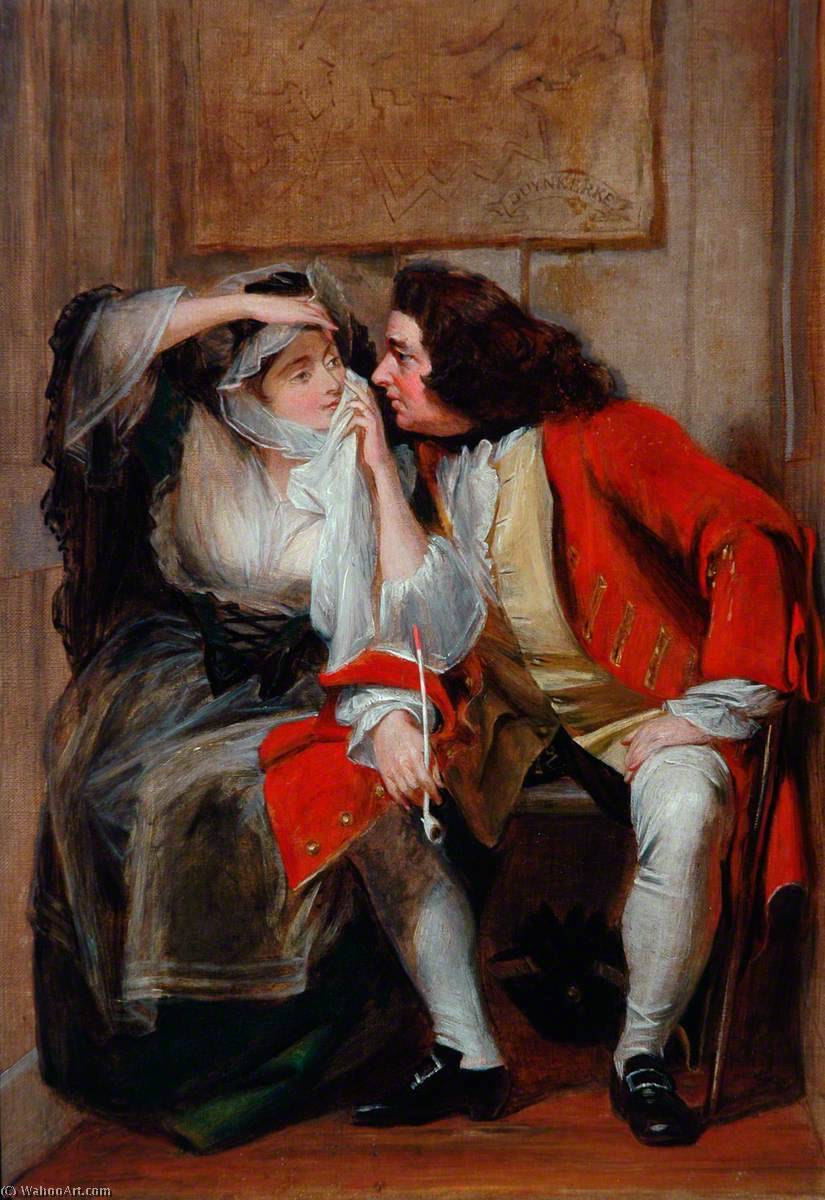
A Moment Frozen in Time: The Intimacy of Leslie’s Vision
In the delicate interplay of light and shadow within "Uncle Toby and Widow Wadman," we are invited into a private, whispered world created by the masterful hand of Charles Robert Leslie. Painted in 1831, this intimate portrait transcends mere representation, offering instead a profound glimpse into a shared human connection. The composition centers on two figures caught in a moment of quiet communion; the man, draped in a striking red coat that commands the viewer's attention, leans toward the woman, whose white attire lends an ethereal, pure quality to her presence. Their proximity suggests a narrative far deeper than what is visible on the surface—a conversation perhaps filled with shared secrets, gentle humor, or the quiet weight of long-held affection.
The artistry of Leslie shines through in his ability to balance the grandiosity of classical portraiture with the tender nuances of genre painting. While his early training under masters like Benjamin West pushed him toward historical themes, it is in scenes such as this that he truly finds his soul. The technique employed here utilizes a soft, painterly approach that blurs the edges of the background, ensuring that the emotional gravity remains fixed upon the faces of the subjects. Every brushstroke serves to heighten the sense of atmosphere, making the viewer feel less like an observer and more like an unobserved guest in this charming, historical vignette.
Symbolism and the Art of Domestic Elegance
Beyond the central figures, the surrounding elements of the painting act as silent storytellers, enriching the domestic tapestry Leslie has woven. The presence of a chair to the left and a carefully placed handbag suggests a setting of refined comfort, grounding the emotional intensity of the characters within a tangible, lived-in reality. Even the subtle details, such as the placement of ties within the frame, contribute to a sense of organized elegance characteristic of the early 19th-century British aesthetic. These objects are not merely props; they are symbols of status, stability, and the quiet comforts of a well-ordered life.
For the discerning collector or interior designer, this piece offers more than just visual beauty; it provides a focal point of historical depth and emotional resonance. The contrast between the bold crimson of the man's coat and the luminous white of the woman's dress creates a dynamic visual rhythm that can breathe life into any sophisticated space. Whether placed in a study filled with leather-bound books or as a centerpiece in a contemporary gallery, a high-quality reproduction of this work serves as a window into the Romantic era—a period defined by its passion, its drama, and its profound appreciation for the beauty found in the most intimate of human encounters.