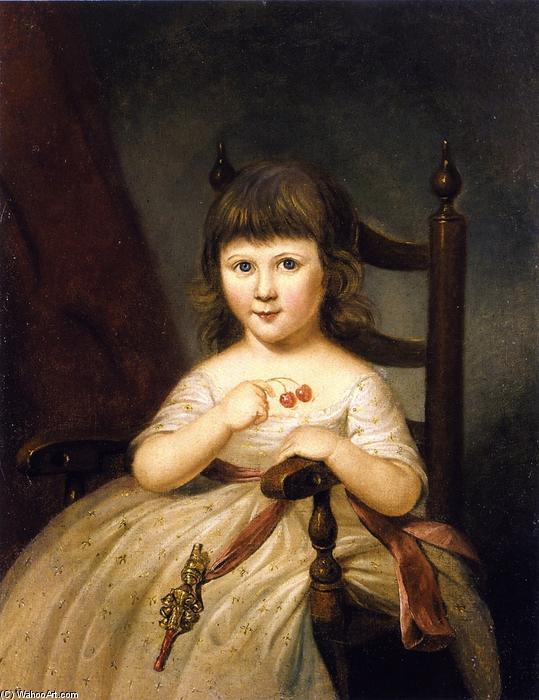
Admire Charles Willson Peale’s ‘Mary O’Donnell,’ a stunning Neoclassical portrait from 1791. Explore this masterpiece's beauty, detail & historical context at the Chrysler Museum.
The painting
Mary O'Donnell by
Charles Willson Peale is a stunning example of Neoclassical art, showcasing the artist's mastery of capturing the essence of his subjects. Created in 1791, this oil on canvas painting is currently housed at the
Chrysler Museum of Art in the United States.
Artistic Style and Composition
The painting features a young girl sitting on a chair with her hands clasped in front of her, wearing a dress and a pink ribbon around her neck. The composition is balanced, with the subject occupying most of the left side of the frame, while the chair is positioned towards the right side. The use of color and lighting creates a sense of depth and dimensionality, drawing the viewer's eye to the subject.
Key Elements of the painting include the subject's gentle expression, the intricate details of her dress, and the subtle play of light on her face. These elements demonstrate
Charles Willson Peale's skill in capturing the subtleties of human emotion and his attention to detail.
Artist and Historical Context
Charles Willson Peale was a prominent American artist, known for his portraits of influential figures of the time. His work can be found in various museums, including the
Brigham Young University Museum of Art and the
National Portrait Gallery. Other notable works by
Charles Willson Peale include
Thomas McKean and
Charles Willson Peale Self-Portrait, which can be found on
ArtsDot.com.
The painting
Mary O'Donnell is a testament to
Charles Willson Peale's skill as a portrait artist and his ability to capture the essence of his subjects. As a masterpiece of Neoclassical art, it continues to inspire and fascinate art lovers to this day.