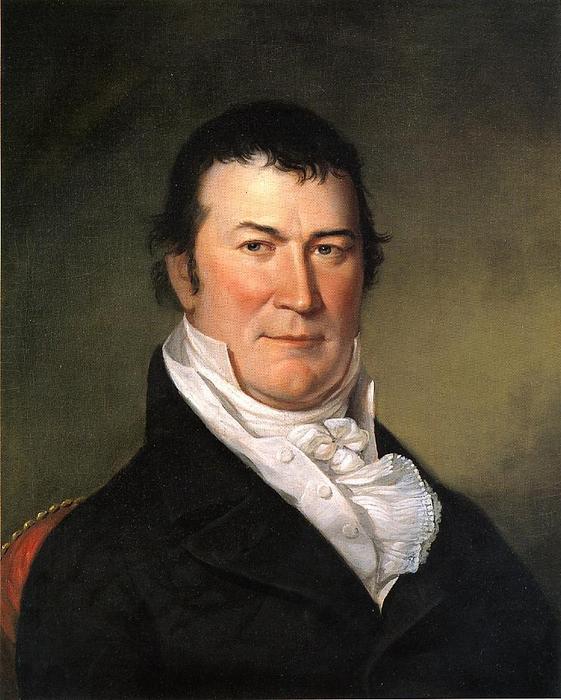
This striking oil on canvas portrays William Harris Crawford, a Georgian politician and Secretary of War under James Madison. Painted by Charles Willson Peale in 1818, it exemplifies neoclassical style and showcases meticulous detail—a testament to Peale's skill as both artist and scientist.
Portrait of William Harris Crawford (1818) by Charles Willson Peale
Charles Willson Peale’s “Portrait of William Harris Crawford” stands as a testament to the artistic fervor and intellectual curiosity that characterized early 19th-century America. Completed in 1818, this oil on canvas masterpiece transcends mere likeness; it embodies a profound exploration of identity and ambition within the context of a nation grappling with its burgeoning role on the world stage. Currently residing at the High Museum of Art in Atlanta, Georgia, the painting offers viewers an unparalleled glimpse into the visage of William Harris Crawford—a pivotal figure in Georgia’s political landscape and a champion of westward expansion—captured by one of America's foremost artists.
- Subject Matter: The portrait depicts Crawford seated formally, gazing directly at the viewer with unwavering composure. His attire – a dark coat adorned with intricate embroidery and a crisp white cravat – speaks to his status as a respected statesman and underscores the conventions of aristocratic portraiture prevalent during the era.
- Style & Technique: Peale’s masterful execution demonstrates an impressive command of neoclassical principles, mirroring the stylistic trends championed by artists like Jacques-Louis David in Paris. He skillfully employs chiaroscuro—the dramatic interplay between light and shadow—to sculpt Crawford's form and imbue the painting with depth and realism. The meticulous attention to detail extends beyond mere anatomical accuracy; Peale meticulously rendered textures – from the fabric of Crawford’s coat to the subtle sheen of his skin – elevating the artwork to a level of artistic sophistication.
- Historical Context: Painted during Crawford's tenure as Secretary of War under President James Madison, “Portrait of William Harris Crawford” reflects the anxieties and aspirations surrounding America’s westward expansion. The painting captures Crawford at a moment of considerable political influence, symbolizing his commitment to securing Georgia’s interests amidst growing tensions with Native American tribes and debates over federal policy.
- Symbolism: Peale's deliberate composition—the seated posture, the direct gaze—communicates confidence and authority. Furthermore, the subtle use of color contributes to the painting’s symbolic resonance, conveying Crawford’s dignity and representing him as a figure of noble character.
- Emotional Impact: The portrait succeeds in conveying Crawford's inner strength and resolve. It invites contemplation on themes of leadership, ambition, and the pursuit of national greatness—qualities that resonated deeply with audiences during Peale’s lifetime and continue to captivate viewers today.
The painting’s enduring appeal lies not only in its technical brilliance but also in its ability to transport us back to a pivotal moment in American history. It serves as an invaluable record of Crawford's appearance and demeanor, offering insights into the psychological landscape of his time—a testament to Peale’s artistic vision and a cornerstone of Georgia’s cultural heritage. Its presence at the High Museum ensures that this iconic artwork remains accessible to generations of art enthusiasts eager to appreciate its beauty and contemplate its significance.