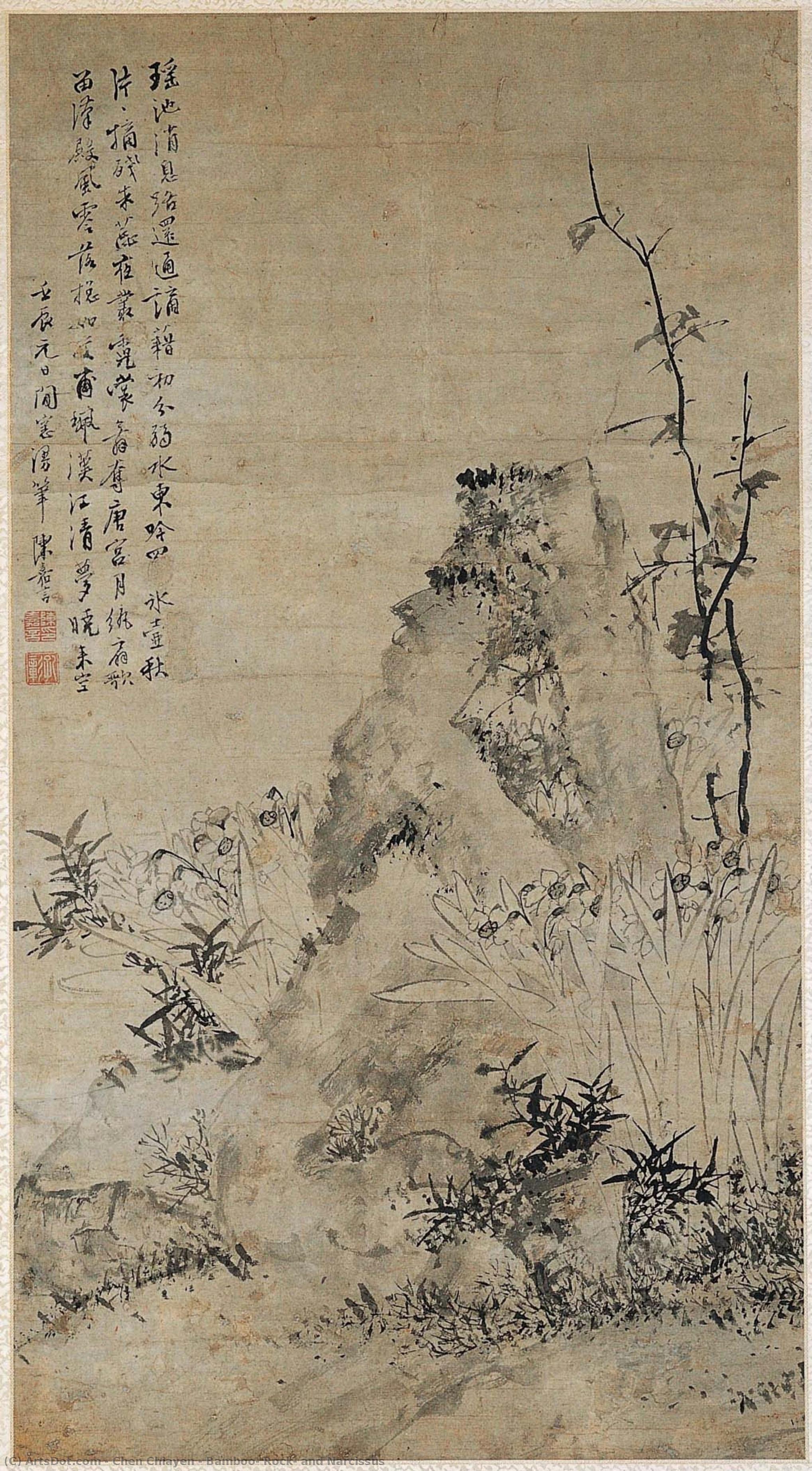
A Whisper of Resilience: Exploring Chen Jiayen's Bamboo, Rock, and Narcissus
To gaze upon this exquisite depiction of bamboo, rock, and wild narcissi is to encounter not merely a landscape, but a profound meditation on endurance. Executed by the masterful hand of Chen Jiayen in 1652, this scroll transcends the simple genre of floral still life or mountain vista. It captures a moment suspended between desolation and burgeoning hope. The composition itself—the interplay between the solid permanence of the rock, the graceful curve of the narcissi blossoms, and the vertical thrust of the bamboo stalks—creates an immediate sense of balanced harmony, even as its underlying narrative speaks of profound struggle.
Mastery in Ink Wash Technique
Chen Jiayen’s technical prowess is immediately apparent. The artist employs a breathtaking technique utilizing soft, gradated tones of ink wash, allowing the monochrome medium to achieve remarkable depth and subtlety. Observe how the darker ink is used with such precision to define the spiky vitality of the bamboo leaves, contrasting beautifully with the areas left pure white, which delineate the delicate, curving petals of the narcissi. This masterful restraint—the decision to let the white space breathe—is what gives the painting its ethereal quality. It is a demonstration of how much can be conveyed through suggestion and shadow rather than overt declaration.
Symbolism Woven into Nature
For the connoisseur, this work resonates deeply with Chinese artistic tradition, where flora rarely exists without symbolic weight. The inclusion of bamboo, which bends mightily in the wind yet refuses to break, stands as an ancient emblem of unwavering integrity and flexibility. The narcissus, blooming early, heralds the inevitable return of spring, a promise against the bleakest backdrop. These elements combine with the steadfast rock formations to form a visual allegory: even when civilization seems shattered, strength and renewal persist within nature itself. This is art speaking directly to the human spirit.
A Reflection on Turmoil and Hope
The historical context elevates this piece from mere decoration to poignant cultural artifact. Written in 1652, shortly after the tumultuous fall of the Ming dynasty, the accompanying poem—though unseen here—speaks volumes of despair. Yet, Chen Jiayen does not allow the melancholy to overwhelm his vision. By presenting these symbols of resilience against a backdrop hinting at national sorrow, he offers solace. It is an art that acknowledges pain but insists upon the necessity of looking forward, suggesting that self-regeneration and inner fortitude are the most vital resources when times are darkest.
Bringing Tranquility Home
For the collector or designer seeking a piece imbued with intellectual depth alongside unparalleled beauty, this reproduction offers an extraordinary focal point. Its delicate scale (80 x 43 cm) allows it to grace a mantelpiece or gallery wall without dominating the space, acting instead as a quiet source of contemplation. Owning this work is acquiring more than just exquisite craftsmanship; it is adopting a philosophy—a reminder that even in times of apparent collapse, beauty, strength, and the promise of renewal are always waiting to bloom.