A Tapestry of Text and Memory
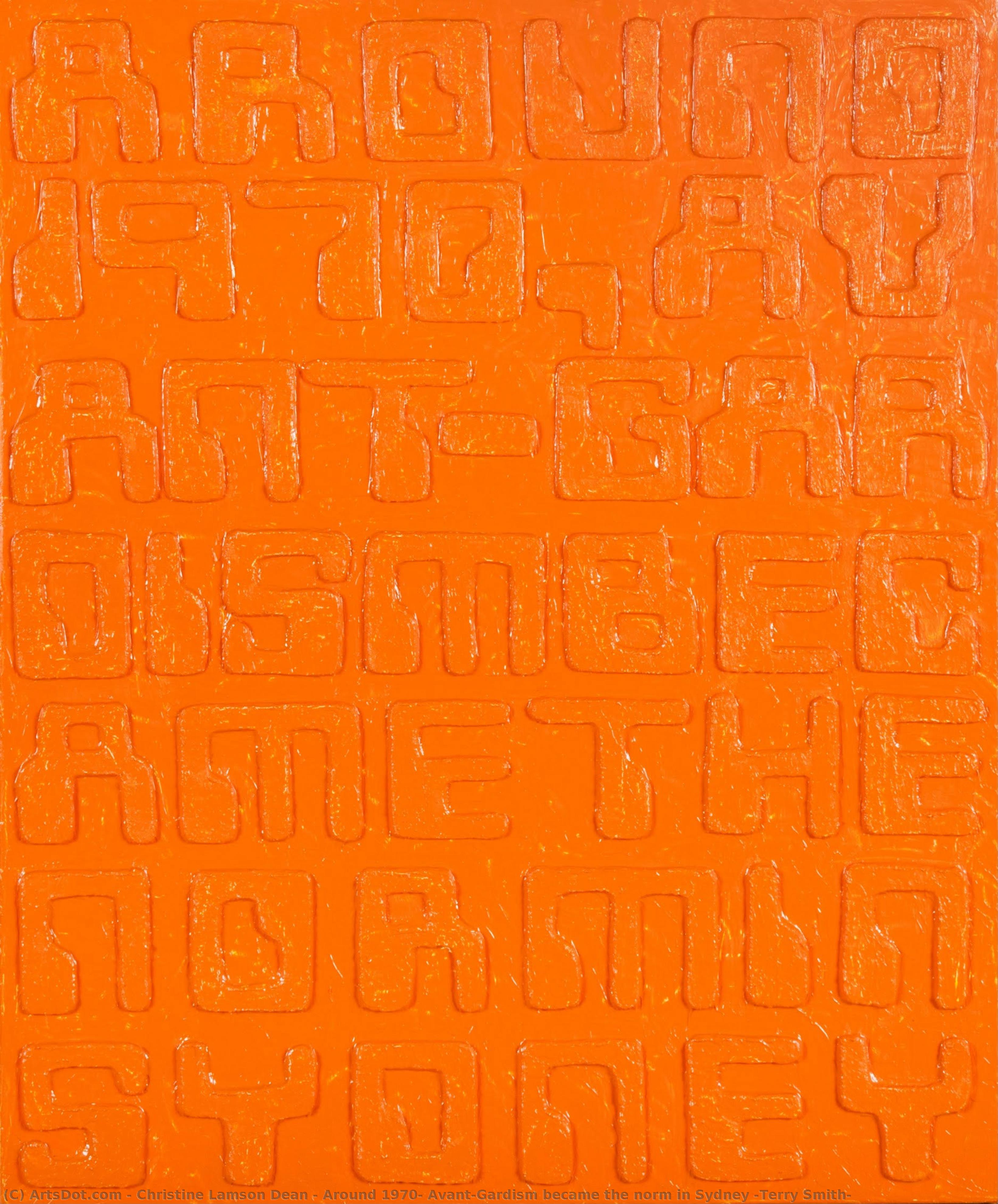
In the vibrant, pulsating landscape of contemporary Australian abstraction, few works capture the intellectual friction of art history quite like "Around 1970, Avant-Gardism became the norm in Sydney (Terry Smith)". Created by the evocative artist Christine Lamson Dean, this piece serves as a profound meditation on the layers of meaning that define our perception of modernity. At first glance, the eye is immediately arrested by a bold, saturated orange background—a hue that radiates with an almost electric energy, demanding presence within any curated space. Yet, as one lingers, the surface reveals itself to be far more than a mere field of color; it is a canvas of linguistic echoes, where words and phrases dance across the expanse in a rhythmic, typographic choreography.
The work functions as a visual dialogue between the physical medium of paint and the intellectual weight of language. By arranging text in varying sizes and orientations, Dean creates a sense of depth and movement that mimics the way memory itself operates—fragmented, overlapping, and occasionally overwhelming. This technique transforms the painting from a static object into a dynamic experience, inviting the viewer to navigate the composition like a map of historical consciousness. For the discerning collector or interior designer, this piece offers a sophisticated focal point that bridges the gap between minimalist abstraction and conceptual storytelling.
The Echoes of Modernism
To understand the soul of this work, one must look toward the rich historical tapestry from which it is woven. Dean’s practice is deeply rooted in an ongoing review of the philosophical foundations of Australian modernism. This specific piece emerged from a transformative residency at the Penrith Regional Gallery, where the artist immersed herself in the legacies of titans such as Margo Lewers and Lyndon Dadswell. The painting acts as a scholarly yet poetic tribute to this era, specifically referencing the influential critical discourse provided by figures like Terry Smith and Clement Greenberg. It is not merely an aesthetic object; it is a curated archive of influence.
The symbolism within the work lies in its very structure—the way the text interacts with the void of the orange field. There is a palpable tension between the permanence of the written word and the ephemeral nature of the "avant-garde" movement it describes. By utilizing a format that feels almost like a fragment of a larger, lost manuscript, Dean evokes a sense of nostalgia for the radical shifts of the 1970s Sydney art scene. This layer of historical depth provides an intellectual gravity that makes the work particularly compelling for those who appreciate art that challenges the mind as much as it delights the eye.
A Statement of Sophisticated Presence
For those seeking to infuse a contemporary interior with character and narrative, this reproduction offers an unparalleled opportunity. The striking contrast between the warm, energetic orange and the structured typography allows it to integrate seamlessly into both minimalist modern settings and more eclectic, curated environments. It possesses a rare ability to act as both a conversation starter and a stabilizing element of color.
Investing in a high-quality reproduction of Dean’s work means bringing a piece of Australian art history into the home—a piece that embodies the spirit of experimentation and the enduring power of the avant-garde. Whether placed in a professional gallery setting or as a centerpiece in a private study, "Around 1970, Avant-Gardism became the norm in Sydney (Terry Smith)" remains a testament to the beauty found in the intersection of art, history, and the written word.