Christoffer Wilhelm Eckersberg: The Dawn of Danish Modernity
Christoffer Wilhelm Eckersberg (1783-1853) stands as a monumental figure in the history of Danish art, recognized universally as “The Father of Danish Painting.” His artistic vision irrevocably shaped the nation’s aesthetic sensibilities during its Golden Age—a period characterized by intellectual ferment and burgeoning national pride. Unlike many of his contemporaries who adhered to academic conventions, Eckersberg championed a revolutionary approach rooted in meticulous observation and profound engagement with the natural world.
Born in Kolding, Eckersberg's formative years were marked by a duality: his father’s carpentry workshop instilled in him a disciplined craftsmanship alongside excursions to Alssund—a windswept coastal landscape that would forever inform his artistic sensibility. This early exposure cultivated both technical precision and an instinctive understanding of light and texture – qualities that would become hallmarks of his oeuvre.
Formal training commenced with Jes Jessen in Aabenraa, propelling him toward a mastery of classical ideals while simultaneously nurturing his burgeoning talent. Eckersberg’s artistic trajectory wasn't merely about replicating established styles; it was about forging a new path—one that prioritized realism and emotional resonance.
The Model: Trine Nielsen
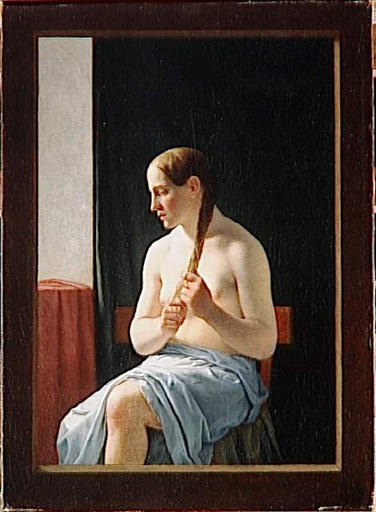
Eckersberg’s most celebrated work, “Le Modele” (Trine Nielsen), exemplifies this commitment to naturalism. Completed in 1839 at the Royal Danish Academy of Art, the portrait depicts Trine Nielsen—a young woman who served as Eckersberg's muse—seated gracefully on a wooden chair. The composition is remarkably balanced, focusing intently on Nielsen’s figure against a dark background that maximizes contrast and illuminates her facial features.
Eckersberg skillfully employed oil paints on canvas to capture the subtle nuances of human anatomy and expression. His brushwork is characterized by smooth layering—a technique designed to achieve luminous effects and convey a sense of tranquility. The artist’s meticulous attention to detail extends beyond mere representation; he strives to imbue the painting with an emotional depth that transcends its formal elements.
Neoclassical Realism: A Departure from Tradition
“Le Modele” represents a decisive break from prevailing academic styles of the time. Eckersberg rejected idealized forms and theatrical poses, opting instead for a restrained aesthetic grounded in observation—a hallmark of Neoclassicism. Influenced by artists like Jacques-Louis David and Antonio Canova, Eckersberg sought to emulate classical ideals of beauty and harmony while simultaneously capturing the individuality of his subject.
The muted color palette—dominated by earthy tones accented with shades of blue and red—contributes to the painting’s contemplative mood. The dark background serves as a foil for Nielsen’s skin tone, enhancing her presence and creating an atmosphere of solemn dignity. Eckersberg's masterful use of light and shadow sculpts the figure, conveying both physical form and psychological depth.
Symbolism and Emotional Resonance
Beyond its technical brilliance, “Le Modele” possesses a profound symbolic significance. The seated posture conveys a sense of quiet contemplation—a reflection of Nielsen’s inner life and aspirations. Eckersberg's gaze is directed outwards, suggesting an awareness of the surrounding environment and a connection to the natural world.
The painting’s understated elegance speaks to the enduring values of Neoclassicism: rationality, virtue, and moral seriousness. “Le Modele” remains a testament to Eckersberg's artistic vision—a masterpiece that continues to inspire admiration for its beauty and intellectual depth. It embodies the spirit of the Danish Golden Age, capturing a moment of serene grace amidst the complexities of human experience.