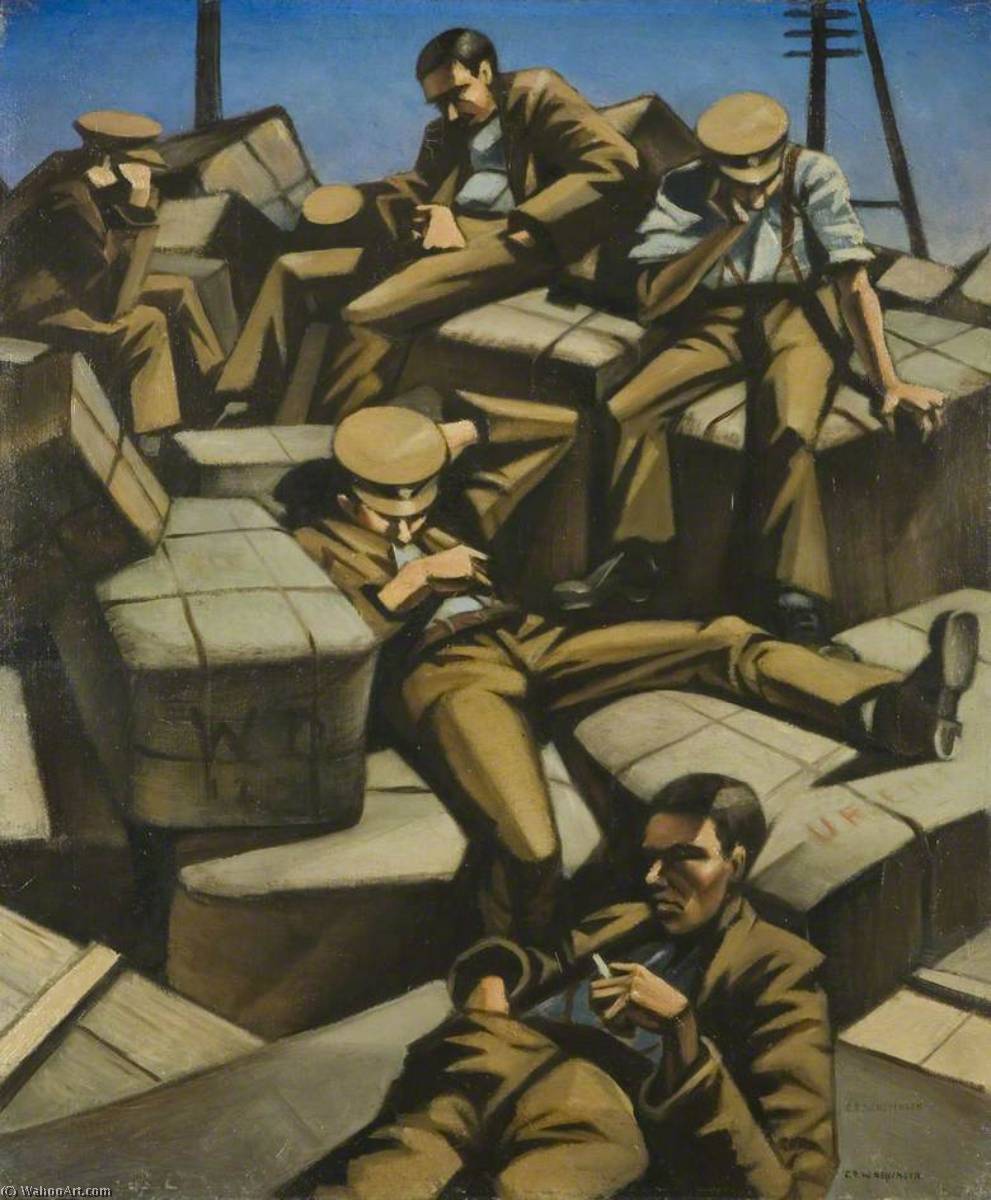
Experience 'Dog Tired' by C.R.W. Nevinson (1916). A powerful WWI painting of weary men & a dog, rendered in striking black & white. Hand-painted reproduction available.
Discover C.R.W. Nevinson's powerful art! Explore his Futurist & Cubist depictions of WWI, dynamic landscapes, and avant-garde spirit. A key British war artist.
Discover the Bristol Museum - Art Gallery's diverse treasures ranging from ancient Egyptian mummies to iconic works by Turner and Banksy in a stunning Edwardian setting that invites you to explore its rich cultural legacy.
Dog Tired by Christopher Richard Wynne Nevinson
Christopher Richard Wynne Nevinson (1889–1946) stands as one of the most prominent figures in British art during the tumultuous years of World War I, a painter whose visceral depictions of the battlefield transcended mere documentation to become emblems of trauma and resilience. Born into an intellectually stimulating environment shaped by his father’s journalistic pursuits and his mother's unwavering advocacy for women’s suffrage, Nevinson possessed an innate sensitivity to social injustices that would profoundly influence his artistic trajectory. His early life instilled a spirit of independent thought—a characteristic that fueled his exploration of avant-garde movements and cemented his reputation as a visionary artist.
Initially grappling with artistic direction, Nevinson found solace and inspiration in the Slade School of Art under Henry Tonks, alongside fellow artists like Stanley Spencer and Mark Gertler. Tonks’ encouragement of traditional methods contrasted sharply with Nevinson's burgeoning fascination for Futurism and Cubism, movements that championed dynamism, fragmentation, and a rejection of academic conventions. This embrace of radical experimentation would define his artistic style—a bold fusion of geometric abstraction and expressive brushwork designed to convey the psychological impact of war experience. The Slade’s influence extended beyond technique; it fostered a critical engagement with contemporary issues, mirroring Nevinson's commitment to confronting uncomfortable truths about human suffering.
The outbreak of hostilities propelled Nevinson into active service with the Friends’ Ambulance Unit, exposing him to the horrors of trench warfare firsthand. These experiences ignited within him an urgent desire to communicate the profound emotional and physical toll inflicted upon soldiers—a conviction that drove him to produce a series of paintings that captured not just visual impressions but also the inner turmoil of those embroiled in combat. His fellow artist Walter Sickert famously remarked on Nevinson’s “La Mitrailleuse,” stating it "will probably remain the most authoritative and concentrated utterance on the war in the history of painting." This assessment underscores Nevinson's ability to distill complex emotions into powerfully rendered images—a testament to his artistic prowess and unwavering dedication to conveying the human condition under extreme pressure.
Nevinson’s wartime paintings employed Futurist techniques – angular perspectives, jagged lines, and a deliberate disregard for naturalistic representation – to convey the frenetic energy of the trenches. The influence of Cubism is evident in the fractured planes and multiple viewpoints presented within each canvas, mirroring the disorientation experienced by soldiers navigating the battlefield. These stylistic choices weren’t merely aesthetic gestures; they served as deliberate tools for communicating psychological states—fear, exhaustion, and a desperate yearning for escape from the unrelenting violence surrounding them. The resulting artworks are not simply depictions of physical landscapes but explorations of inner landscapes—representations of trauma and resilience rendered with uncompromising honesty.
Beyond its stylistic innovation, “Dog Tired” carries significant symbolic weight. The depiction of weary men slumped against concrete blocks embodies the pervasive sense of disillusionment felt by Britain’s soldiers during the First World War. The central figure—a dog—represents companionship and loyalty amidst adversity, symbolizing the enduring human spirit's capacity for compassion and connection even in the face of unimaginable suffering. Nevinson’s masterful use of monochrome reinforces the bleakness of the scene, emphasizing the emotional gravity of his subject matter. Ultimately, “Dog Tired” stands as a poignant reminder of the psychological scars inflicted by war—a timeless masterpiece that continues to resonate with audiences today.