A Moment Frozen in Rain – Christopher Richard Wynne Nevinson’s “The Towpath”
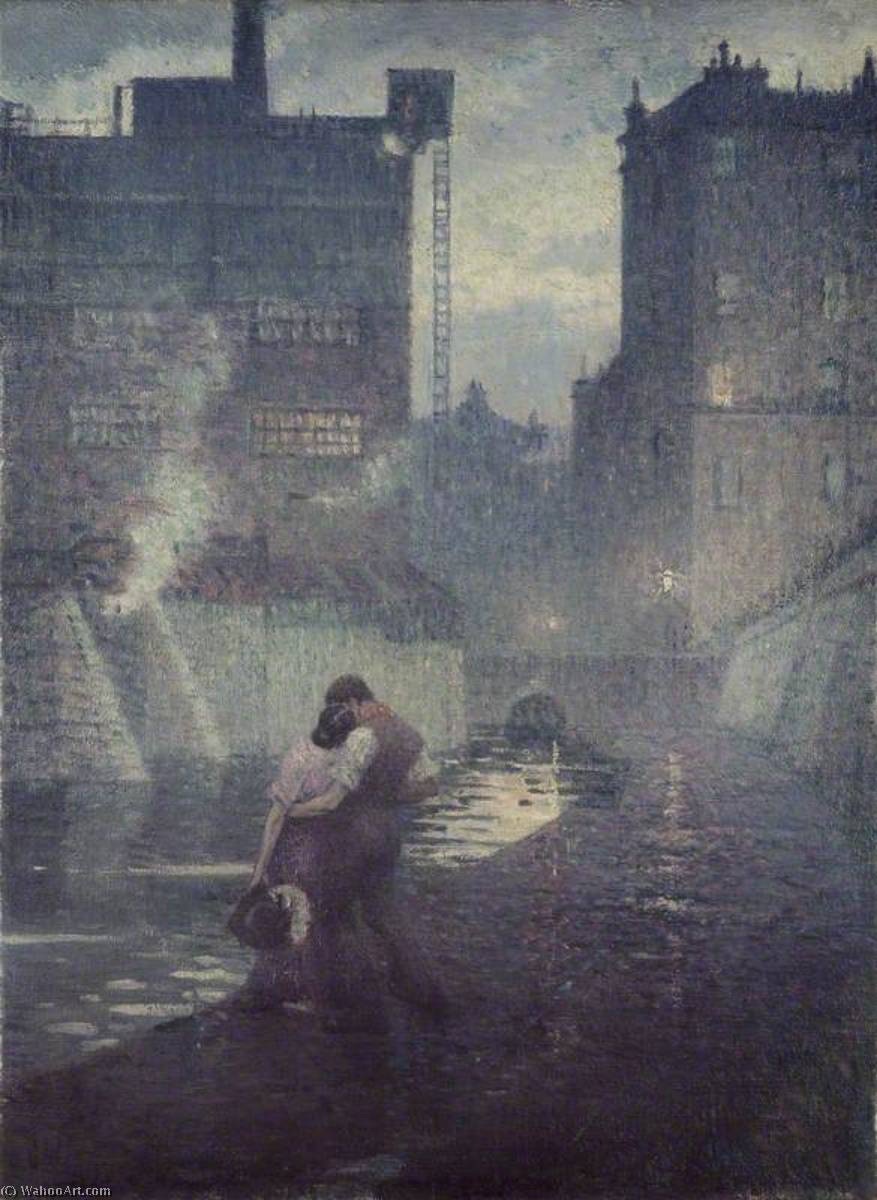
Christopher Richard Wynne Nevinson's "The Towpath," painted in 1912, isn’t merely a depiction of an urban scene; it’s a carefully constructed mood piece, steeped in the anxieties and nascent futurism of its time. The painting immediately draws the viewer into a world of muted tones – grays, blues, and browns dominate, creating an atmosphere of quiet melancholy that speaks to the isolation inherent within industrial landscapes. It's a scene both familiar and subtly unsettling, capturing a fleeting moment of human presence against the backdrop of imposing, almost monolithic, architecture.
Nevinson, a key figure in British art during the early 20th century, was deeply influenced by movements like Futurism and Cubism. This is evident not just in the painting’s fractured perspective – lines converge and recede in a way that suggests movement and dynamism – but also in his deliberate use of color and form. The rigid geometry of the buildings contrasts sharply with the more organic shapes of the figures, hinting at a tension between the human desire for connection and the impersonal nature of modern urban life. The painting’s genesis lies within Nevinson's experiences during World War I, reflecting a growing disillusionment with traditional notions of heroism and progress.
Composition and Technique – A Dance of Lines and Light
The composition is remarkably balanced, albeit subtly off-center. The couple, positioned near the foreground bridge, anchors the scene while drawing the eye towards the distant buildings. Nevinson masterfully employs atmospheric perspective; the background structures fade into a hazy distance, creating a sense of depth and scale that emphasizes the vastness of the urban environment. The artist’s brushwork is loose and expressive, contributing to the painting's overall impressionistic quality. Notice how he uses short, broken strokes to capture the texture of the buildings and the shimmering effect of rain on the water – a technique that imbues the scene with a palpable sense of movement.
The use of color is particularly noteworthy. Rather than relying on bright hues, Nevinson employs a restrained palette of cool tones, reinforcing the painting’s somber mood. The subtle variations within these shades create visual interest without disrupting the overall atmosphere. He skillfully utilizes light – or rather, the lack thereof – to further enhance the sense of gloom and isolation. The diffused lighting suggests an overcast day, casting long shadows and blurring outlines, adding to the painting's dreamlike quality.
Symbolism and Emotional Resonance – A Portrait of Modernity
“The Towpath” is rich in symbolic meaning. Rain, a recurring motif in Nevinson’s work, often represents sadness, loss, or uncertainty. The industrial architecture serves as a potent symbol of modernity—a world characterized by speed, efficiency, and detachment. The couple, seemingly lost within this vast urban landscape, embodies the human struggle to find connection and meaning amidst the impersonal forces of progress. Their proximity suggests a yearning for intimacy in a world increasingly defined by anonymity.
There’s an undeniable emotional weight to the painting. It's not simply a depiction of a rainy day; it’s a meditation on loneliness, alienation, and the challenges of navigating a rapidly changing world. The muted colors and somber atmosphere evoke a sense of quiet melancholy, inviting viewers to contemplate their own experiences within the context of modern urban life. The painting’s enduring appeal lies in its ability to capture a universal human emotion—the feeling of being adrift in a vast and indifferent universe.
Historical Context – A Futurist Vision
Painted in 1912, “The Towpath” reflects the artistic ferment of the early 20th century. Nevinson was deeply involved with the burgeoning movement of Futurism, which celebrated speed, technology, and dynamism. While he ultimately distanced himself from the more radical aspects of this movement, its influence is clearly visible in his use of fragmented forms, distorted perspectives, and a focus on capturing fleeting moments of motion. The painting can be seen as a precursor to later movements such as Cubism, which similarly challenged traditional notions of representation.
Furthermore, the work aligns with Nevinson’s broader engagement with social issues. His father was a prominent war correspondent, and his mother an active member of the suffrage movement. This upbringing instilled in him a keen awareness of the challenges facing British society at the turn of the century – including industrialization, urbanization, and social inequality. “The Towpath” can be interpreted as a subtle critique of these trends, capturing the human cost of progress.