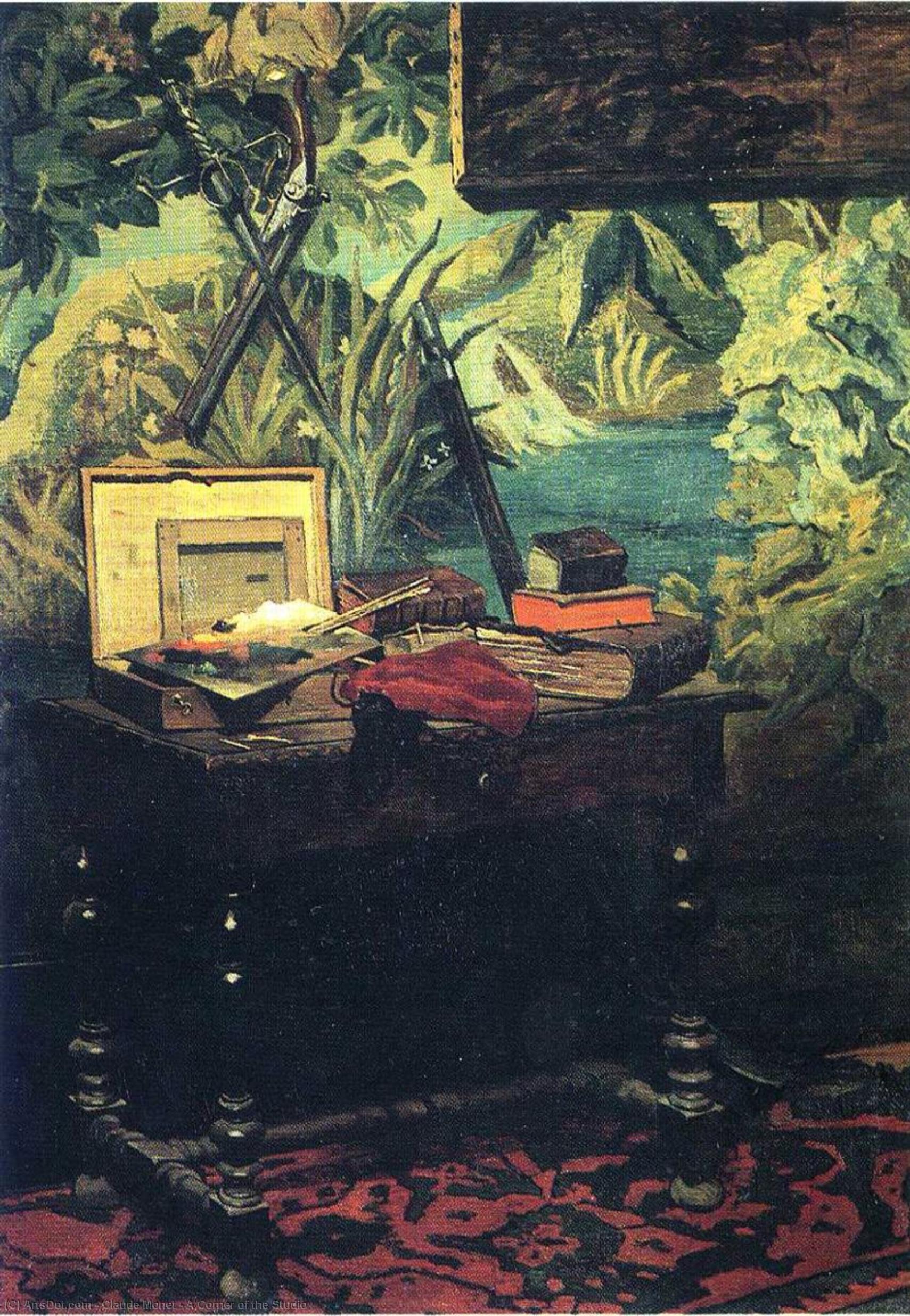
A Corner of the Studio (1861) - Claude Monet
Claude Monet’s “A Corner of the Studio,” painted in 1861, stands as an emblem of Impressionism's nascent spirit—a deliberate rejection of academic conventions and a fervent embrace of capturing fleeting moments of natural light. More than just a depiction of a workspace, it embodies Monet’s revolutionary approach to painting itself: observing and recording visual sensations rather than meticulously recreating reality. This intimate scene offers a glimpse into the artist’s creative process and serves as a cornerstone for understanding his enduring legacy.
The canvas portrays a modest studio space bathed in diffused sunlight—a characteristic element of Impressionist landscapes that sought to convey atmosphere and emotion. Dominating the composition is a wooden easel holding a partially finished canvas, alongside stacks of canvases leaning against the wall. Scattered around are brushes, palettes laden with pigment, and tubes of paint – tangible reminders of Monet’s daily toil and artistic dedication. A vase containing flowers adds splashes of color and textural interest to the scene, subtly countering the muted tones of the walls and floor. The artist himself is absent from the frame, yet his presence is palpable in the carefully arranged objects that speak volumes about his artistic vision.
Monet's technique—characterized by loose, expressive brushstrokes—is instantly recognizable as a hallmark of Impressionism. Rather than blending colors smoothly to achieve tonal accuracy, he applied pigment directly onto the canvas in short, broken dashes, allowing the light to illuminate and blend on the surface itself. This method prioritizes visual perception over precise representation, striving to convey the impression of color and luminosity—the very essence of what Monet termed “impression.” The brushwork is particularly evident around the easel and canvases, where Monet’s energetic strokes capture the dynamism of his creative endeavor.
“A Corner of the Studio” resides in the Musée d'Orsay, Paris, France, a testament to its significance within Impressionist art history. Painted during Monet’s formative years—before he fully established his distinctive style—it exemplifies the movement’s initial exploration of plein air painting and its fascination with capturing transient effects of light and color. The studio setting itself reflects the broader preoccupation of Impressionists with depicting everyday life, albeit infused with artistic sensibility. It's a scene that invites contemplation on the artist’s role as observer and recorder—a profound statement about the pursuit of beauty and truth in the natural world.
- Artist: Claude Monet
- Year: 1861
- Style: Impressionism
- Medium: Oil on Canvas
- Location: Musée d'Orsay, Paris, France
This artwork exemplifies the Impressionist movement’s revolutionary approach to painting—capturing fleeting moments of light and color rather than meticulously recreating reality.