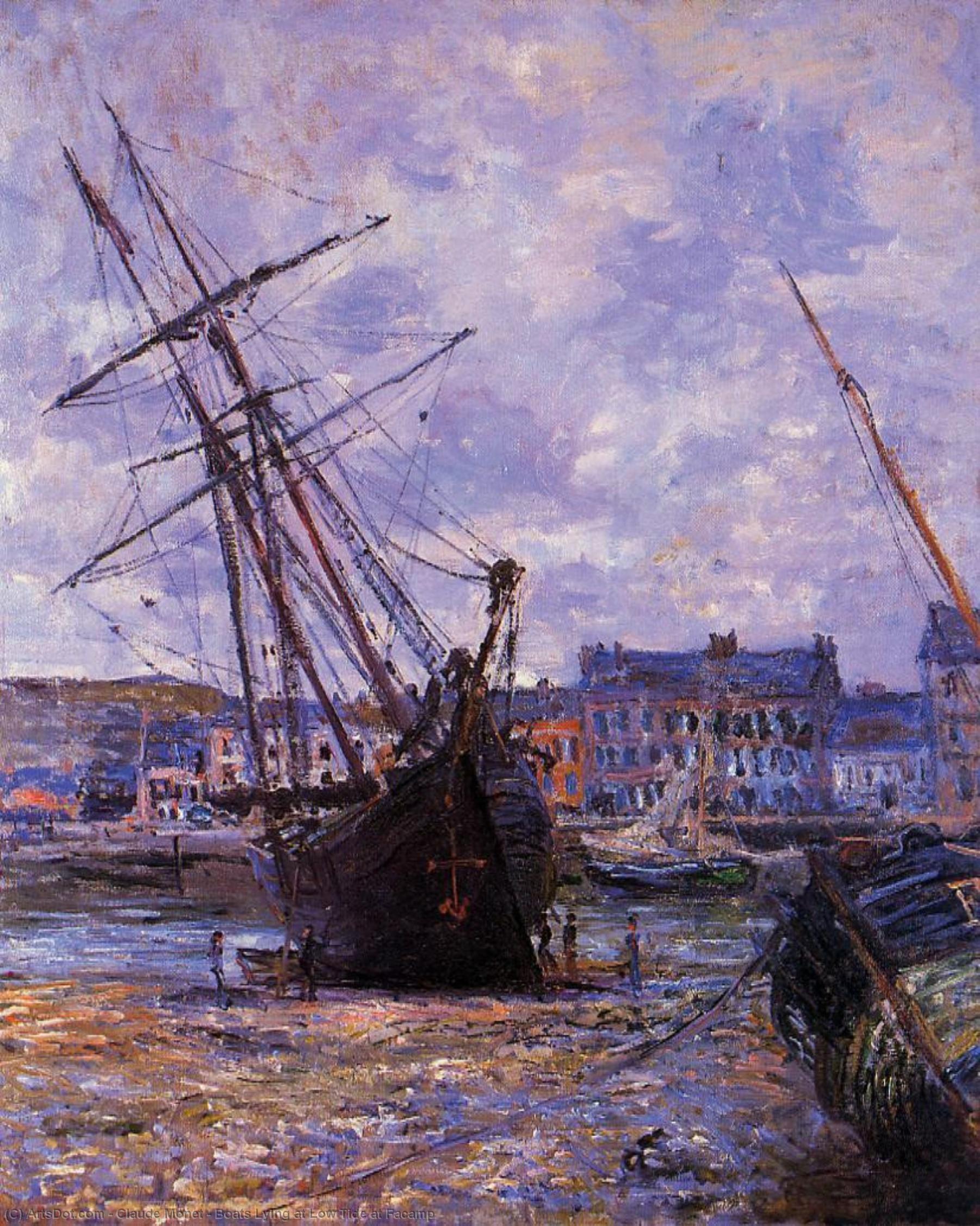
Claude Monet’s “Boats Lying at Low Tide at Facamp” exemplifies Impressionism, utilizing soft brushstrokes and vivid blues & greens to convey tranquility. Created in 1881, it showcases boats on the water under a cloudy sky—a hallmark of Monet's revolutionary approach to capturing light and atmosphere. Explore this iconic artwork’s details and artistic style at ArtsDot.com.
Boats Lying at Low Tide at Facamp
Claude Monet’s Boats Lying at Low Tide at Facamp is more than just a depiction of maritime scenery; it’s a distillation of Impressionism itself. Painted in 1881 during Monet's formative years as an artist—a period profoundly influenced by Eugène Boudin’s advocacy for capturing nature directly—the canvas embodies the movement’s core tenets: light, atmosphere, and subjective perception.
The painting presents a tranquil tableau of boats resting on the mudflats at low tide in Fécamp, Normandy. Dominating the foreground is a substantial ship, its masts reaching upwards against a hazy sky—a deliberate compositional choice that emphasizes scale and directs the viewer’s gaze. Scattered amongst these vessels are smaller boats, some closer to shore and others venturing further into the water, creating a sense of dynamism despite the stillness of the scene.
The Artistic Style of Claude Monet
Monet's mastery lies in his ability to translate fleeting moments of visual experience onto canvas. He achieves this through a technique characterized by loose brushstrokes—a hallmark of Impressionism—and vibrant color palettes. Rather than striving for photographic accuracy, Monet sought to convey the feeling of being present at that particular moment, capturing the subtle nuances of light and color as they shifted across the landscape.
- Color Harmony: Monet employs a masterful blend of blues and greens to evoke the mood of the coastal environment. These hues aren’t blended smoothly; instead, they are applied in juxtaposed patches, allowing individual pigments to shimmer and interact with each other—a technique known as optical mixing.
- Brushwork Texture: The brushstrokes themselves are bold and expressive, adding considerable texture to the painting surface. Monet’s impasto style—thickly applied paint—creates a palpable sense of physicality, mirroring the materiality of the natural world.
- Atmospheric Perspective: Crucially, Monet utilizes atmospheric perspective to convey depth and realism. Objects in the distance appear paler and less detailed than those closer to the viewer, simulating how light scatters through the air, creating an illusion of space.
The overall effect is one of profound serenity—a visual poem celebrating the beauty of a simple coastal scene. Monet invites the observer to immerse themselves in this luminous world, experiencing it as he did himself: acutely aware of its sensory richness and emotionally attuned to its transient charm.
Handmade Oil Painting Reproductions
A stunning reproduction of Boats Lying at Low Tide at Facamp is available on ArtsDot.com, offering art enthusiasts the opportunity to acquire a piece of artistic history.
Beyond ArtsDot.com, explore other iconic works by Monet at ArtsDot.com. Delve into “The Road to Vetheuil,” a similarly evocative depiction of rural Normandy, capturing the ethereal quality of twilight.
For deeper insights into Monet’s artistic vision and his contribution to Impressionism, visit the Musée d'Orsay or the J. Paul Getty Museum—institutions that house extensive collections of Impressionist masterpieces.
Furthermore, The Art of Painting Styles at ArtsDot.com provides a comprehensive overview of Monet’s stylistic innovations and techniques.