A Vision of Japonisme: The Radiance of La Japonaise
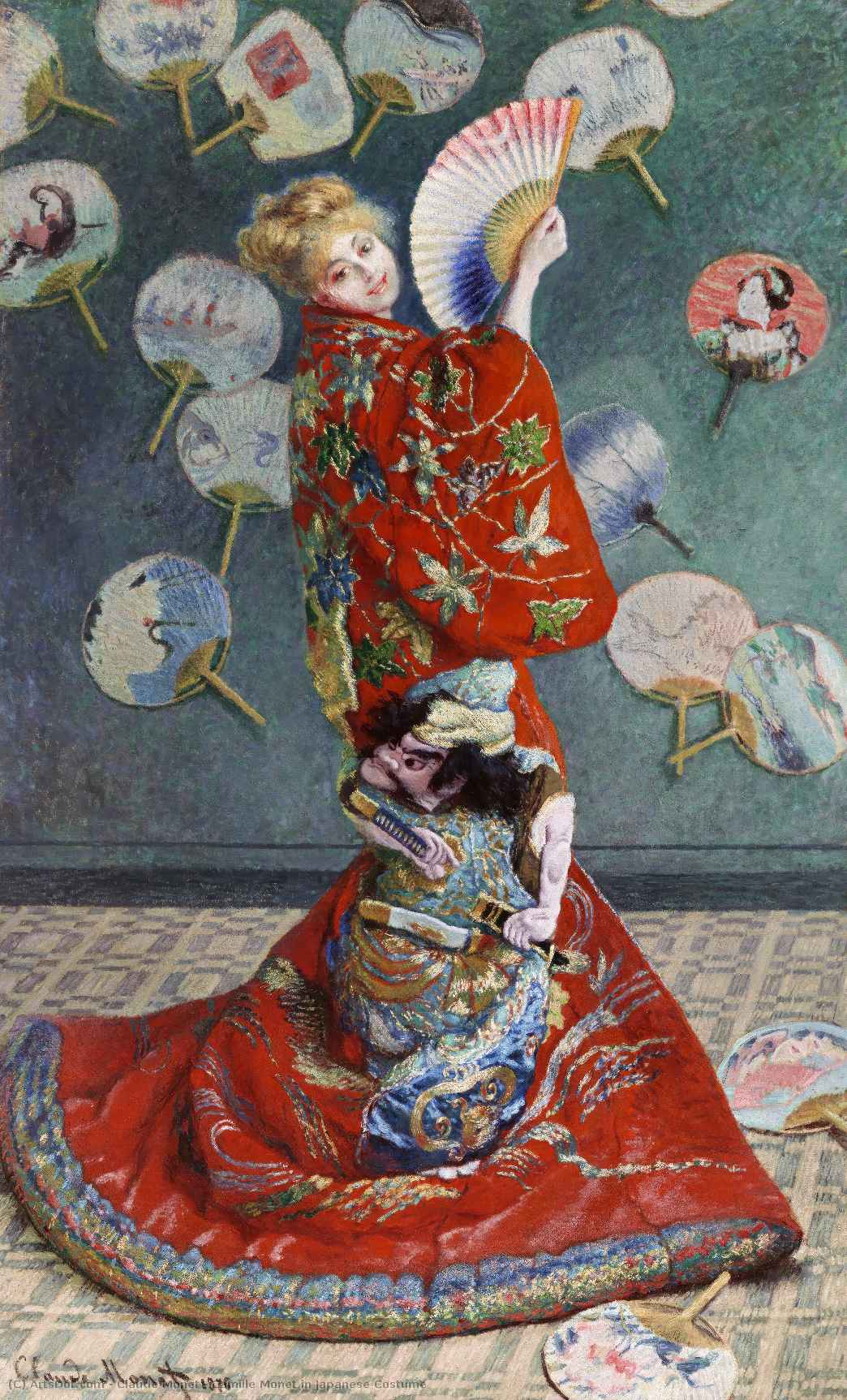
In the heart of the late nineteenth century, Paris was a city undergoing a profound sensory transformation, caught in the vibrant currents of Japonisme. Claude Monet’s Camille Monet in Japanese Costume, painted in 1876, serves as a breathtaking window into this era of cultural fascination. The painting is far more than a mere portrait of his first wife; it is a masterful orchestration of color and exoticism that captures the very essence of the Belle Époque. As the viewer gazes upon Camille, they are not just seeing a woman in costume, but witnessing the collision of Western tradition and Eastern aesthetic, a moment where the boundaries of art were being redrew by the influx of Japanese silks, ceramics, and woodblock prints into the European consciousness.
The subject of the piece is nothing short of captivating. Camille stands as a central, luminous figure, draped in an elaborately embroidered kimono that commands immediate attention. The vibrant, scarlet hues of her robe are punctuated by intricate floral patterns, creating a rhythmic visual energy that dances across the canvas. In one hand, she holds a delicate blue parasol, providing a cool, chromatic contrast to the warmth of her attire, while her other hand gracefully interacts with a fan. This careful arrangement of objects—the lanterns, the fans, and the textures of the fabric—creates a sense of staged elegance, making the scene feel like a theatrical performance frozen in time.
Technique and the Impressionist Spirit
Monet’s technical execution in this work is a testament to his role as a pioneer of the Impressionist movement. Eschewing the rigid, polished finishes favored by the traditional Salons of the time, Monet employed thick, visible brushstrokes that imbue the canvas with a palpable sense of life and movement. This tactile quality is particularly striking in the depiction of the kimono’s folds and the soft, diffused glow of the Japanese lanterns hanging in the background. He does not seek to replicate every minute detail with photographic precision; instead, he captures the fleeting effects of light as it dances upon silk and skin.
The artist utilizes a sophisticated palette of complementary colors to achieve a sense of depth and brilliance. The fiery reds and oranges of the costume are balanced by the subtle blues and greens found in the surrounding elements, creating a visual harmony that is both stimulating and soothing. This mastery of light and color allows the painting to breathe, giving the impression that the atmosphere within the frame is shifting even as we observe it. For the collector or interior designer, this technique offers a dynamic quality that can serve as a focal point in any room, bringing an enduring sense of vitality to a space.
Symbolism and Emotional Resonance
Beyond its surface beauty, La Japonaise is rich with layers of symbolic meaning. While the costume suggests an exotic Orient, there is a subtle, clever nod to French identity hidden within the composition. The fan held by Camille features the red, white, and blue of the French tricolor, a poignant reminder that despite the Japanese attire, the soul of the subject remains quintessentially Parisian. This duality—the tension between the "exotic" and the "familiar"—is what gives the painting its profound intellectual depth. It reflects a period of intense curiosity where the world was becoming smaller through trade and artistic exchange.
Emotionally, the painting evokes a sense of wonder and sophisticated playfulness. There is an intimacy in the way Camille is presented, yet she remains somewhat enigmatic, a "doll-like" figure as some contemporary critics once disparagingly suggested, but one that possesses a modern, spirited grace. For those seeking to adorn their homes with art, this reproduction offers more than just decoration; it offers an invitation to contemplate a pivotal moment in art history. It is a piece that inspires conversation, evokes the romanticism of 19th-century Paris, and brings the luminous, transformative power of Monet’s vision into the modern living space.