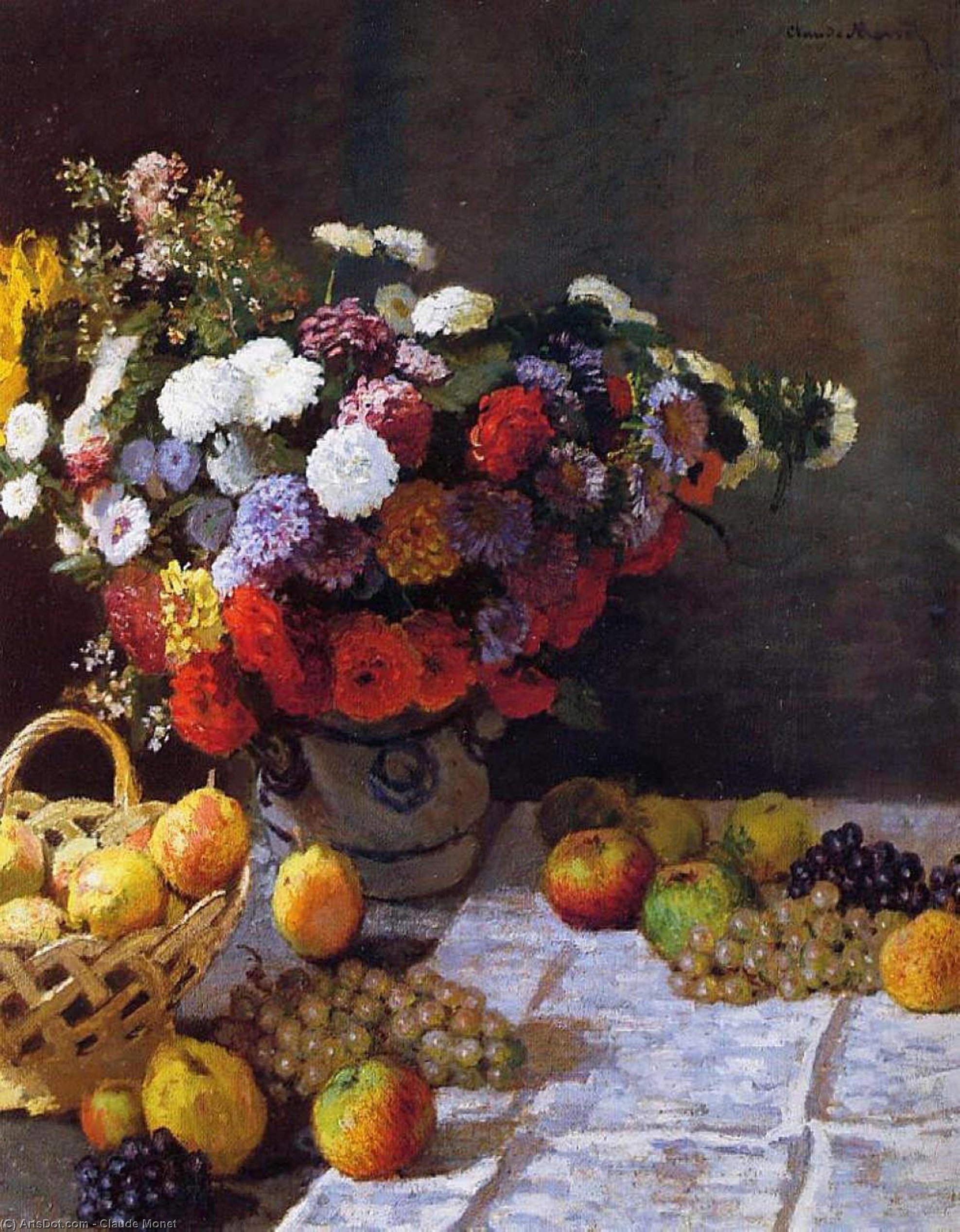
Flowers and Fruit
Claude Monet, a renowned French artist, is celebrated for his captivating works that epitomize the essence of Impressionism. Among his notable creations is the painting titled
Flowers and Fruit, which showcases his unique approach to capturing light and color. This article delves into the intricacies of this masterpiece, highlighting its significance in the realm of art.
The Painting's Composition
Flowers and Fruit is an oil on canvas painting created in 1869, currently housed at the
J. Paul Getty Museum in Los Angeles, United States. The composition features a vase filled with various flowers and fruits placed on a table, surrounded by apples, grapes, and oranges. A basket containing more fruit is positioned in the foreground, while a bowl on the table adds to the arrangement's complexity. Monet’s meticulous attention to detail—the subtle gradations of color, the delicate folds of petals—reflects his unwavering commitment to portraying the natural world as he perceived it.
Monet's Innovative Technique
Monet’s innovative technique of capturing light and its effects on color is evident in
Flowers and Fruit. He employed short, broken brushstrokes—almost like dashes of pigment—and vivid colors to convey a sense of movement and immediacy. This approach was characteristic of Impressionist painting, which sought to capture the fleeting moments of modern life. Rather than attempting to render precise representations, Monet prioritized conveying the atmosphere and sensation of the scene, prioritizing visual experience over intellectual analysis. The resulting surface is textured and luminous, capturing the ephemeral quality of sunlight filtering through foliage—a hallmark of Monet’s artistic vision.
Series Paintings by Monet
Monet is famous for his series paintings, where he explored a single theme or subject in multiple works. Examples include Haystacks,
Water Lilies, and
Rouen Cathedrals. These series demonstrate Monet’s fascination with the effects of light and weather on his subjects. Each painting in a series captures a particular aspect of the subject—a specific time of day, a particular season—allowing viewers to appreciate the subtle transformations that occur over time. This methodical approach underscored Monet's belief that true artistic expression resided in faithfully documenting the observable world.
Influence on Modern Art
Monet’s work, including
Flowers and Fruit, influenced subsequent art movements. His emphasis on color and light paved the way for Expressionism and Fauvism. Artists like Henri Matisse and Pablo Picasso drew inspiration from Monet’s innovative techniques—particularly his use of bold hues and loose brushwork—to liberate themselves from academic conventions and explore subjective emotional experience. The legacy of Impressionism continues to resonate in contemporary art, reminding us that beauty can be found not only in accurate representation but also in capturing the essence of feeling.
For more information on Claude Monet and his works, refer to the list of paintings by Claude Monet at Wikipedia.

- Impressionism: A movement that emphasizes capturing the fleeting moments of modern life.
- Series Paintings: Monet's approach to exploring a single theme or subject in multiple works.
- Influence on Modern Art: Monet’s work influenced subsequent art movements, including Expressionism and Fauvism.
For those interested in experiencing the beauty of this painting firsthand,
visit ArtsDot for a detailed view.