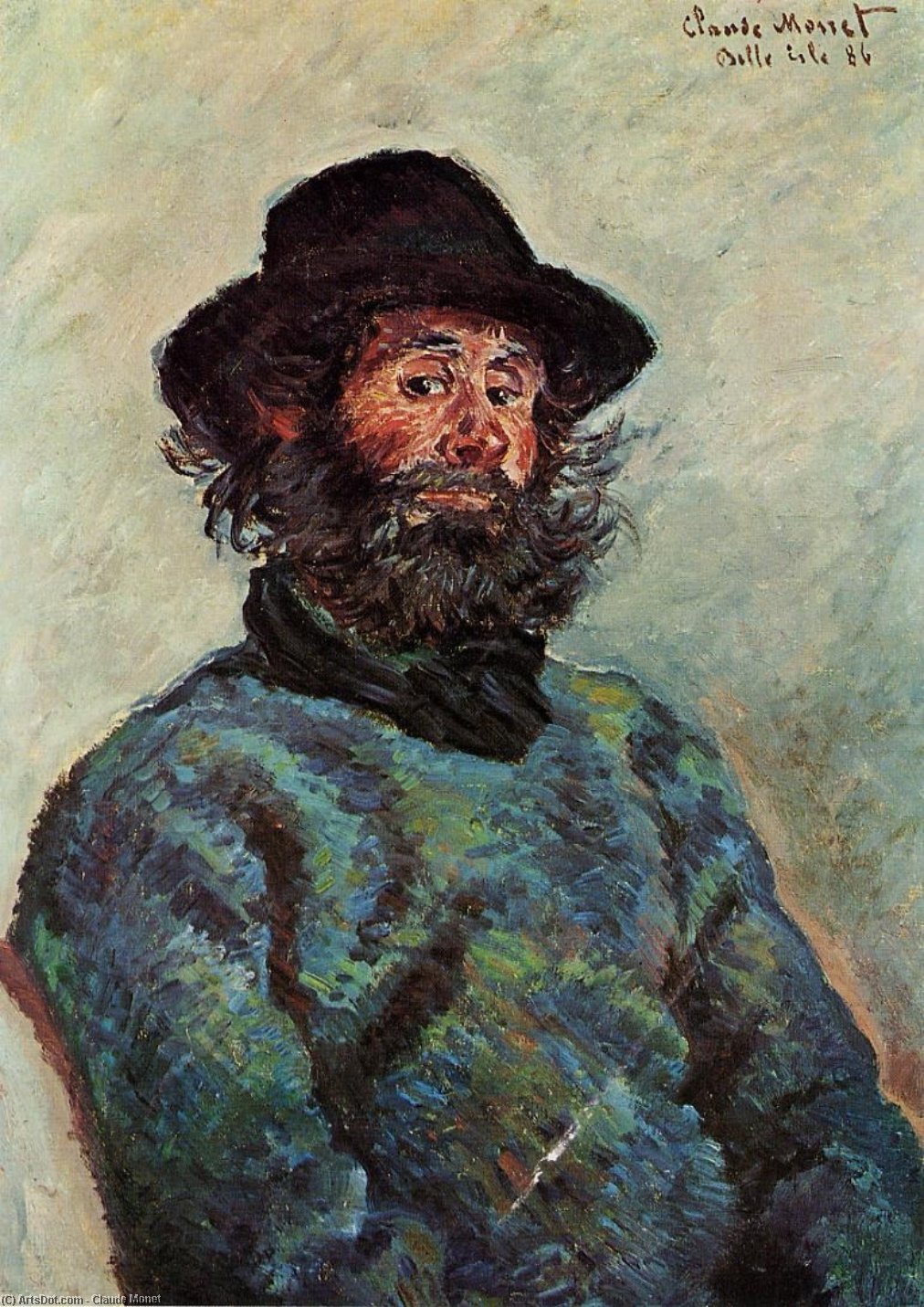
Portrait of Poly, fisherman at Kervillaouen – A Window into Impressionist Light
Claude Monet’s
Portrait of Poly, fisherman at Kervillaouen, created in 1886, stands as a quintessential example of Impressionist painting—a movement that fundamentally altered the course of art history. Housed within the Musée Marmottan Monet in Paris, France, this oil on canvas offers more than just a depiction of a fisherman; it’s an exploration of atmosphere and perception, capturing a fleeting moment in time with remarkable sensitivity.
The Essence of Impressionism: Capturing Transient Beauty
At its core, Impressionism rejected the academic conventions of its predecessors—detailed realism and meticulous shading—favoring instead a technique that prioritized capturing the effects of natural light on color and texture. Monet’s approach was revolutionary: he abandoned studio painting altogether, venturing outdoors (“en plein air”) to observe and record his surroundings directly. This dedication to observation is palpable in
Portrait of Poly, where loose brushstrokes blend seamlessly to convey the hazy warmth of a Normandy afternoon. The artist skillfully utilizes broken color—applying pigment in small patches rather than blending it smoothly—to simulate how light scatters and transforms hues.
A Detailed Look at Composition and Technique
The painting’s composition is deceptively simple yet profoundly effective. Monet focuses on Poly, seated calmly with his hands clasped in his lap, against a muted wall that serves as an anchor for the eye. The fisherman wears a hat and a blue sweater—clothing choices typical of the era—and embodies the quiet dignity of rural life. Notice how Monet’s brushwork is particularly prominent around Poly's face and torso, emphasizing the texture of the wool fabric and conveying a sense of immediacy. He employs subtle gradations of color to create depth and dimension, subtly hinting at the surrounding landscape beyond the wall. The muted palette—dominated by blues, browns, and yellows—contributes to the painting’s tranquil mood.
Historical Context: Monet's Contribution to Modern Art
Claude Monet was undeniably a pioneer of French Impressionism, driven by an unwavering belief in portraying nature as he experienced it. His groundbreaking series paintings – Haystacks,
Water Lilies,
Rouen Cathedrals,
Houses of Parliament,
Charing Cross Bridge, and
Poplar Trees – solidified his legacy as one of the most influential artists of the 19th century. The very term “Impressionism” itself originated from Monet’s painting
Impression, Sunrise—a bold assertion of artistic freedom and a rejection of academic conventions that paved the way for subsequent movements like Cubism and Surrealism.
Symbolic Resonance: Quiet Contemplation and Rural Harmony
Beyond its technical brilliance,
Portrait of Poly speaks to broader themes of serenity and connection with the natural world. The fisherman’s posture—relaxed hands clasped in his lap—suggests a state of quiet contemplation, mirroring the artist's own desire to capture fleeting moments of beauty. The painting embodies the Impressionist ethos of celebrating the everyday—transforming ordinary subjects into canvases brimming with emotion and artistic insight.
Claude Monet: Portrait of Poly, fisherman at Kervillaouen –
Paul Cézanne: Madame Cézanne (Barnes) –
List of paintings by Claude Monet
### Availability of Reproductions
For those wishing to experience the beauty and artistry of Monet’s vision firsthand, ArtsDot offers exceptional high-quality oil painting reproductions. Explore our curated collection at /art/list/?Filter=Claude+Monet,+Portrait+of+Poly,+fisherman+at+Kervillaouen,+Oil+Painting,+Reproductions