A Moment Captured in Purple: Claude Monet’s “Purple Poppies”
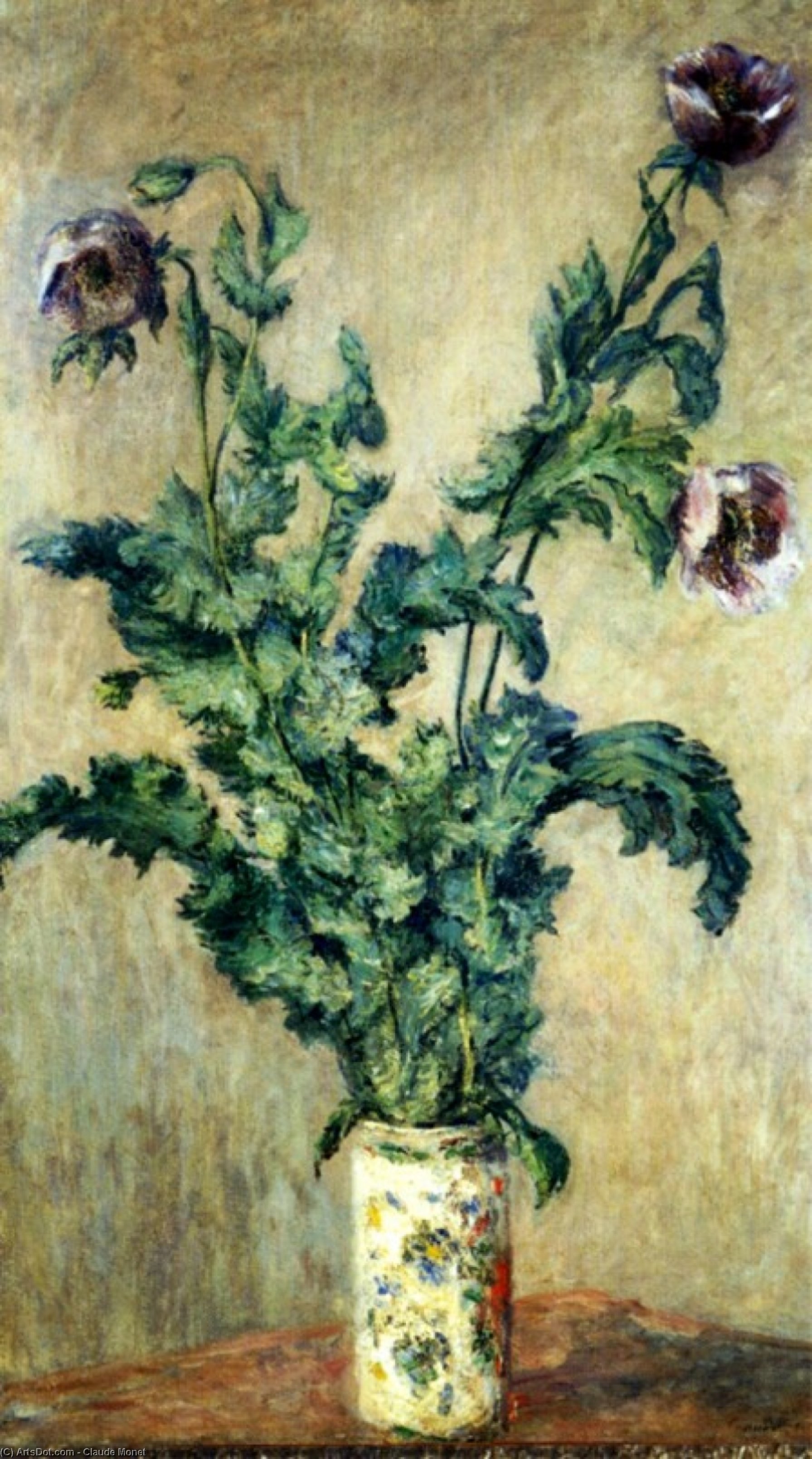
Claude Monet's "Purple Poppies" isn't merely a depiction of flowers; it’s an immersion into the very essence of Impressionism – a fleeting, luminous capture of light and color. Painted in 1883 during his prolific period at Giverny, this intimate still life transcends its subject matter to become a testament to Monet’s revolutionary approach to painting. The work immediately draws the viewer in with its vibrant palette dominated by the rich hues of purple poppies, contrasted against the cool tones of a simple white vase and subtle blue detailing. It's a piece that whispers of summer afternoons, dappled sunlight, and the quiet beauty found within the domestic sphere – a hallmark of Monet’s lifelong fascination with capturing everyday life.
The painting’s composition is deceptively simple yet profoundly effective. The arrangement of the poppies isn’t meticulously posed; instead, they appear almost spontaneously gathered within the vase, creating a sense of movement and vitality. Notice how Monet doesn't strive for photographic realism but rather uses the flowers as points of color to define space and create depth. The white vase acts as a grounding element, its delicate blue pattern providing a subtle counterpoint to the intensity of the purple blooms. This careful balance between form and color is characteristic of Monet’s mature style – he wasn't interested in rendering objects with precision but rather in conveying their *impression* upon his eye.
Monet’s Impressionistic Technique: A Dance of Light
At the heart of “Purple Poppies” lies Monet’s signature technique – a rapid, broken application of paint known as ‘broken brushstrokes.’ He employed short, visible strokes of pure color, layering them upon one another to create an effect of shimmering light and atmosphere. This method, so crucial to Impressionism, deliberately avoided blending colors on the palette, allowing the viewer's eye to mix them optically when viewed from a distance. Observe how he uses these small dabs of purple, pink, and white to suggest the velvety texture of the petals and the delicate sheen of the water droplets clinging to their surfaces. The painting isn’t about precise detail; it’s about capturing the *feeling* of being in the presence of these flowers – a vibrant, almost tangible experience.
Symbolism and Context: A Window into Monet's World
“Purple Poppies” offers a glimpse into Monet’s personal world. He was deeply devoted to his garden at Giverny, transforming it into an artistic laboratory where he could experiment with light, color, and composition. The poppies themselves held particular significance for him – they were among the first flowers to bloom in spring, signaling the renewal of life and beauty. Furthermore, Monet’s interest in capturing fleeting moments was deeply influenced by his friendship with photographer Eugène Boudin, who encouraged him to paint *en plein air* (outdoors) directly from nature. This commitment to direct observation is evident in the painting's immediacy and spontaneity.
Beyond Reproduction: Experiencing Monet’s Vision
A hand-painted reproduction of “Purple Poppies” offers a remarkable opportunity to bring this iconic work into your home or studio. ArtsDot meticulously recreates Monet’s technique, employing the finest pigments and traditional oil painting methods to capture the luminosity and vibrancy of the original. Unlike digital reproductions, our hand-painted versions retain the subtle nuances of brushwork, texture, and color depth – allowing you to truly experience the emotional impact of this masterpiece. Consider how a reproduction can transform a room, injecting it with the spirit of Impressionism and evoking memories of summer days bathed in golden light. For more information on Claude Monet’s life and work, and to explore our full collection of Monet reproductions, please visit ArtsDot.com.