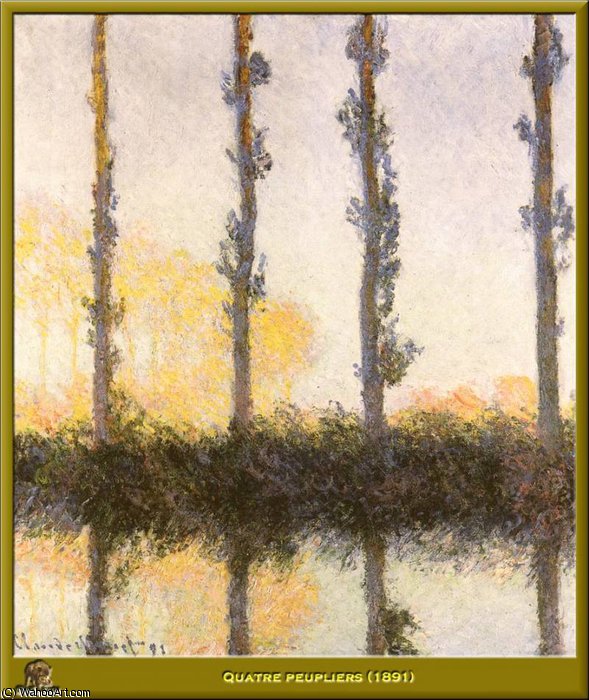
A Symphony of Light and Reflection
In the quiet corners of art history, few moments capture the ephemeral magic of nature as poignantly as Claude Monet’s 1891 masterpiece, “Quatre Peupliers” (Four Poplars). This serene landscape is far more than a mere depiction of riverside flora; it is a profound embodiment of the Impressionist philosophy, designed to freeze a fleeting second of light before it dissolves into memory. As the viewer gazates upon the canvas, they are transported to the banks of the Epte River near Giverny, where four slender poplar trees stand as silent sentinels along the water's edge. Monet does not simply paint trees; he paints the very atmosphere that surrounds them, creating a dreamlike vision where the boundaries between the physical world and its watery reflection begin to blur.
The composition is a masterclass in balance and verticality. The rhythmic repetition of the tree trunks creates a sense of structural stability, yet this rigidity is softened by the fluid, dancing reflections that stretch toward the viewer across the river's surface. Through his revolutionary use of plein air techniques, Monet captures the diffused, hazy light characteristic of either a waking dawn or a fading dusk. The color palette is a delicate whisper of pastels—soft pinks, luminous yellows, and gentle greens—that work in harmony to evoke a sense of profound tranquility. For the collector or interior designer, this piece offers a breath of fresh air, bringing a sense of organic peace and light-filled serenity to any sophisticated space.
The Art of the Impressionist Brush
To understand “Quatre Peupliers” is to appreciate the technical brilliance of Monet’s late 19th-century experimentation. Moving away from the rigid, polished finish of academic realism, Monet employed loose, visible brushstrokes that prioritize immediate sensory experience over meticulous detail. He utilized a sophisticated layering of paint washes to achieve an atmospheric haze, a technique that allows light to appear as if it is vibrating within the pigment itself. This method creates a textured, almost tactile surface where the eye must work to assemble the scene, much like how our own eyes struggle to focus on a landscape shrouded in morning mist.
This approach was deeply rooted in the historical context of the Belle Époque. Influenced by the landscape painter Eugène Boudin, Monet sought to capture the "impression" of a moment—the way light shifts, the way shadows move, and the way color transforms under changing weather. There is a subtle, rhythmic movement within the foliage and the water, suggesting a gentle breeze that disturbs the surface of the river. This technique ensures that the painting never feels static; it possesses a living, breathing quality that continues to evolve as the light in your room changes throughout the day.
Symbolism and Emotional Resonance
Beyond its visual splendor, “Quatre Peupliers” carries a weight of symbolic meaning that resonates with the human experience. The poplar trees, standing tall and resilient against the elements, serve as metaphors for strength and endurance. Yet, their presence in this painting is inextricably linked to their reflections—a reminder of the duality between reality and perception, the permanent and the transient. This tension between the solid trunk and the liquid reflection mirrors Monet’s own fascination with the fleeting nature of time.
For those seeking to adorn a home or gallery with fine art, this reproduction offers more than just aesthetic beauty; it offers an emotional sanctuary. The painting invites a meditative state, encouraging the viewer to slow down and observe the subtle nuances of the natural world. Whether placed in a sun-drenched living room or a quiet study, “Quatre Peupliers” acts as a window into a world of eternal spring and quietude, making it an incomparable choice for anyone looking to infuse their environment with the timeless elegance of French Impressionism.