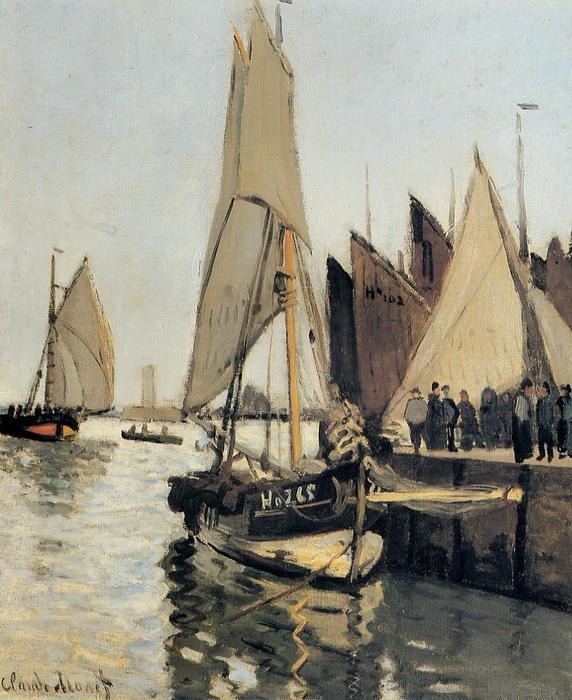
Inspired by Eugène Boudin's encouragement to paint en plein air, Monet meticulously observed the changing light conditions at Honfleur, resulting in this iconic depiction. Its serene beauty continues to resonate with viewers today.
Explore the world of Claude Monet, the Impressionist master renowned for capturing fleeting light and color through iconic landscapes like Water Lilies & Haystacks.
A Window into Impressionistic Normandy: Monet’s ‘Boats at Honfleur’
Claude Monet's “Boats at Honfleur,” painted in 1866, isn’t merely a depiction of a seaside harbor; it’s an embodiment of the Impressionist movement’s core philosophy – capturing fleeting moments of light and atmosphere. This serene scene nestled within Normandy exemplifies Monet’s revolutionary approach to painting, forever altering the course of art history. The canvas vibrates with color, primarily blues and greens reflecting the shimmering surface of Étretat Bay and the surrounding foliage, yet punctuated by splashes of ochre and lemon yellow illuminating the boats themselves and highlighting the figures scattered along the pier.
The Pioneering Spirit of Plein Air Painting
Monet’s artistic journey began under the mentorship of Eugène Boudin, who instilled in him the transformative concept of *plein air* – painting outdoors directly from nature. Prior to this, artists typically labored indoors, meticulously recreating scenes from memory or sketches. Boudin championed a radically different method: observing and recording the subtle shifts in light as it danced across surfaces. Monet wholeheartedly embraced this ethos, prioritizing immediacy and sensory experience above all else. This dedication is palpable in “Boats at Honfleur,” where every brushstroke seems to strive to capture the ephemeral beauty of the day.
Technical Brilliance: Layered Impasto and Color Modulation
Monet’s technique—characterized by *impasto*, a thick application of paint—is central to conveying the painting's emotional resonance. The textured surface captures the physicality of light itself, creating palpable depth and simulating the shimmering reflections on the water. Monet skillfully employed color modulation, blending hues subtly to create an illusion of luminosity and atmospheric perspective. He meticulously mixed pigments to achieve nuanced shades that wouldn’t be possible with traditional glazing techniques. This layering process allows for a remarkable interplay between light and shadow, enhancing the painting's realism while simultaneously conveying its mood—a feeling of tranquil contemplation amidst the bustle of maritime activity.
Historical Context: Impressionism Takes Root
“Boats at Honfleur” emerged during a pivotal moment in artistic history – the genesis of Impressionism. Artists like Monet, Camille Pissarro, and Pierre-Auguste Renoir were rejecting academic conventions that prioritized meticulous detail and idealized representations. Instead, they sought to depict scenes as they appeared to the eye, prioritizing subjective perception over objective accuracy. The painting reflects the broader intellectual currents of the time, influenced by scientific discoveries concerning optics and color theory—particularly Hermann Helmholtz’s work on color perception. This newfound understanding fueled artists' desire to translate visual experience into pigment and brushstrokes.
Symbolism Beyond Representation: A Reflection of Tranquility
While seemingly straightforward in its subject matter – sailboats in a harbor – “Boats at Honfleur” carries deeper symbolic significance. The calm waters of Étretat Bay represent serenity and contemplation, mirroring Monet’s own artistic temperament. The boats themselves symbolize movement and connection to the natural world, embodying the spirit of exploration and discovery that characterized the Impressionist era. Furthermore, the figures along the pier suggest human presence within this idyllic landscape—a reminder that beauty is enriched by experience and interaction with our surroundings. Ultimately, Monet's masterpiece invites viewers to savor a moment of stillness and appreciate the transformative power of light and color.