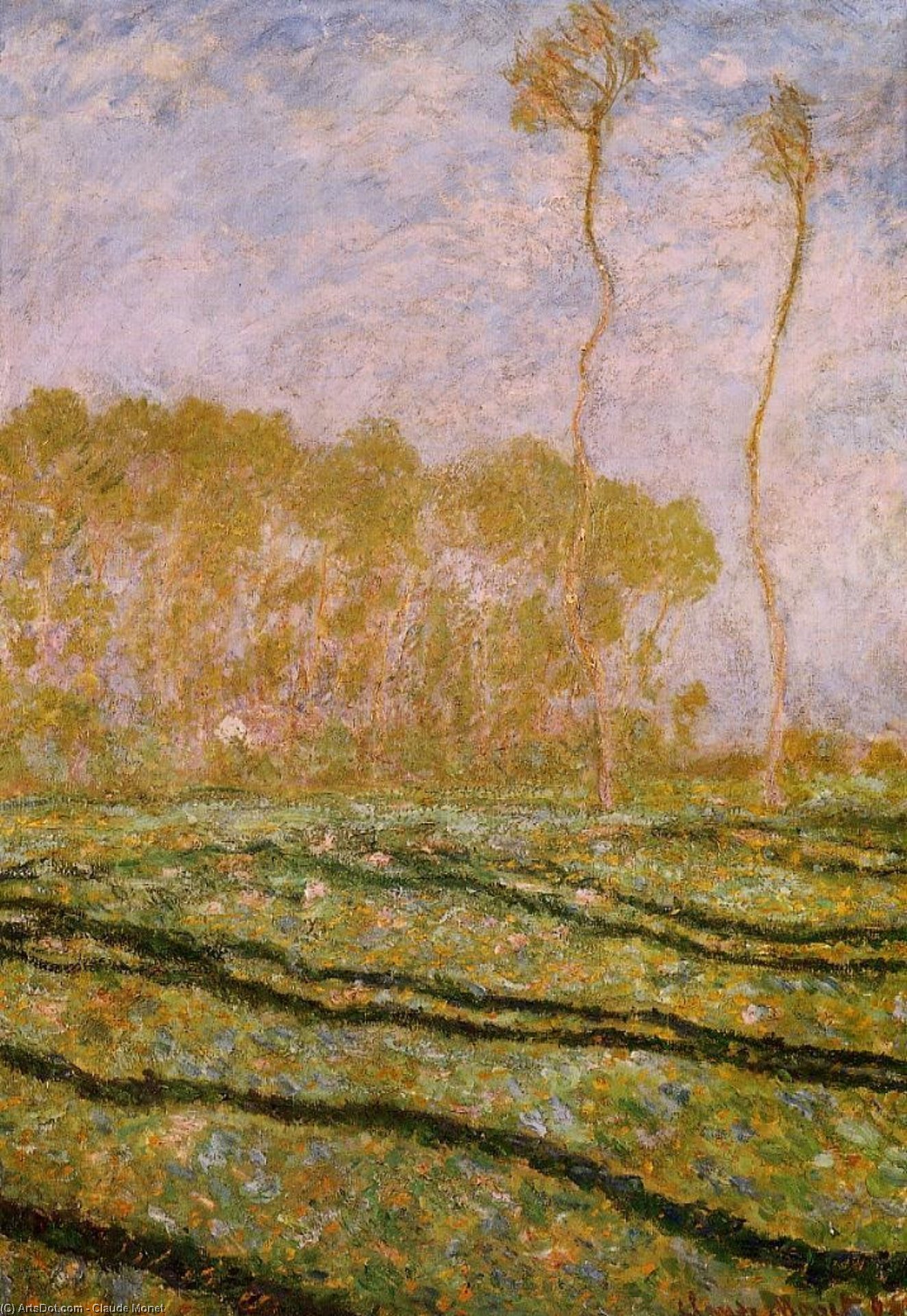
Springtime Landscape at Giverny
Claude Monet’s “Springtime Landscape,” painted in 1893, stands as a quintessential embodiment of Impressionist philosophy—capturing fleeting moments of beauty and sensory experience rather than striving for photographic realism. More than just a depiction of a meadow bathed in springtime sunlight, it's an invitation to immerse oneself in the artist’s perception of nature itself, a testament to Monet’s unwavering dedication to portraying light as it dances across surfaces.
The painting immediately draws the eye with its vibrant palette—dominantly greens and yellows—reflecting the burgeoning life of spring. Monet skillfully employs short, broken brushstrokes, characteristic of Impressionism, creating an illusion of movement and luminosity. These strokes aren't blended smoothly; instead, they overlap and interact, mirroring the way sunlight refracts through foliage and illuminates blossoms. This technique is particularly evident in the dappled light filtering through the trees, lending a sense of ethereal quality to the scene. The artist’s meticulous observation of color nuances—ranging from pale greens to rich yellows—demonstrates his mastery of capturing atmospheric conditions.
Monet's compositional choices further enhance the painting’s impact. He arranges the trees in varying distances, creating depth and perspective that draws the viewer into the landscape. Foreground trees are rendered with denser brushstrokes and darker tones, anchoring the composition while emphasizing texture. As the eye travels upwards towards the distant horizon, the brushstrokes become looser and paler, conveying a feeling of serenity and expansiveness. The inclusion of a solitary figure—likely Monet himself—adds a human element to the scene, suggesting contemplation amidst the grandeur of nature.
The painting’s symbolism resonates deeply with Impressionist ideals. Springtime represents renewal, rebirth, and optimism—themes central to the movement's exploration of emotion and subjective experience. Monet’s deliberate focus on capturing light and color isn’t merely an artistic technique; it’s a conscious effort to convey the transformative power of nature to inspire awe and wonder.
“Springtime Landscape” exemplifies Monet’s groundbreaking approach to painting, securing its place as one of the most celebrated works of Impressionism. Its enduring beauty lies in its ability to transport viewers back to a moment of tranquil contemplation—a reminder that art can capture not just what we see but also how we feel.
- Claude Monet was a French Impressionist painter.
- “Springtime Landscape” is one of his notable works.
- The painting is characterized by its use of Impressionist techniques.
For a deeper understanding of Claude Monet’s life and artistic style, visit the
ArtsDot.com website or explore the
Walters Art Museum collection.