Explore the world of Claude Monet, the Impressionist master renowned for capturing fleeting light and color through iconic landscapes like Water Lilies & Haystacks.
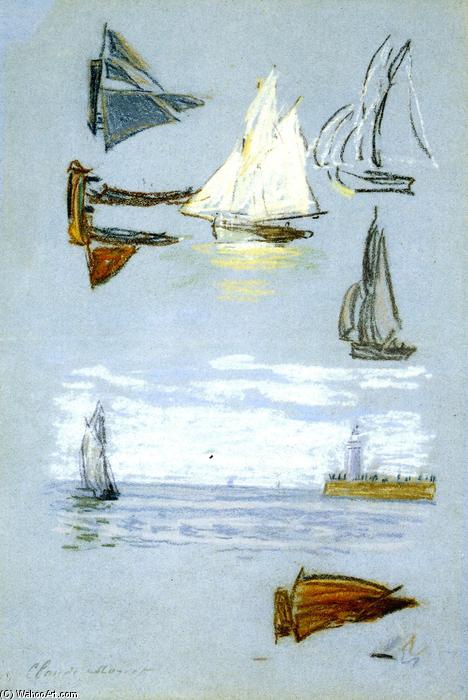
A Symphony of Light and Water: Exploring Monet’s ‘Study of Sailboats and Harbor’
Claude Monet's 'Study of Sailboats and Harbor,' painted in 1864, isn’t simply a depiction of maritime scenery; it’s a cornerstone of Impressionism—a movement that fundamentally altered the course of art history. Created during Monet’s formative years, this canvas embodies his pioneering approach to capturing the ephemeral qualities of nature, cementing his legacy as one of the most influential artists of the 19th century. The painting resides in Le Havre Museum and is a testament to Boudin's influence on Monet's artistic vision.
The Essence of Impressionism: Capturing Fleeting Moments
Monet’s revolutionary technique—*plein air* painting—was born from his collaboration with Eugène Boudin, who championed the practice of working outdoors directly before the eye. Unlike academic painters who meticulously crafted studio canvases based on idealized representations, Monet sought to record the immediate sensory experience of a scene: the shifting hues of sunlight filtering through mist, the subtle variations in color as reflected on the water’s surface. This method prioritized capturing the *impression* of light and atmosphere over precise detail—a deliberate rejection of traditional artistic conventions. The resulting brushstrokes are loose, broken, and blended to create an illusion of shimmering luminescence, mirroring Monet's obsession with observing and documenting the natural world.
A Harbor Landscape Steeped in Symbolism
The harbor depicted in ‘Study of Sailboats and Harbor’ transcends mere topographical accuracy; it speaks to broader themes of tranquility, observation, and connection with the environment. The sailboats themselves represent movement, aspiration, and perhaps even a hint of adventure—elements that resonate deeply within the human spirit. Monet's careful placement of figures adds another layer of significance, suggesting contemplation and appreciation for the beauty surrounding him. Furthermore, the muted palette – predominantly blues and greens – evokes feelings of serenity and nostalgia, reflecting Monet’s profound sensitivity to color and its ability to convey emotion. The hazy atmosphere contributes to this mood, blurring boundaries between reality and imagination.
Technical Brilliance: Monet's Pioneering Approach
Monet achieved his remarkable effects through a masterful manipulation of pigment and brushwork. He employed layering techniques—applying thin washes of color followed by thicker strokes—to build up tonal depth and create textural richness. The artist’s meticulous attention to detail, despite the apparent spontaneity of the style, is evident in the subtle gradations of color and the careful rendering of reflections on the water. Monet's use of complementary colors – blues against oranges – enhances visual vibrancy and contributes to the overall impressionistic aesthetic. This painting exemplifies the culmination of Boudin’s teachings and represents a pivotal moment in Monet’s artistic development.
Bringing Monet’s Vision Home: A Reproduction Worthy of Distinction
A high-quality reproduction of ‘Study of Sailboats and Harbor’ allows you to experience the captivating beauty and emotional resonance of this iconic Impressionist masterpiece within your own space. ArtsDot offers exceptional reproductions crafted with archival inks on premium canvas, ensuring that you can preserve Monet's legacy for generations to come. Explore our collection today and discover how a stunning print can transform your interior design aesthetic!