A Symphony of Light and Reflection
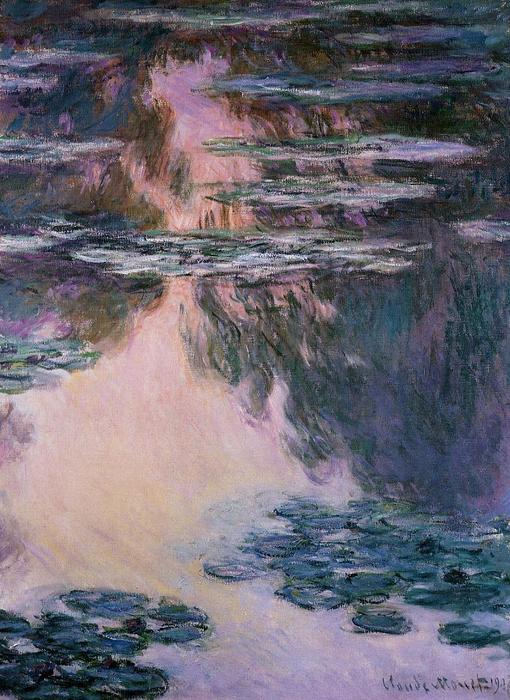
In the quiet corners of Giverny, where the boundaries between water and sky seem to dissolve, Claude Monet captured a moment of eternal stillness. His Water Lilies (30) is not merely a depiction of a pond; it is an immersive experience of light and atmosphere. The painting invites the viewer into a tranquil world where the surface of the water becomes a mirror for the heavens, reflecting deep violets, soft ultramarine blues, and the shimmering essence of sunlight. As one gazes upon this masterpiece, the eye wanders across an expansive panorama of floating lilies, some drifting near the foreground in sharp, delicate focus, while others recede into a dreamy, hazy distance, creating a profound sense of depth and infinite space.
This work stands as a pinnacle of Impressionism, a movement that sought to break free from the rigid constraints of academic realism. Rather than documenting every petal with scientific precision, Monet focused on the subjective perception of a fleeting moment. Through his revolutionary approach, he captured the way light dances upon the murky, life-filled waters, transforming a simple garden pond into a celestial landscape. For the collector or interior designer, this piece offers more than just color; it provides an atmospheric anchor, bringing a sense of organic peace and sophisticated serenity to any curated space.
Mastery of Technique and Color Theory
The magic of this composition lies in Monet’s masterful use of plein air techniques. Working directly from the edge of his beloved pond, he utilized loose, rhythmic brushstrokes and a complex layering of translucent glazes to achieve an ethereal luminosity. The palette is a sophisticated dance of emerald greens, deep purples, and brilliant blues, applied with such fluidity that the pigments seem to merge within the canvas itself. This technique allows the light to appear as if it is emanating from within the painting, rather than merely reflecting off its surface.
Monet’s brilliance was deeply informed by the scientific advancements of his era, particularly the burgeoning understanding of optics and color theory. Influenced by researchers like Eugène Chevreuil, Monet understood how contrasting colors could create a sense of atmospheric perspective. By layering cool tones against warmer highlights, he achieved an illusion of movement and air, making the water feel heavy with moisture and the light feel warm with summer heat. It is this technical precision, hidden beneath a veil of soft abstraction, that gives the reproduction its lifelike, breathing quality.
Symbolism and the Emotional Journey
Beyond its breathtaking aesthetic, Water Lilies (30) carries a profound emotional weight. Created during Monet’s mature period in 1907, the painting serves as a microcosm of the natural world, embodying themes of continuity, rebirth, and the inexorable passage of time. The lily pond, meticulously crafted by the artist himself, represents a sanctuary of contemplation—a place where the chaos of the outside world is replaced by the rhythmic pulse of nature.
To live with such an artwork is to invite a meditative state into one's surroundings. The deliberate blurring of boundaries between reality and imagination encourages the viewer to lose themselves in the reflections, finding a sense of calm amidst the complexity of the brushwork. Whether displayed in a grand gallery or a private study, this piece serves as a timeless testament to the beauty of the ephemeral, offering an enduring source of inspiration for those who find poetry in the natural world.