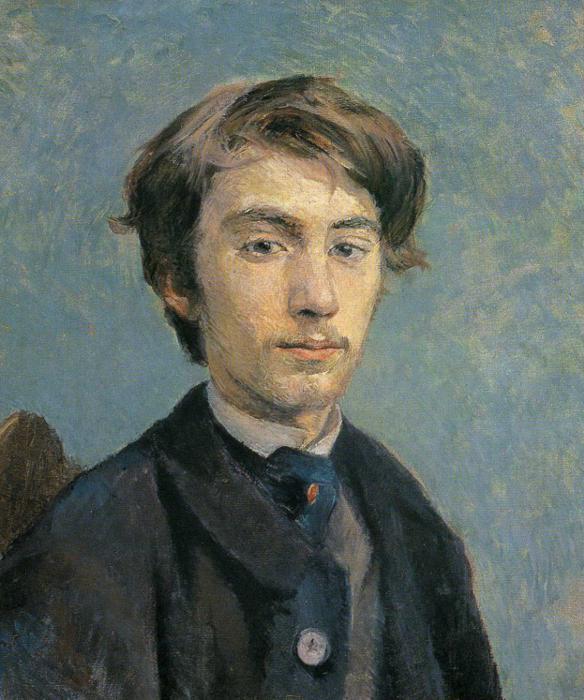
Emile Bernard: A Portrait of Parisian Melancholy
The painting depicts Emile Bernard, a prominent figure in Impressionism and Post-Impressionism, captured in a moment of contemplative repose. Bernard’s gaze drifts slightly off-camera, conveying an inner stillness that speaks volumes about the artist's psychological landscape—a landscape marked by sensitivity and profound observation.
Style and Technique: Impressionistic Echoes
Executed in oil on canvas, “Emile Bernard” adheres to the stylistic principles of Impressionism, albeit imbued with a subtle melancholic hue. Toulouse-Lautrec’s masterful brushwork—characterized by loose, blended strokes—captures the diffused light of Montmartre, creating an atmosphere that is both luminous and subtly shadowed. The artist skillfully utilizes color palettes dominated by blues and greens, reflecting the moodiness inherent in Bernard's subject matter.
Historical Context: Fin de Siècle Paris
Created in 1885 during the “Fin de Siècle” era—a period of artistic experimentation and societal unease preceding World War I—the painting embodies the spirit of its time. Parisian society was grappling with anxieties about modernity, while artists like Toulouse-Lautrec sought to express the complexities of human experience beyond mere visual representation. Bernard himself was a pivotal member of Impressionist circles, pushing boundaries in terms of artistic innovation.
Symbolism: The Weight of Observation
Beyond its aesthetic qualities, “Emile Bernard” carries symbolic weight. Bernard’s posture—seated calmly yet thoughtfully—suggests an artist wrestling with the profound impact of his observations on the world around him. The muted color scheme reinforces this sense of introspection, hinting at a deeper emotional resonance beneath the surface.
Emotional Impact: Capturing Inner Reflection
Toulouse-Lautrec’s portrait succeeds in conveying a palpable feeling of melancholy—a quiet sadness born from empathy and an understanding of human vulnerability. It invites viewers to contemplate the artist's inner life, prompting reflection on themes of solitude, contemplation, and the enduring power of artistic perception. The painting remains a testament to Toulouse Lautrec’s ability to transform visual experience into emotionally evocative art.
- Artist: comte henri marie raymond de toulouse-lautrec-monfa
- Birth Year: 1864
- Death Year: 1901
- Birth City: Albi
- Birth Country: France
The artwork is displayed at the Tate Gallery in London, United Kingdom.