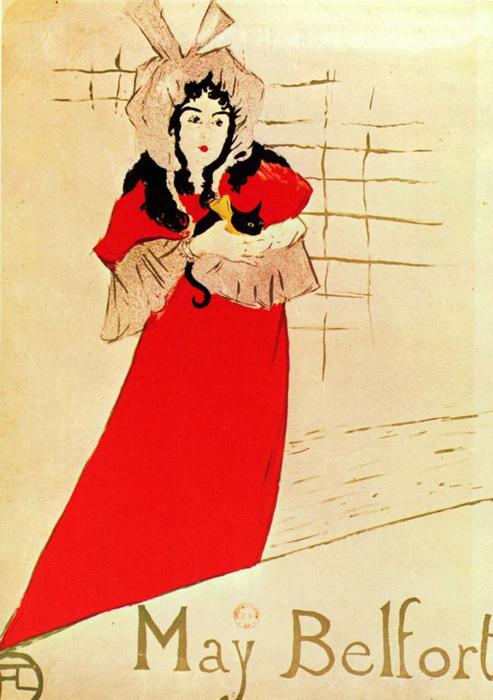
Henri de Toulouse-Lautrec’s ‘Jardin de Paris’ lithograph captures Parisian nightlife with loose lines & vibrant red. Explore this Art Nouveau masterpiece – a unique print by a renowned artist.
Discover Toulouse-Lautrec (1864-1901), Post-Impressionist master of Parisian nightlife! Explore iconic paintings, prints & the bohemian world of Montmartre.
A Portrait of Parisian Nightlife: Exploring Toulouse-Lautrec’s “Jardin de Paris, May Belfort”
The lithograph "Jardin de Paris, May Belfort," created by Henri Marie Raymond de Toulouse-Lautrec-Monfa in 1883, offers a glimpse into the bohemian heart of Montmartre during its golden age. More than just a depiction of a woman in red, this artwork encapsulates the spirit of Impressionism blended with Toulouse Lautrec’s distinctive artistic vision—a vision shaped irrevocably by his physical limitations and fueled by an unwavering fascination for the marginalized figures inhabiting Parisian urban spaces.
The Artist's Context: Toulouse-Lautrec and Montmartre
Henri Toulouse-Lautrec emerged from a privileged aristocratic lineage, yet he rejected societal conventions in favor of immersing himself in the vibrant artistic community of Montmartre. This district, renowned for its artists, performers, and prostitutes, became his muse and primary subject matter. The lithograph reflects this environment—a world of fleeting encounters and raw emotion—where Toulouse Lautrec sought to capture not just appearances but also the essence of human experience. His condition, pycnodysostosis, prevented him from achieving normal stature, forcing him to observe the world from a unique perspective, one that imbued his art with empathy and sensitivity.
Style and Technique: Impressionistic Realism
The artwork’s style is characterized by an intriguing fusion of Impressionist looseness and meticulous realism. Toulouse Lautrec skillfully employs lithographic technique—a process known for its tonal subtlety and ability to reproduce textures—to achieve a remarkable level of detail despite the simplified composition. The artist utilizes hatching and scratching extensively, creating a palpable sense of surface roughness that mimics the materiality of paper and contributes to the overall atmosphere. Thin, flowing lines delineate the woman’s form and drapery, emphasizing contours while conveying movement and dynamism. Unlike traditional perspective methods, Toulouse Lautrec prioritizes capturing light and shadow—essential elements in Impressionist art—to imbue the image with depth and emotional resonance.
Symbolism Within the Frame: Color and Form
The dominant color is crimson – a bold choice that immediately draws attention to the woman’s dress and symbolizes passion or perhaps defiance against societal expectations. The dark grid pattern serves as a neutral backdrop, highlighting the figure's presence without distracting from its expressive qualities. Furthermore, Toulouse Lautrec’s deliberate use of organic shapes—following the curves of the woman’s body—suggests an appreciation for natural forms and contributes to the artwork’s humanist aesthetic. The hat, positioned prominently, speaks to formality and tradition but also hints at a bygone era, anchoring the image in its historical context.
Emotional Impact: Capturing Transient Beauty
Ultimately, “Jardin de Paris, May Belfort” transcends mere visual representation; it evokes a feeling of melancholy beauty—a poignant reminder of fleeting moments captured on paper. Toulouse Lautrec’s masterful technique conveys not only the woman's physical form but also her inner life, inviting viewers to contemplate themes of vulnerability and resilience. The artwork stands as testament to Toulouse Lautrec’s ability to transform personal hardship into artistic brilliance, cementing his legacy as one of the most influential figures in Impressionist art history.