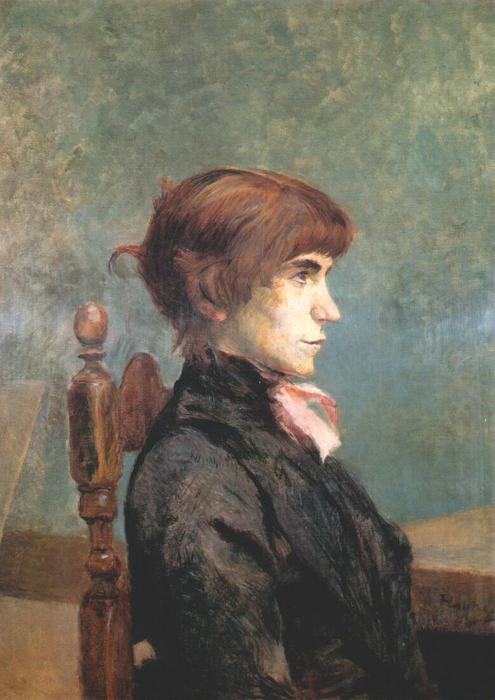
A Portrait Steeped in Parisian Nocturne: Exploring Toulouse-Lautrec’s Jeanne Wenz
Henri Marie Raymond de Toulouse-Lautrec-Monfa, a name synonymous with bohemian artistry and the decadent allure of Montmartre, bequeathed to us not merely images but an entire atmosphere—one captured with unflinching honesty and imbued with profound psychological insight. His oeuvre is defined by its ability to distill the essence of urban life, particularly the vibrant pulse of Paris’s artistic underworld, and “Portrait of Jeanne Wenz,” painted in 1886, exemplifies this masterful approach. This captivating portrait transcends a simple depiction of a woman; it's an emblem of Lautrec’s distinctive vision—a testament to his unwavering fascination with marginalized figures and his unparalleled skill at conveying emotion through subtle visual cues.
The Subject: Jeanne Fontaine – A Fragment of Parisian Life
“Portrait of Jeanne Wenz” centers on Jeanne Fontaine, a young woman whose gaze meets the viewer's directly, establishing an immediate connection that speaks volumes about Lautrec’s humanist sensibility. Fontaine is posed in a chair, bathed in soft light—a deliberate choice that contrasts sharply with the shadowy recesses of Montmartre where Lautrec habitually observed his subjects. The inclusion of a book subtly reinforces the intellectual milieu of the time, hinting at Fontaine's aspirations and reflecting Lautrec’s own scholarly pursuits. More than just an individual face, Fontaine embodies the spirit of her era—a woman navigating the complexities of social expectations while retaining a quiet dignity.
Style & Technique: Impressionistic Echoes with Toulouse-Lautrec’s Signature Touch
While firmly rooted in Impressionism – Lautrec absorbed influences from Monet and Renoir – “Portrait of Jeanne Wenz” distinguishes itself through Lautrec's unmistakable stylistic signature. He eschewed the meticulous blending characteristic of Impressionists, favoring instead a looser brushstroke that captures the immediacy of observation. The artist skillfully employs tonal variations to sculpt Fontaine’s face and drapery, creating depth and texture without resorting to heavy shading. This technique—informed by his own physical limitations—allowed Lautrec to convey emotion with remarkable precision, prioritizing expressive gesture over photographic realism. Notice particularly how Lautrec renders the folds of Fontaine's dress; these aren’t merely decorative elements but conduits for conveying movement and atmosphere.
Historical Context: Montmartre at Its Zenith – A Crucible of Artistic Innovation
Painted during the Belle Époque—Paris’s golden age—the portrait resides within a milieu brimming with artistic experimentation and social upheaval. Montmartre, Lautrec's chosen home, was a haven for artists, writers, and performers alike, attracting figures like Picasso, Renoir, and Degas. The painting reflects this spirit of defiance against convention, portraying Fontaine as an independent woman—a courageous stance considering the societal constraints imposed upon women during that period. Furthermore, it speaks to Lautrec’s broader preoccupation with depicting individuals outside the mainstream, challenging prevailing notions of beauty and elevating the dignity of ordinary life.
Symbolism & Emotional Resonance: Beyond Appearance – Capturing Inner States
Beyond its visual elements, “Portrait of Jeanne Wenz” resonates with deeper symbolic significance. The chair symbolizes stability amidst the restless energy of Montmartre, while the book represents Fontaine’s intellect and her yearning for knowledge—a subtle allusion to Lautrec's own intellectual curiosity. However, the most compelling aspect is Fontaine’s gaze – it conveys a quiet contemplation that hints at inner thoughts and emotions unseen. Lautrec’s masterful rendering captures not just what Fontaine looks like but how she *feels*, demonstrating his profound understanding of human psychology. The painting invites viewers to contemplate themes of vulnerability, resilience, and the enduring power of observation—elements that solidify its place as one of Toulouse-Lautrec's most poignant achievements.
- Artist: Henri Marie Raymond de Toulouse-Lautrec-Monfa
- Year Painted: 1886
- Medium: Oil on Canvas
- Dimensions: Unknown