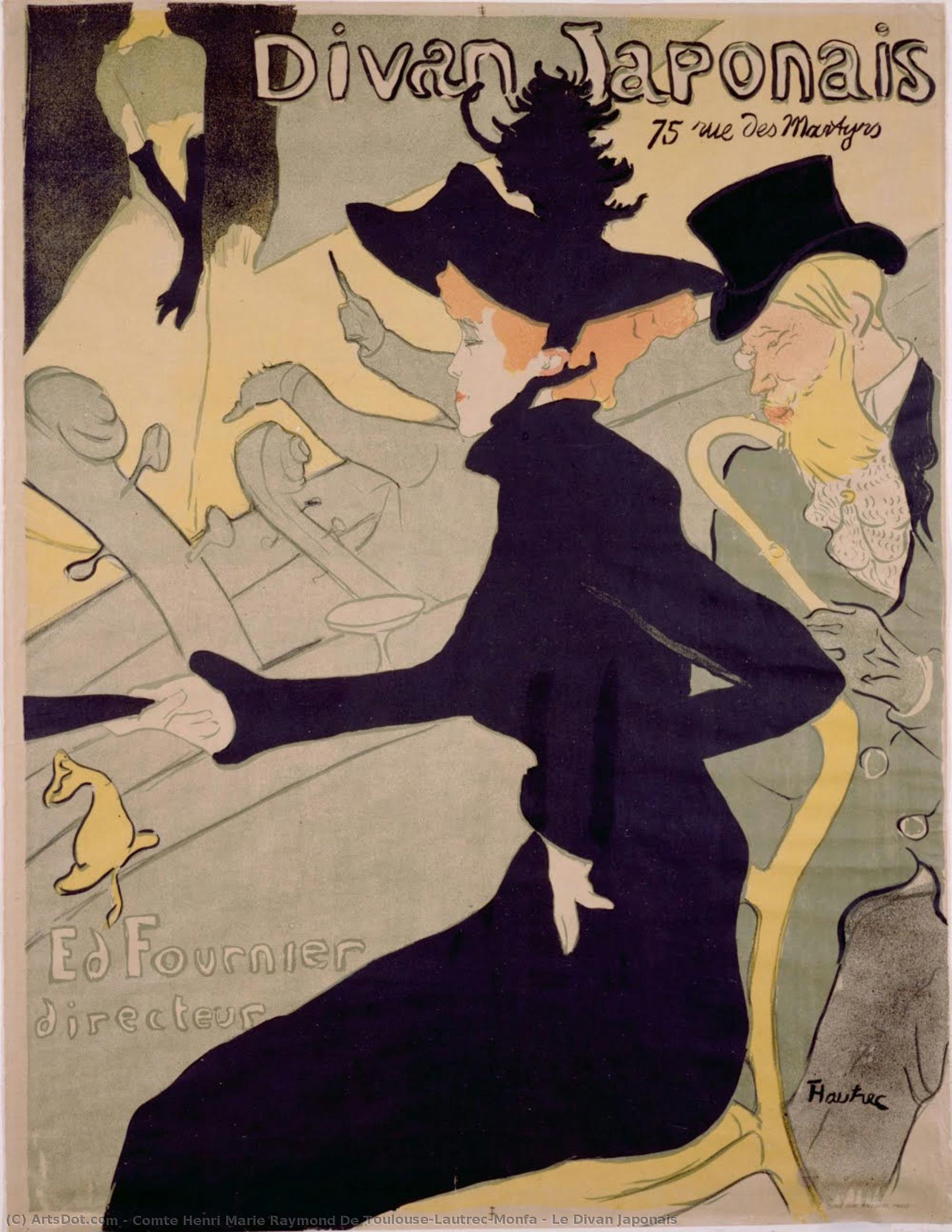
Le Divan Japonais: A Parisian Nightscape of Intrigue and Elegance
Henri de Toulouse-Lautrec’s “Le Divan Japonais” isn't merely a painting; it’s a meticulously crafted window into the vibrant, often scandalous, heart of late 19th-century Paris. Completed in 1893, this iconic work captures the atmosphere of the Divan Japonais café-concert, a legendary establishment nestled within Montmartre’s bohemian district – a place where artists, performers, and socialites mingled amidst a haze of cigarette smoke and captivating entertainment. Lautrec, acutely attuned to the city's undercurrents, masterfully translates this sensory experience onto canvas with an arresting blend of observation and artistic license.
The scene unfolds within a dimly lit interior, dominated by a plush Japanese-style divan – the namesake of the artwork. Two women occupy its cushions, their postures suggesting both intimacy and guarded reserve. One, adorned in a striking black hat and dress, exudes an air of quiet sophistication, while her companion, with flowing blonde hair, appears more relaxed, almost lost in contemplation. The figures are not sharply defined; instead, Lautrec employs loose brushstrokes and subtle gradations of color to create a sense of hazy ambiguity. This deliberate blurring of details mirrors the ephemeral nature of the Parisian nightlife he so brilliantly depicted – a fleeting moment captured before dissolving back into the city’s ceaseless flow.
Technically, “Le Divan Japonais” exemplifies Lautrec's signature style: a masterful synthesis of realism and impressionism. He utilizes a broken color palette, employing short, visible brushstrokes to convey texture and movement. The lighting is dramatic, casting deep shadows that heighten the sense of mystery and intrigue. Notice particularly how he renders the fabrics – the velvet upholstery of the divan, the folds of the women’s dresses – with an almost tactile quality. Lautrec's meticulous attention to detail, combined with his loose brushwork, creates a dynamic composition that draws the viewer into the scene.
The Divan Japonais: A Hub of Parisian Bohemia
To fully appreciate “Le Divan Japonais,” it’s crucial to understand the significance of its setting. The Divan Japonais was more than just a café-concert; it was a crucible for artistic and social innovation. Established in 1873, it quickly became a magnet for avant-garde artists, writers, and performers – including Toulouse Lautrec himself. The establishment’s exotic décor, inspired by Japanese aesthetics, reflected the growing fascination with Eastern cultures during the late 19th century. It was a place where new ideas were exchanged, boundaries were challenged, and the spirit of rebellion thrived.
The café-concert provided a platform for performers like Yvette Guilbert, a pioneering singer who helped popularize cabaret music. The Divan Japonais also hosted theatrical productions, including “Le Coucher de la Mariée” (The Bride Going to Bed), a controversial pantomime that pushed the boundaries of social acceptability with its depiction of nudity. Lautrec’s paintings frequently depicted scenes from this vibrant world, offering glimpses into the lives and personalities of its inhabitants.
Symbolism and Emotional Resonance
Beyond its immediate visual appeal, “Le Divan Japonais” is rich in symbolic meaning. The divan itself represents a space of refuge and contemplation – a place where individuals can escape the pressures of everyday life. The two women, shrouded in shadow and ambiguity, embody themes of intimacy, loneliness, and social constraint. Their averted gazes suggest a hidden narrative, inviting the viewer to speculate about their relationship and motivations.
Lautrec’s masterful use of light and shadow further enhances the painting's emotional impact. The dim lighting creates an atmosphere of mystery and intrigue, while the subtle gradations of color evoke a sense of melancholy and longing. The overall effect is one of quiet contemplation – a poignant reminder of the fleeting beauty and inherent sadness of human experience.
A Legacy of Parisian Impressionism
“Le Divan Japonais” stands as a testament to Toulouse-Lautrec’s unique artistic vision and his profound understanding of Parisian society. It is a quintessential example of late 19th-century impressionism, capturing the energy, excitement, and underlying complexities of a rapidly changing world. Today, reproductions of this iconic work continue to captivate audiences worldwide, offering a glimpse into a bygone era of bohemian glamour and artistic innovation. Its enduring appeal lies in its ability to evoke a powerful sense of nostalgia for a time when Paris was a city of dreams, secrets, and endless possibilities.