A Moment of Galloping Grace: Toulouse-Lautrec’s ‘The Jockey’
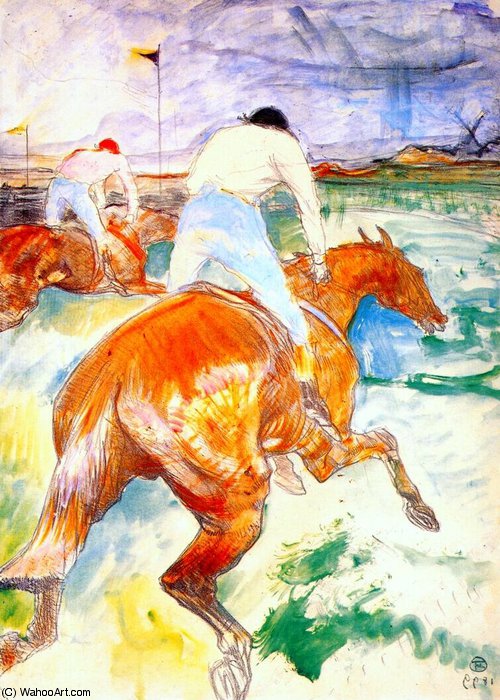
Captured in 1899 by the masterful Henri de Toulouse-Lautrec, “The Jockey” is more than just a depiction of horse riders; it's a vibrant distillation of Parisian life and a poignant exploration of human connection within a rapidly changing world. The painting immediately draws the eye with its bold color palette – rich ochres, deep blues, and flashes of white – characteristic of Lautrec’s distinctive style. He wasn’t interested in idealized beauty or historical grandeur; instead, he sought to capture the raw energy and unvarnished truth of everyday scenes, particularly those found within the bustling artistic hub of Montmartre.
The scene itself is deceptively simple: three figures on horseback traverse a sun-drenched field. The central rider, positioned with a confident stride, dominates the composition, while the flanking riders add to the dynamic movement. Lautrec’s meticulous attention to detail – the strained muscles of the horses, the slightly blurred motion of their legs, the individual expressions of the riders – elevates this seemingly casual tableau into something profoundly engaging. It's a snapshot of leisure, perhaps a private moment shared amongst friends, yet imbued with an undeniable sense of vitality.
The Artist’s Vision: Lautrec and Montmartre
Understanding Toulouse-Lautrec requires understanding his environment – Montmartre in 1899. This district was undergoing a dramatic transformation, shifting from a primarily agricultural area to a center for bohemian artists, performers, and prostitutes. Lautrec, despite his aristocratic lineage, embraced this new world with an almost anthropological curiosity. He wasn’t simply painting what he saw; he was documenting a culture in flux, capturing the essence of its spirit before it vanished entirely. His work reflects a deep empathy for those on the fringes of society – the marginalized and the unconventional – a theme that resonates powerfully throughout his oeuvre.
Born with a severe physical deformity, Lautrec’s own experiences undoubtedly informed his artistic perspective. He possessed an acute observational skill, honed by his unique vantage point, allowing him to perceive nuances others missed. This sensitivity is palpable in “The Jockey,” where the figures aren't merely horses and riders; they are individuals caught in a fleeting moment of shared experience.
Technique and Impressionistic Influences
Lautrec’s technique is characterized by bold, expressive brushstrokes and a flattened perspective – a deliberate departure from traditional academic painting. He employed a technique often described as “pointillism” or “divisionism,” though not in the strict manner of Seurat. Instead, he utilized small, distinct strokes of color to create an overall impression of light and movement, contributing significantly to the painting’s vibrant energy. This approach was heavily influenced by Impressionism, but Lautrec pushed beyond mere optical representation, prioritizing emotional impact and a sense of immediacy.
- Color as Emotion: The intense use of color isn't just descriptive; it’s expressive, conveying the heat of the sun, the energy of movement, and perhaps even the riders’ emotions.
- Dynamic Composition: Lautrec masterfully uses diagonals and overlapping forms to create a sense of motion and depth, pulling the viewer into the scene.
- Loose Brushwork: The visible brushstrokes contribute to the painting's raw, energetic feel, reflecting the dynamism of the subject matter.
Symbolism and Legacy
"The Jockey" transcends a simple equestrian scene; it’s a meditation on movement, freedom, and the transient nature of experience. The horses themselves symbolize power, speed, and perhaps even escape – themes frequently explored by Lautrec in his work. More broadly, the painting represents a pivotal moment in art history, bridging the gap between Impressionism and Post-Impressionism while firmly establishing Lautrec’s unique voice within the Parisian artistic landscape. Today, this captivating artwork continues to resonate with viewers, offering a glimpse into a bygone era and reminding us of the enduring power of observation and artistic expression.