The Two Friends: A Portrait of Intimacy in Toulouse-Lautrec’s Montmartre
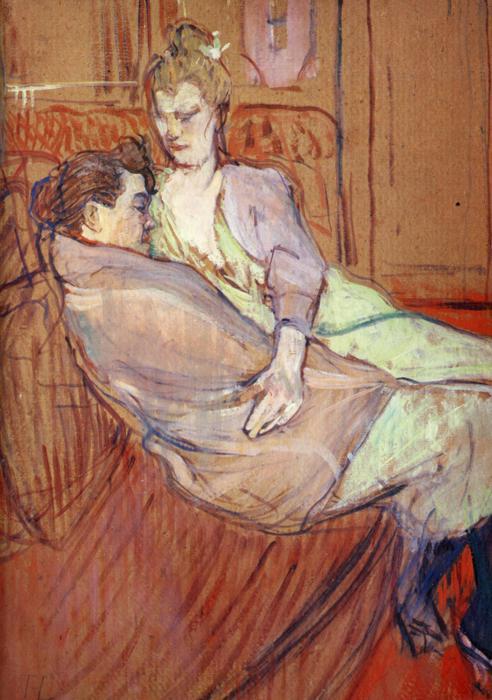
Henri de Toulouse-Lautrec's “The Two Friends,” painted in 1894, offers a remarkably intimate glimpse into the bohemian heart of Paris at the fin de siècle. This seemingly simple depiction – two figures nestled on a couch within a modestly furnished room – is far more than just a snapshot; it’s a carefully constructed tableau brimming with social commentary and profoundly personal observation. Measuring 48 x 35 cm, the painting immediately draws the viewer in with its quiet drama and palpable sense of connection.
The scene itself unfolds within a typical Montmartre setting. The room, though not opulent, speaks to a certain degree of comfort and familiarity. The man, lying down with his head resting on the woman’s lap, embodies a relaxed vulnerability rarely depicted in formal portraiture of the era. His posture suggests both trust and a gentle surrender – a dynamic powerfully conveyed by Lautrec's masterful use of light and shadow. The woman, while less overtly expressive, possesses an air of quiet strength and attentiveness, her gaze directed towards her companion with evident affection.
A Masterclass in Post-Impressionist Technique
Toulouse-Lautrec’s style is immediately recognizable as a pivotal moment within the broader movement of Post-Impressionism. Rejecting the strict realism championed by earlier Impressionists, Lautrec embraced a looser, more expressive approach to form and color. Notice the deliberate lack of precise detail; the figures are rendered with broad brushstrokes, giving them an almost sketched quality that feels remarkably immediate and alive. This technique wasn’t about photographic accuracy but rather capturing the *impression* of movement and emotion.
The artist's use of color is equally significant. He employs a muted palette – browns, ochres, and subtle blues – to evoke a sense of atmosphere and intimacy. The warm tones of the couch and the figures’ clothing contrast with the cooler hues of the wall, creating depth and drawing attention to the central relationship. The clock hanging above them adds a poignant element, subtly reminding us of the fleeting nature of time and the preciousness of shared moments – a recurring theme in Lautrec's work.
Social Commentary and the Figure of the Outsider
“The Two Friends” is more than just a romantic scene; it’s a subtle critique of Parisian society. Toulouse-Lautrec, himself an outsider due to his physical deformity and unconventional lifestyle, was deeply fascinated by the marginalized figures who populated Montmartre – prostitutes, artists, musicians, and other ‘nonconformists.’ This painting reflects this fascination, presenting a scene of quiet domesticity within a world often defined by excess and spectacle.
The couple’s relaxed posture and apparent contentment challenge the prevailing social norms of the time. They represent a rejection of the rigid formality and superficiality that characterized much of Parisian high society. Lautrec's ability to capture this genuine connection between two individuals speaks volumes about his empathy and artistic vision.
Symbolism and Emotional Resonance
The painting’s power lies not just in its technical skill but also in its evocative symbolism. The simple act of sitting together, the shared gaze, and the physical intimacy all contribute to a sense of profound connection. The room itself – with its modest furnishings and single clock – suggests a sanctuary, a space where these two individuals can escape the pressures and anxieties of the outside world.
Toulouse-Lautrec’s “The Two Friends” remains a poignant reminder of the beauty to be found in everyday moments and the importance of human connection. This hand-painted reproduction captures not just an image, but the very essence of Lautrec's artistic genius – a testament to his ability to transform ordinary scenes into enduring works of art.