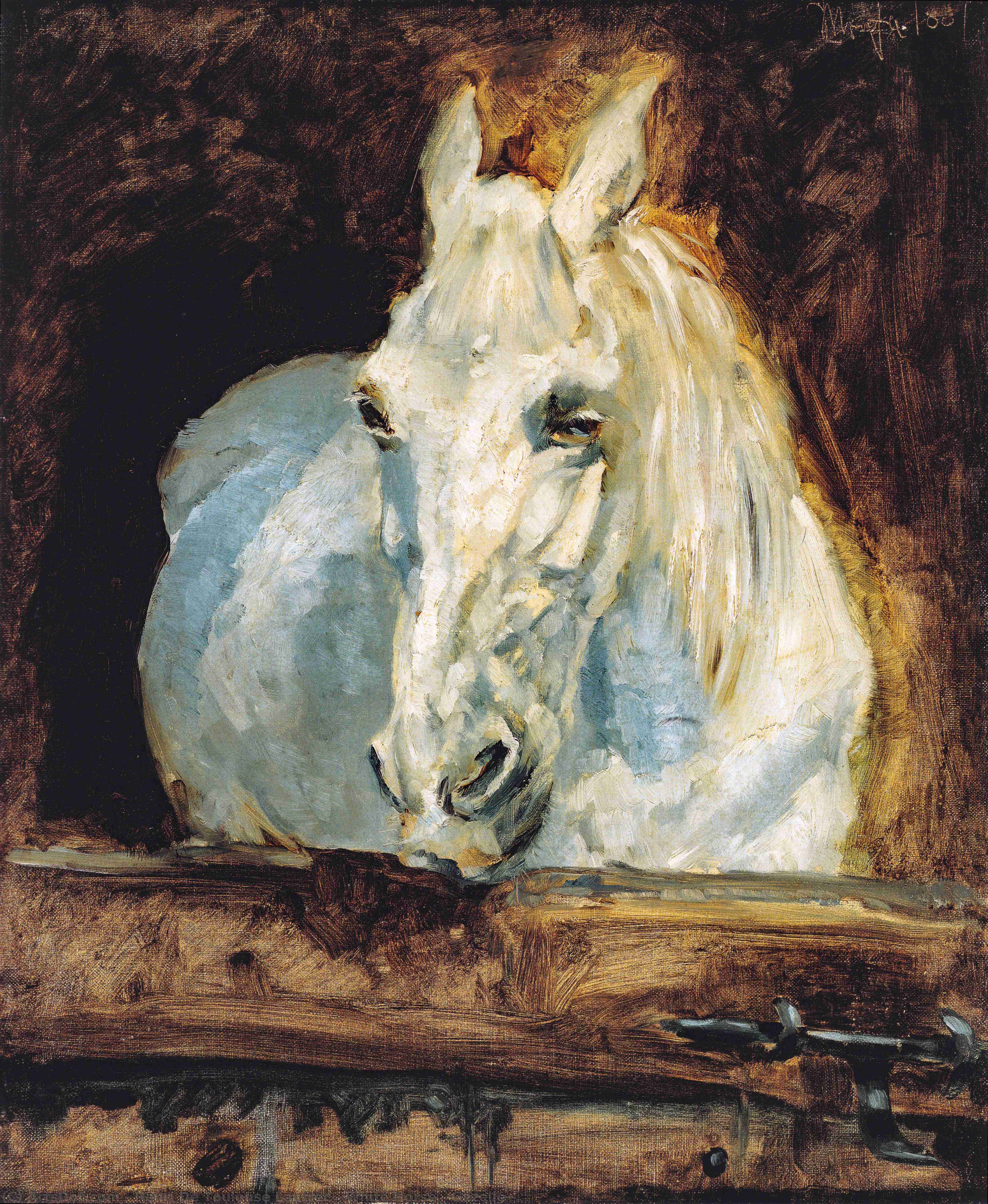
The White Horse “Gazelle”: A Parisian Reverie Captured in Oil
Henri de Toulouse-Lautrec’s “White Horse ‘Gazelle’” stands as an emblem of late 19th-century Montmartre – a vibrant tableau of bohemian life rendered with remarkable sensitivity and stylistic innovation. Painted in 1881, this canvas transcends mere depiction; it embodies the artist's fascination for equine subjects and his profound engagement with the marginalized figures inhabiting Paris’s artistic epicenter.
A Post-Impressionist Vision: Depth Beyond Surface
Lautrec firmly established himself within the burgeoning Post-Impressionist movement, rejecting Impressionists’ preoccupation with fleeting light effects in favor of exploring deeper emotional resonance. Unlike his contemporaries who sought to faithfully reproduce nature, Toulouse Lautrec prioritized conveying feeling and atmosphere—a characteristic evident throughout his oeuvre. “The White Horse ‘Gazelle’” exemplifies this approach through its textured brushstrokes and subtly modulated color palette.
Technical Mastery: Oil on Canvas – Texture and Emotion
The artist skillfully employed oil paint on canvas, a medium that allowed for unparalleled textural richness and tonal nuance. Visible brushwork—particularly around the horse’s mane and torso—creates a palpable sense of movement and dynamism. Lautrec's meticulous attention to detail captures the subtle nuances of light and shadow, enhancing the painting’s visual impact and conveying an emotional depth that surpasses mere representation.
Subject Matter: Symbolism Within Everyday Life
The central figure – a white horse gazing upwards—holds symbolic significance beyond its literal portrayal. Horses were frequently depicted in Parisian art during this period, representing strength, nobility, and connection to the pastoral realm. However, Toulouse Lautrec’s choice of subject matter wasn't merely decorative; it reflected his empathy for those excluded from mainstream society – a recurring theme in his artistic explorations.
Historical Context: Montmartre at Its Zenith
"The White Horse ‘Gazelle’” is inextricably linked to the cultural dynamism of Montmartre during Toulouse Lautrec’s formative years. This district attracted artists, writers, and performers alike—creating a crucible for experimentation and innovation. The painting captures the spirit of this era—a celebration of beauty amidst urban decay and a fascination with the unconventional.
- Artist: comte henri marie raymond de toulouse-lautrec-monfa
- Born Year: 1864
- Death Year: 1901
- Birth City: Albi
- Birth Country: France
This artwork is available as a handmade oil painting reproduction at ArtsDot.com.