A Glimpse into Parisian Life: Toulouse-Lautrec’s “Woman with Gloves”
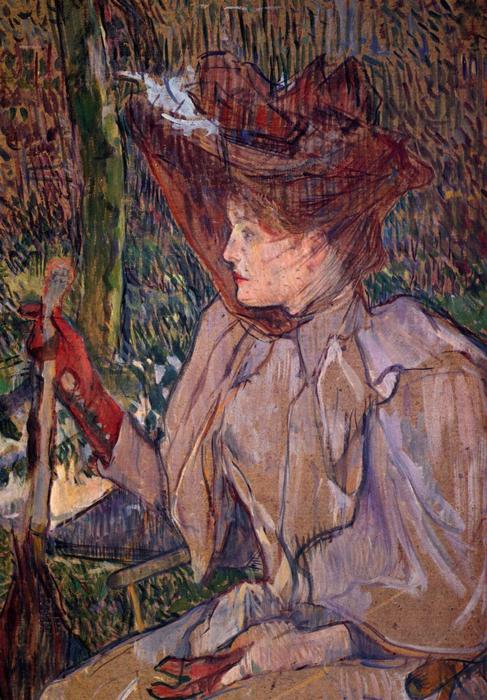
Henri de Toulouse-Lautrec's "Woman with Gloves," painted in 1890 and now residing within the hallowed halls of the Musée d'Orsay, is far more than a simple portrait; it’s a vibrant snapshot of late 19th-century Parisian society, imbued with the artist’s distinctive Post-Impressionistic vision. The painting immediately draws the eye to Honorine Platzer, a woman whose presence radiates both vulnerability and quiet strength. She sits on a bench, a seemingly ordinary pose transformed by Lautrec's masterful manipulation of color and form. The red hat, adorned with a delicate feather – a symbol often associated with femininity and fleeting beauty – immediately commands attention, while the tennis racket held loosely in her hand hints at leisure, social gatherings, and perhaps even a touch of defiance against societal expectations.
Post-Impressionism: Distortion and Emotion
Toulouse-Lautrec’s style firmly places “Woman with Gloves” within the Post-Impressionist movement. Rejecting the Impressionists' focus on capturing fleeting moments of light, Lautrec sought to express deeper emotions and psychological states through his art. He employed bold, often jarring colors – the intense red of the hat contrasting sharply with the muted tones of the background – to heighten the emotional impact. His figures are deliberately distorted, not in a grotesque manner, but rather to emphasize their individuality and inner lives. The slight asymmetry of Honorine’s posture, for instance, speaks volumes about her character, suggesting a complexity that transcends mere physical representation.
The Artist's Intimate Subject – Honorine Platzer
It is crucial to understand the significance of Honorine Platzer within Lautrec’s oeuvre. She was not merely a model; she was a close friend and muse, a figure deeply intertwined with his personal life and artistic vision. The fact that he painted multiple portraits of her – this being one of several – reveals a profound connection and an ongoing exploration of her character. The painting captures a moment of quiet contemplation, as if Honorine is lost in thought, perhaps reflecting on the social dynamics surrounding her or simply enjoying a private moment amidst the bustling energy of Montmartre. The subtle shift of her gaze, directed slightly off-camera, invites us to imagine what she’s considering.
Technique and Texture: The Language of Oil on Panel
Toulouse-Lautrec's choice of oil paint on panel is integral to the painting’s overall effect. This medium allowed him to build up layers of color, creating a rich texture that adds depth and physicality to the image. Notice how he uses short, broken brushstrokes – a hallmark of his style – to define the fabric of her dress and the contours of her face. The subtle variations in tone suggest light and shadow, lending a sense of realism while simultaneously maintaining the painting’s expressive quality. The background, rendered with looser strokes, provides a hazy backdrop that emphasizes Honorine's presence without overwhelming it.
Symbolism and Social Commentary
Beyond its immediate visual appeal, “Woman with Gloves” offers subtle commentary on the social landscape of Paris at the turn of the century. The tennis racket speaks to the leisure class, while Honorine’s attire – though modest – hints at a degree of independence and self-possession. The birds in the background, fleeting and ephemeral, could symbolize the transient nature of beauty and pleasure. Ultimately, Lautrec's painting is a poignant meditation on human connection, social dynamics, and the enduring power of art to capture the essence of a particular moment in time. A reproduction of this captivating work offers a unique opportunity to bring a piece of Parisian history into your home, allowing you to appreciate the genius of Toulouse-Lautrec’s vision for years to come.
Explore High-Quality Reproductions