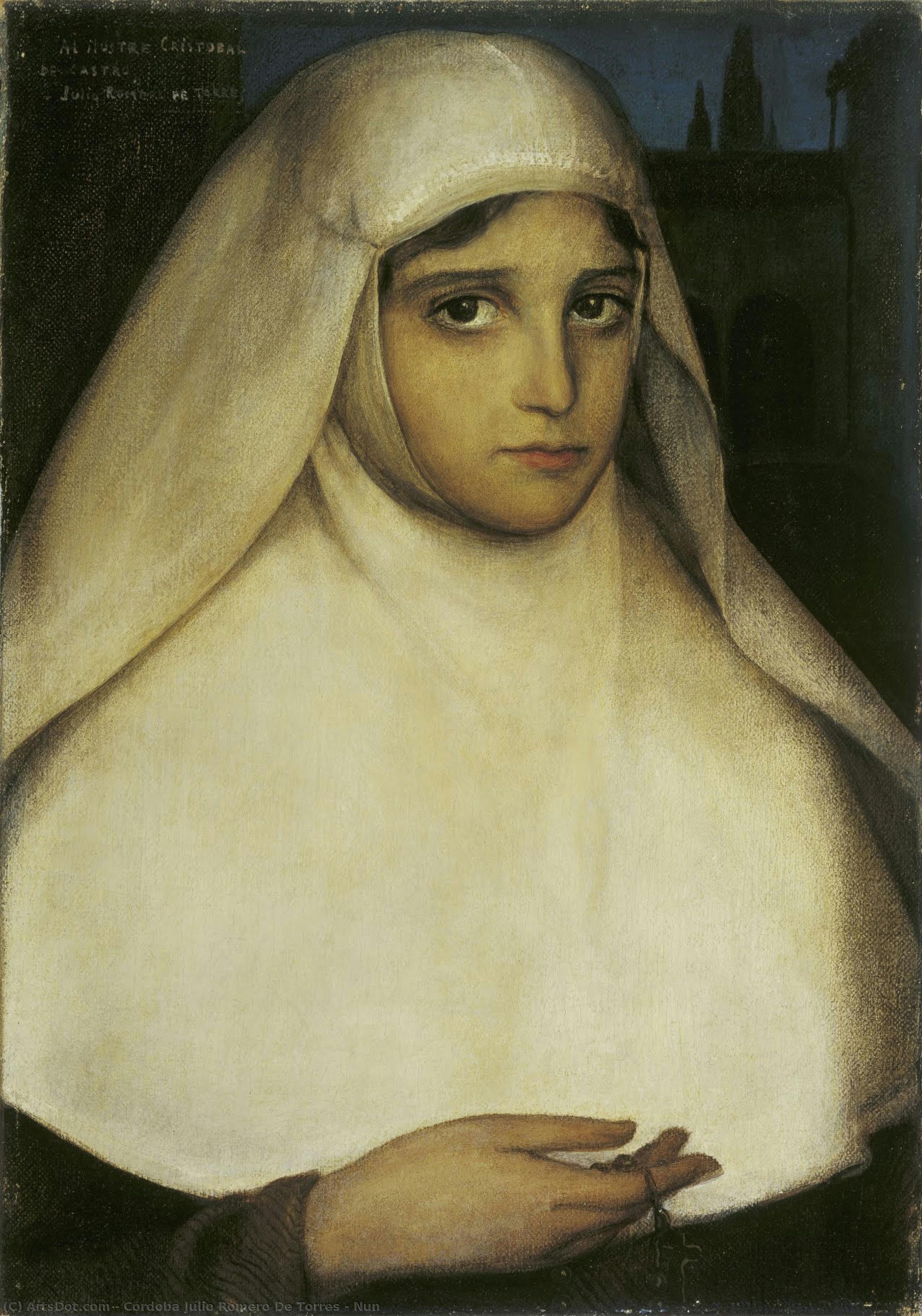
This captivating painting portrays a nun in prayerful contemplation, illuminated by soft light against a dark backdrop—a testament to Romero de Torres' profound emotional depth and stylistic innovation.
Delve into the serene beauty of Julio Romero de Torres' 'Nun,' a poignant depiction capturing Andalusian spirituality and masterful technique. Explore Córdoba’s artistic heritage!
A Visionary Echo of Andalusia: Exploring Julio Romero de Torres’s “Nun”
Julio Romero de Torres (1874 – 1930), born in Córdoba, Spain, stands as a pivotal figure in the Spanish avant-garde movement. His artistic journey was deeply intertwined with the spirit of his homeland—Andalusia—a region grappling with profound social and cultural transformations at the dawn of the 20th century. Influenced by Symbolism and Realism alike, Romero de Torres sought to capture not merely what he saw but what he felt – a quest for expressive truth that distinguishes him from many of his contemporaries. His father, Rafael Romero Barros, was himself a respected realist painter and founder of Córdoba’s Museum of Fine Arts, providing Julio with an early exposure to artistic excellence and shaping his formative years. This familial legacy instilled in him a meticulous attention to detail and a profound understanding of visual language.
Romero de Torres embarked on his formal artistic training at Córdoba's School of Fine Arts, honing his skills under the guidance of masters who championed both observation and imagination. He swiftly developed a distinctive style characterized by vibrant color palettes—particularly reds and yellows—that mirrored the fiery hues of Andalusian landscapes. However, it was his ability to infuse these colors with symbolic resonance that truly cemented his reputation as an artist of exceptional sensitivity. Unlike many artists preoccupied with grand narratives or monumental forms, Romero de Torres focused on capturing intimate moments – often depicting everyday life in rural Andalusia – imbued with profound emotional depth.
“Nun,” painted circa 1910, exemplifies this artistic ethos perfectly. The artwork portrays a woman draped in white fabric—a deliberate allusion to monastic purity and spirituality—seated quietly before what appears to be a darkened interior. Romero de Torres’s masterful technique reveals an astonishing level of precision; the folds of the garment are rendered with painstaking accuracy, capturing the subtle nuances of light and shadow that contribute to the painting's contemplative atmosphere. The woman’s hands clasped together in prayer convey a palpable sense of devotion and serenity—a visual embodiment of inner peace amidst external obscurity.
The dark background serves as a counterpoint to the central figure, directing the viewer’s gaze towards her serene countenance and emphasizing the painting’s spiritual core. Romero de Torres skillfully employs chiaroscuro – the dramatic interplay between light and darkness – to heighten emotional impact and create an illusion of depth. The muted tones of the surroundings amplify the luminosity of the woman's face, symbolizing enlightenment and transcendence. Beyond its technical brilliance, “Nun” speaks volumes about the artist’s preoccupation with themes of faith, solitude, and contemplation—values deeply rooted in Andalusian culture and reflected throughout Romero de Torres’s oeuvre.
The painting resonates powerfully with viewers today, offering a glimpse into a bygone era while simultaneously conveying timeless truths about human experience. It stands as a testament to Romero de Torres's unwavering commitment to artistic integrity and his ability to transform simple observation into profound emotional expression—a legacy that continues to inspire artists and collectors alike.
- Artist: Córdoba Julio Romero de Torres
- Born Year: 1874
- Death Year: 1930
- Birth City: Cordoba
- Birth Country: Spain