A Moment Frozen in Time: The Quiet Brilliance of Bega’s Alchemist
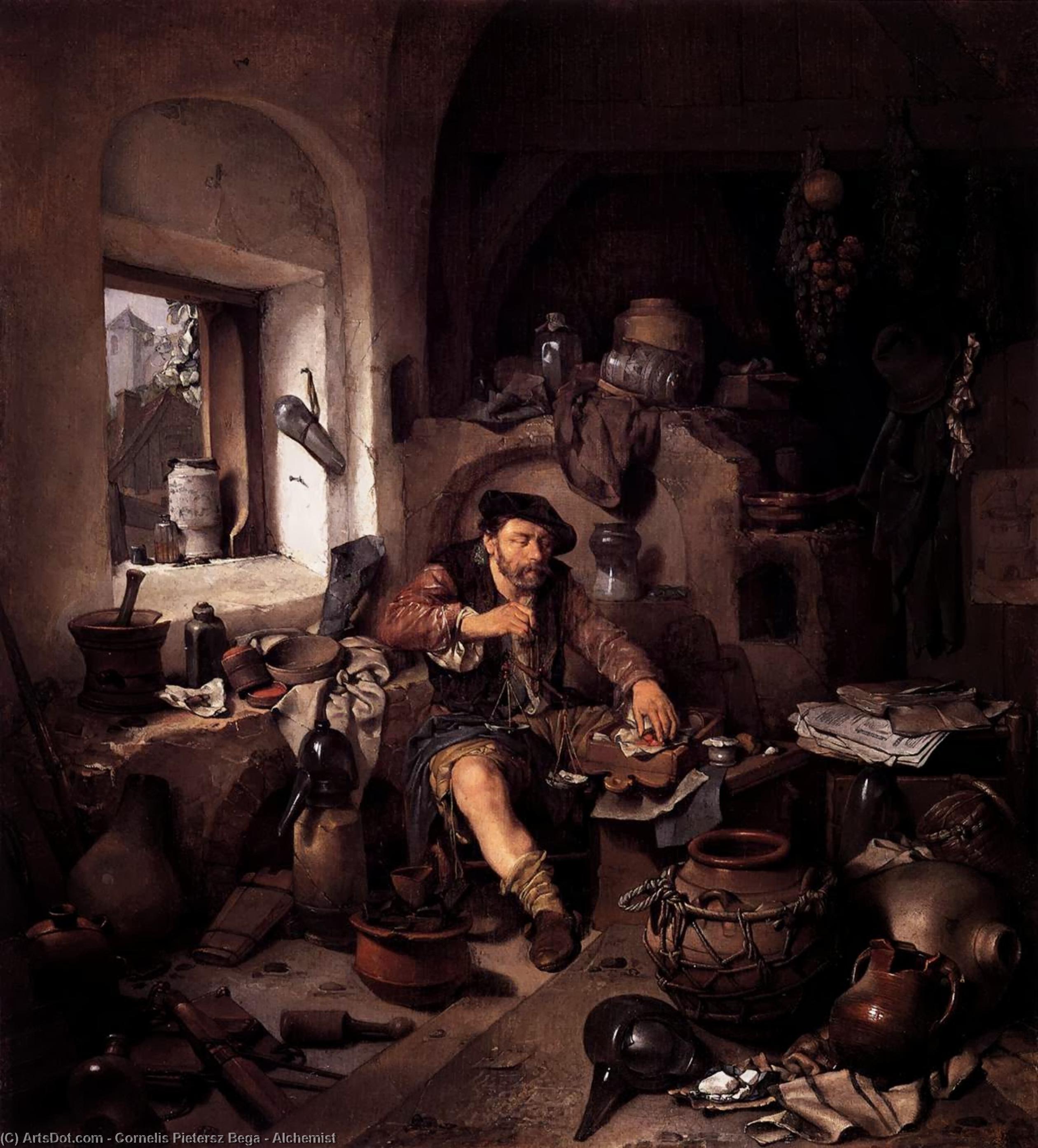
In the dim, amber-hued corners of the seventeenth century, few images capture the profound stillness of intellectual pursuit as poignantly as Cornelis Pietersz Bega’s “The Alchemist.” Painted in 1663, this masterpiece serves as more than a mere portrait; it is an invitation into a private sanctuary of thought. As we gaze upon the figure seated amidst his scholarly clutter, we are not just observing a man at work, but witnessing the very essence of the Dutch Golden Age—a period where the boundaries between scientific curiosity and spiritual contemplation were beautifully blurred. The painting breathes with a sense of quietude, pulling the viewer into a world where time seems to have slowed to the rhythm of a single, deep breath.
The composition is a masterclass in atmospheric depth. Bega, a student of the great Adriaen van Ostade, utilizes a sophisticated technique of light and shadow to sculpt the space around his subject. Through the subtle application of atmospheric perspective, the room feels tangible, its corners receding into a soft, velvety darkness that suggests an infinite expanse beyond the immediate candlelight. Light filters through a window with a gentle persistence, catching the rim of a glass vessel, the edge of a weathered book, and the thoughtful profile of the man himself. This interplay of light does not merely illuminate; it sanctifies the mundane objects of the room, transforming simple bowls, cups, and bottles into relics of a dedicated life.
The Symbolism of Discovery and the Human Spirit
Every element within this shadowy interior serves as a silent narrator in the story of human potential. The scattered books, the meticulously rendered clock on the wall, and the various scientific apparatuses are not merely decorative; they are symbols of Renaissance Humanism. They represent the era's burgeoning fascination with reason, the measurable world, and the pursuit of hidden truths. The presence of a small bird perched amidst the clutter adds a delicate layer of life and fragility to the scene, perhaps acting as a metaphor for the fleeting nature of inspiration or the soul’s flight during moments of deep meditation.
For the discerning collector or interior designer, this artwork offers a profound emotional resonance. The muted palette—dominated by earthy browns, slate grays, and deep blacks—provides a sophisticated anchor for any space, offering a sense of stability and historical weight. It is a piece that does not demand attention through loud colors, but rather commands respect through its tonal harmony and understated elegance. To hang such a reproduction is to introduce a sense of contemplative luxury into a room, fostering an environment where reflection and intellectual engagement can flourish.
Ultimately, Bega’s “The Alchemist” remains a timeless testament to the beauty of the internal journey. It reminds us that even in our most solitary moments of study or introspection, there is a magnificent, quiet drama unfolding. Whether viewed as a historical document of the Dutch Golden Age or as a soulful piece of decor, it continues to inspire awe through its ability to capture the very heartbeat of human curiosity.