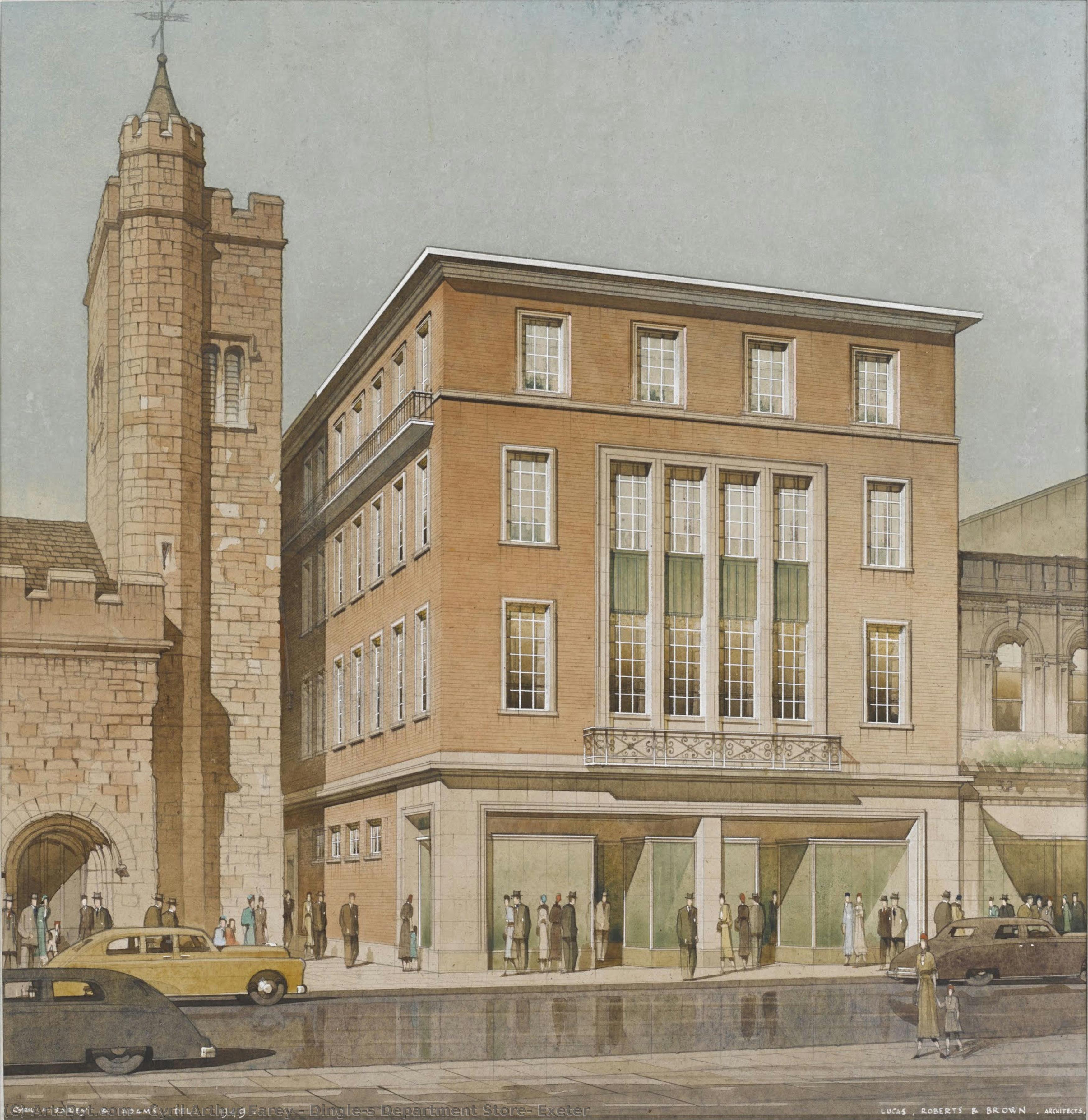
Dingle’s Department Store, Exeter – A Snapshot of Post-War Commerce
- Subject: Cyril Arthur Farey's meticulously rendered depiction of Dingle’s Department Store in Exeter, England, circa 1949. The artwork transcends a simple architectural drawing; it captures a specific moment in the city’s evolution – a period marked by burgeoning retail development and shifting urban landscapes.
- Artist: Created by the esteemed architect and watercolour painter, Cyril Arthur Farey (1888-1954), this piece exemplifies his celebrated skill as an architectural illustrator. Farey's work was highly sought after by prominent architects of his time, demonstrating a profound understanding of perspective and detail.
- Historical Context: The painting’s creation coincides with a pivotal era in Exeter’s history – the post-War period. The scene depicts a time when private cars were permitted on the High Street, a stark contrast to the present day restrictions. This glimpse into a bygone age adds layers of poignant significance, particularly considering the dramatic shifts in shopping habits brought about by events like Covid-19.
A Masterclass in Perspective and Technique
- Style: Farey’s style leans towards realism with a subtly stylized quality. The emphasis is on clarity and precision, prioritizing accurate representation of the building's design and its surrounding environment. This approach was characteristic of architectural illustrations from the mid-20th century, where technical accuracy held paramount importance.
- Technique: The artwork skillfully combines watercolor with pen and ink, resulting in a layered effect that enhances depth and texture. Subtle shading and cross-hatching are employed to suggest material surfaces – brick, stone, and perhaps the polished metal of the automobile. The diffused lighting casts gentle shadows, contributing to the three-dimensionality of the scene.
- Materials: The piece was likely executed on paper using watercolor pigments and drawing inks, reflecting the materials commonly utilized by Farey during his career.
Composition and Symbolic Elements
- Composition: The artwork employs a traditional compositional structure with distinct foreground, middle ground, and background elements, creating a sense of depth and spatial awareness. The flattened perspective, typical of architectural illustrations from this era, further emphasizes the building’s design.
- Details: Noteworthy details include several pedestrians, a yellow automobile (a symbol of modernity in 1949), and the overall bustling streetscape – elements that contribute to the scene's narrative quality. The focus remains firmly on documenting and presenting the architectural design rather than injecting overt symbolic or emotional content.
Emotional Impact and Legacy
The painting’s enduring appeal lies not only in its technical brilliance but also in its ability to evoke a sense of nostalgia for a simpler time. It serves as a visual record of Exeter's architectural evolution, offering a poignant reminder of the city’s past and the changing nature of commerce. This reproduction offers an exceptional opportunity to own a piece of British art history, capturing a significant moment in both Farey’s career and the development of Exeter. Its warm earth tones and meticulous detail create a timeless aesthetic that will complement any interior space.