The Enigmatic Figure – A Study in Victorian Introspection
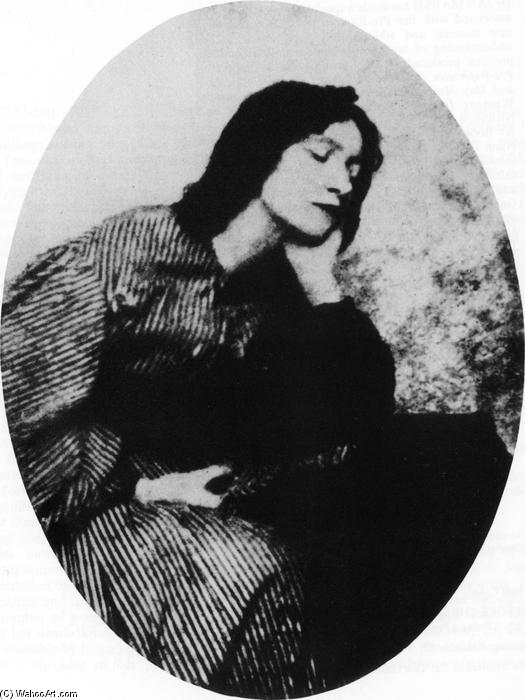
Dante Gabriel Rossetti’s “Elizabeth Siddal Resting, Holding a Parasol” is not merely a portrait; it's a carefully constructed tableau of melancholy and quiet contemplation. Captured in stark black and white, the image presents a young woman seated in profile, seemingly lost within her own thoughts. The photograph, likely produced using albumen paper – a technique common during the Victorian era – possesses a subtle grainy texture that lends an air of timelessness, hinting at its age while simultaneously drawing us into the scene’s intimate atmosphere. The composition is dominated by the figure's posture and expression; she appears to be drifting in a state of reverie or perhaps sorrow, her head slightly bowed, her gaze averted. The folds of her clothing, rendered with remarkable detail through shading, create a sense of depth and volume, while the gentle shadows around her face subtly emphasize her vulnerability.

The Pre-Raphaelite Muse – Elizabeth Siddal’s Significance
To fully appreciate Rossetti's portrait, it’s crucial to understand the pivotal role Elizabeth Siddal played in his artistic life and within the broader context of the Pre-Raphaelite Brotherhood. Siddal was a remarkable woman—an artist herself, a poet, and most famously, Rossetti’s exclusive model for nearly a decade. Born in 1829, she possessed an ethereal beauty that captivated the artists' imaginations, but also a fragile health that tragically cut short her life at the age of 32. Her connection to Rossetti was deeply intertwined with both artistic inspiration and personal affection; he saw in her a reflection of his own romantic ideals and sought to capture her essence through his art. Siddal’s willingness to pose for extended periods, often enduring uncomfortable conditions – as evidenced by her time floating in water for Millais' *Ophelia* – speaks volumes about her dedication to the movement and her profound impact on Rossetti’s work.
Symbolism of Rest and Reflection
The image is rich with symbolic meaning. The parasol, delicately held in Siddal’s hand, suggests protection from an unseen sorrow or perhaps a longing for escape. Her seated posture, reminiscent of classical depictions of mourning figures, evokes themes of loss, introspection, and the quiet dignity of suffering. The muted palette – dominated by shades of grey and white – reinforces this sense of melancholy, while the lack of vibrant color contributes to the portrait’s overall atmosphere of subdued emotion. The photograph's composition invites us to contemplate the inner life of the subject, prompting questions about her thoughts, dreams, and perhaps even her unspoken regrets.
A Window into Victorian Portraiture – Technique and Context
“Elizabeth Siddal Resting, Holding a Parasol” exemplifies the conventions of Victorian portraiture while simultaneously pushing against established boundaries. The formal pose, frontal lighting, and emphasis on capturing an individual’s likeness are hallmarks of the era. However, Rossetti's use of shading and his focus on conveying emotion—rather than simply replicating a likeness—demonstrates a more psychologically nuanced approach to portraiture. The albumen print technique, with its soft tones and subtle gradations, was favored by Pre-Raphaelites for its ability to capture delicate details and create an atmospheric effect. This photograph offers a poignant glimpse into the artistic sensibilities of the Victorian era, revealing both its formal traditions and its burgeoning interest in exploring the complexities of human emotion.