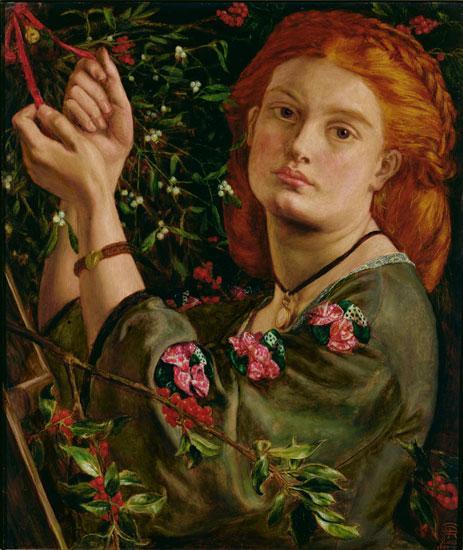
The Enigmatic Figure of Rossetti’s “Hanging the Mistletoe”
Dante Gabriel Rossetti's "Hanging the Mistletoe," painted in 1860, isn’t merely a portrait; it’s a carefully constructed tableau brimming with Victorian symbolism and Pre-Raphaelite romanticism. The image captures a young woman, her fiery red hair a striking counterpoint to the muted tones of her dress and the verdant backdrop, engaged in the delicate act of adorning a branch with mistletoe berries. The scene unfolds within a dimly lit interior, suggesting a private moment of domesticity—a space both intimate and imbued with an undercurrent of melancholy. Rossetti masterfully employs light to draw attention to the woman’s face, highlighting her expressive eyes and subtly conveying a sense of introspection that transcends the simple act of hanging festive decorations.
- Subject Matter: The portrait centers on a young woman, embodying both innocence and a hint of sadness.
- Symbolism: Mistletoe, traditionally associated with peace, love, and reconciliation, hints at domestic harmony—yet the woman’s gaze holds a quiet melancholy that complicates this simple interpretation.
- Historical Context: Painted during the height of the Pre-Raphaelite movement, the work reflects the group's fascination with medieval themes, symbolism, and a rejection of academic art conventions.
A Symphony of Color and Texture – The Artistic Technique
Rossetti’s technique is characterized by an almost obsessive attention to detail and a masterful blending of colors. He employs a rich palette dominated by earthy greens, browns, and deep reds—the vibrant hue of the woman's hair immediately commands attention. The artist utilizes soft, diffused lighting, creating a sense of intimacy and drawing focus onto the subject’s face. Brushstrokes are generally subtle and blended, resulting in a remarkably smooth surface that enhances the realism of the figures and foliage. The rendering of textures—the delicate folds of fabric, the rough bark of branches, and the velvety softness of skin—demonstrates Rossetti's exceptional skill as a painter. The use of oil paints on canvas allows for layering and depth, contributing to the overall richness and luminosity of the work.
Note: The painting’s meticulous detail suggests a significant investment of time and effort by the artist, reflecting the Pre-Raphaelite commitment to painstaking craftsmanship.
Pre-Raphaelite Roots – Style and Influences
“Hanging the Mistletoe” is undeniably a product of the Pre-Raphaelite movement, a reaction against the perceived artificiality of academic art. Rossetti’s work echoes the stylistic conventions of this group—a fascination with medieval themes, an emphasis on naturalism and symbolism, and a rejection of idealized beauty in favor of a more realistic portrayal of human emotion. The composition itself—centered around the woman's face and upper body—is reminiscent of Renaissance portraiture, while the detailed rendering of foliage and drapery reflects the Pre-Raphaelites’ admiration for medieval art. The influence of artists like William Holman Hunt and John Everett Millais is evident in Rossetti’s meticulous attention to detail and his use of symbolic imagery.
Emotional Resonance – A Portrait of Quiet Contemplation
Beyond its technical brilliance, “Hanging the Mistletoe” possesses a profound emotional resonance. The woman's melancholic gaze invites viewers to contemplate her inner world—her thoughts, feelings, and perhaps even unspoken desires. The mistletoe, laden with berries, serves as a potent symbol of hope amidst sadness, suggesting that even in moments of quiet contemplation, the possibility of love and reconciliation remains. This painting is not simply a depiction of a domestic scene; it’s an exploration of human emotion—a poignant reminder of the complexities of life and the enduring power of beauty.