The Enigmatic Figure of Jane Morris
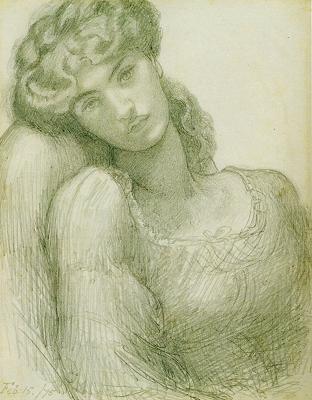
Dante Gabriel Rossetti’s “Jane Morris 1,” a remarkably intimate pencil sketch, offers a glimpse into the soul of a young woman poised in a moment of profound introspection. Rendered with a masterful command of grayscale tones and delicate lines, this study transcends mere portraiture; it's an exploration of mood, emotion, and the subtle beauty of quiet contemplation. The artwork immediately draws the viewer in with its centered composition – Jane Morris’s head and shoulders dominating the frame, creating a sense of immediate connection. It’s not a grand, theatrical display, but rather a deeply personal and vulnerable portrayal, reminiscent of a private moment captured on paper.
Rossetti's approach leans heavily into the Pre-Raphaelite aesthetic, evident in the loose rendering of hair and clothing details – elements that suggest movement and texture without resorting to rigid realism. The artist skillfully employs hatching and cross-hatching techniques, layering lines to simulate the feel of graphite on paper, creating a tactile quality that invites close inspection. The use of varying line weights adds depth and dynamism, particularly in the depiction of her flowing hair, which seems to ripple with an unseen breeze.
A Window into Victorian Sensibility
Created around 1873, “Jane Morris 1” is firmly rooted within the context of late Victorian England. The Pre-Raphaelite Brotherhood, of which Rossetti was a key member, sought to reject the academic conventions of art and return to the perceived purity and emotional honesty of early Italian Renaissance painting. This movement valued beauty in its most natural and spiritual forms, often drawing inspiration from medieval legends, mythology, and literature. Jane Morris herself embodied this ideal – a muse celebrated for her ethereal beauty and connection to the artistic spirit. Her role as model for Rossetti and William Morris further cemented her place within this circle of artists and intellectuals.
The artwork’s subject matter is deceptively simple: a single female figure. However, it's precisely this simplicity that allows the viewer to project their own emotions and interpretations onto the image. Morris’s contemplative expression – a subtle furrow of her brow, a slight downturn of her lips – evokes a sense of melancholy or perhaps simply deep thought. The lack of overt symbolism adds to the piece’s power; it's not telling a specific story but rather inviting us to witness a private moment of introspection.
Technique and Artistic Intent
Rossetti’s technique is characterized by its meticulous attention to detail, balanced with an impressionistic sensibility. The shallow perspective draws the viewer into the scene, creating a sense of intimacy and immediacy. The use of tonal variations – lighter areas suggesting highlights, darker areas indicating shadow – effectively models form and creates depth. The artist's mastery of line is particularly noteworthy; each stroke contributes to the overall effect, guiding the eye and shaping the contours of the face and body.
Interestingly, research suggests a deeper connection between Rossetti and Jane Morris than initially apparent. The artwork’s creation coincided with a period of emotional involvement between the two artists, hinting at a complex and passionate relationship that profoundly influenced their work. The image serves as a poignant reminder of this hidden history, offering a rare glimpse into the private world of a celebrated muse.
This reproduction captures the essence of Rossetti’s original sketch with exceptional fidelity, allowing you to experience the beauty and emotional depth of “Jane Morris 1” in stunning detail. It's a perfect addition to any art collection or a thoughtful gift for those who appreciate the timeless allure of Pre-Raphaelite art.