Jane Morris: A Portrait of Victorian Melancholy
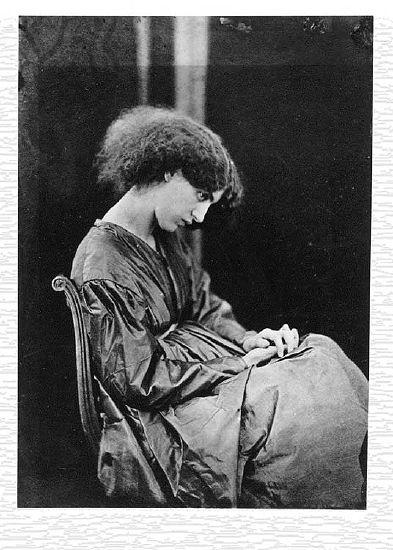
Dante Gabriel Rossetti’s “Jane Morris,” painted in 1865, is more than just a likeness; it's a carefully constructed evocation of the Pre-Raphaelite ideal – a poignant meditation on beauty, sorrow, and the burgeoning romanticism of the Victorian era. The photograph itself, rendered in albumen print, possesses a remarkable stillness, capturing Jane Morris seated with an almost unnerving serenity. Her posture, head bowed as if lost in contemplation, immediately draws the viewer into her private world, inviting us to share in her quiet melancholy.
Rossetti’s skill lies not merely in his technical ability – though the soft lighting and subtle tonal variations demonstrate a mastery of Victorian portraiture – but in his profound understanding of subject matter. Jane Morris herself was a pivotal figure within the Pre-Raphaelite circle, renowned for her exquisite needlework and her role as a muse to both Rossetti and William Morris. This image transcends a simple representation; it’s a carefully orchestrated tableau designed to embody the aesthetic ideals of the time – a return to naturalism, an appreciation for beauty in decay, and a fascination with medieval legend and symbolism.
The Pre-Raphaelite Aesthetic
Rossetti, along with his fellow Pre-Raphaelites, rejected the artificiality and academic conventions of the Royal Academy. Instead, they sought inspiration in the art of the early Italian masters – particularly those predating Raphael – believing that these artists possessed a greater truthfulness and emotional depth. This is evident in “Jane Morris” through her flowing dress, reminiscent of medieval garments, and her carefully arranged pose, which echoes the idealized figures found in Pre-Raphaelite paintings.
The shallow depth of field, blurring the background into indistinct shapes – a couch, another chair, two distant figures – further emphasizes the subject’s isolation and intensifies the mood. This technique was common within the Pre-Raphaelite movement, directing the viewer's attention solely to the central figure and amplifying its emotional impact.
Symbolism and Emotion
The photograph is imbued with a sense of quiet sadness, reflecting the prevalent Romantic sensibility of the period. The muted color palette – dominated by browns, grays, and subtle greens – contributes significantly to this atmosphere. It’s important to note that Jane Morris herself was a model for William Morris, and her relationship with him was complex, marked by both affection and distance. This inherent tension subtly permeates the image, adding another layer of emotional depth.
The photograph's texture – the subtle grain of the paper, the delicate folds of her dress – adds to its vintage aesthetic, transporting the viewer back to 1865. It’s a testament to Rossetti’s meticulous attention to detail and his desire to capture not just a likeness, but an entire mood and atmosphere.
A Timeless Masterpiece
"Jane Morris" remains a powerful example of Pre-Raphaelite artistry – a beautiful, melancholic portrait that continues to captivate viewers today. ArtsDot’s hand-painted reproduction allows you to experience the full impact of Rossetti's vision, bringing this iconic image into your home or office with unparalleled quality and authenticity.