A Vision of Melancholy: The Ethereal Gaze of Jane Morris
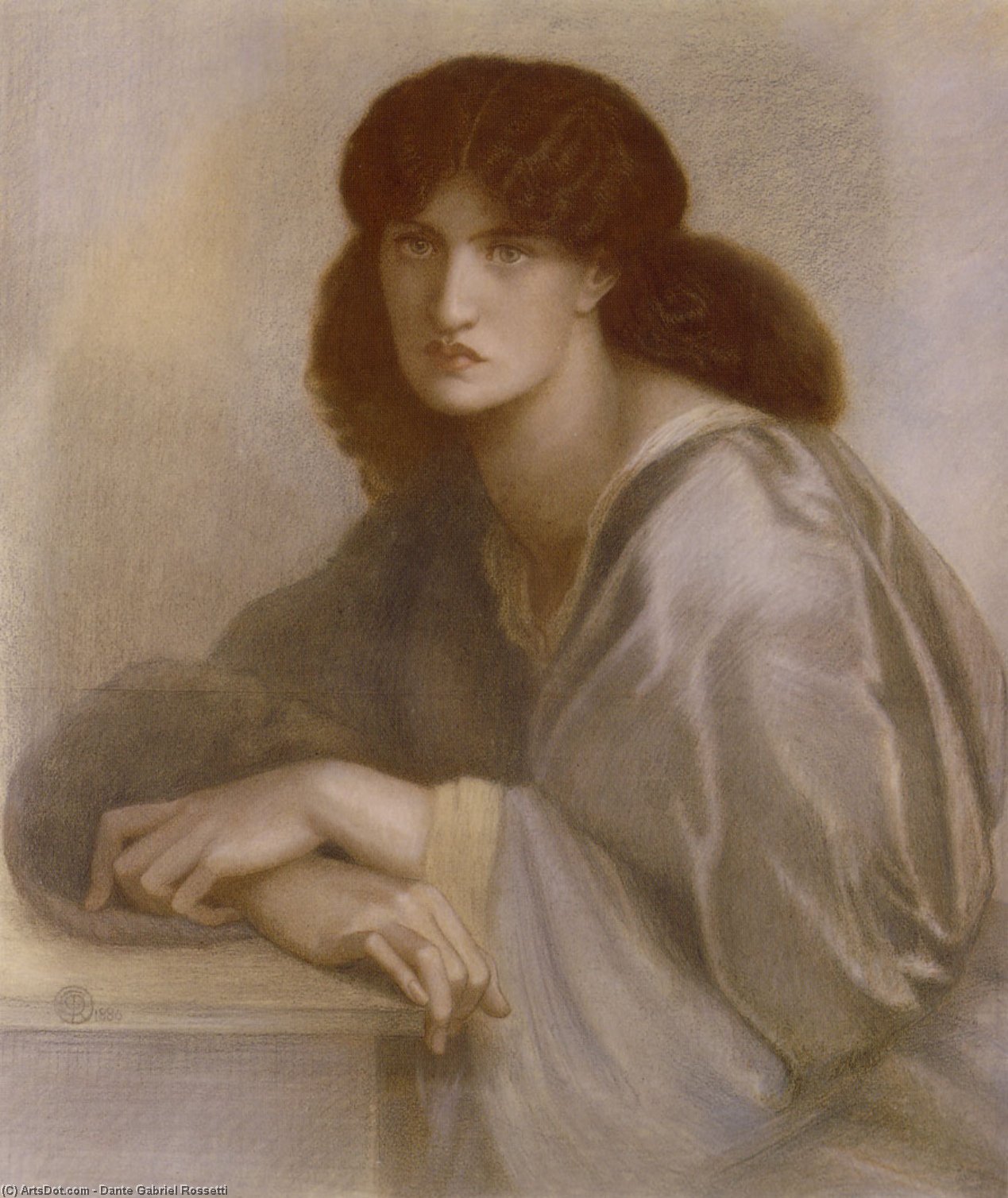
In the quiet, diffused light of a Victorian afternoon, Dante Gabriel Rossetti captures a moment that feels suspended between reality and myth. La Donna della Finestra, also known as Jane Morris, is far more than a mere portrait; it is a hauntingly beautiful window into the soul of the Pre-Ralphaelite movement. Completed in 1880, this masterpiece presents Jane Morris not just as a woman, but as an icon of romantic longing and contemplative sorrow. As she sits by the window, her gaze meets the viewer with an intensity that is both inviting and deeply enigmatic, pulling us into a world where the boundaries between the physical person and the symbolic archetype begin to dissolve.
The composition is masterfully balanced, utilizing a sense of atmospheric depth to create a narrative that extends far beyond the central figure. While Jane remains the focal point, Rossetti subtly incorporates shadowy figures in the background—one to the left and another to the right—which serve to deepen the painting's mystery. These spectral presences evoke the Arthurian legends and Celtic folklore that so deeply influenced the era, suggesting that the subject is surrounded by the ghosts of myth and memory. For the collector or interior designer, this depth provides a profound sense of storytelling, making the piece an evocative centerpiece for any space dedicated to intellectual and emotional reflection.
The Mastery of Pastel: Light, Texture, and Technique
What distinguishes this work from the heavy, oil-laden canvases of his contemporaries is Rossetti’s exquisite command of chalk pastel. In this medium, he achieves a level of luminosity and tonal subtlety that oil paints often struggle to replicate. The artist utilizes the soft, powdery nature of the pastel to render Jane’s flowing auburn hair with a tactile realism, capturing every wave and texture as if it were caught in a gentle breeze. This technique allows for a seamless blending of hues, creating skin tones that seem to glow from within, bathed in the soft, indirect light filtering through the window.
The interplay of light and shadow—the chiaroscuro effect—is used here to emphasize the emotional weight of the subject. The way the light catches the delicate ornamentation of her necklace and the flowing folds of her blue dress adds a layer of aristocratic elegance to the composition. This mastery of texture and light makes a high-quality reproduction of this work particularly striking; the subtle gradients and soft edges are preserved, allowing the artwork to breathe with life and grace when displayed in a curated setting.
A Legacy of Beauty and Symbolism
To understand La Donna della Finestra is to understand the heart of the Aesthetic movement. Rossetti, a polymath who lived at the intersection of poetry and painting, infused this portrait with the concept of "art for art's sake." Every element, from the way Jane’s hair is loosely pulled back to her serious, almost mournful expression, serves a symbolic purpose. She embodies the Pre-Raphaelite ideal of beauty—a beauty that is not merely decorative but deeply spiritual and often tinged with a sense of tragic inevitability.
For those looking to adorn a home or gallery with art that inspires conversation, this piece offers an unparalleled emotional resonance. It brings with it the historical weight of the Arts & Crafts movement and the romantic spirit of the late 19th century. Whether placed in a sunlit study or a moody, dimly lit library, Rossetti’s depiction of Jane Morris acts as a portal to a bygone era of profound beauty, making it an essential acquisition for anyone who appreciates art that speaks to the complexities of the human condition.