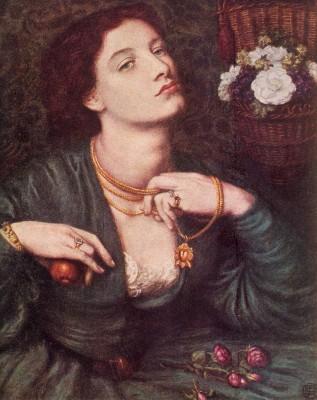
A Portrait of Melancholy Beauty – Dante Gabriel Rossetti’s Monna Pomona
Dante Gabriel Rossetti's “Monna Pomona,” completed in 1864, stands as a quintessential emblem of the Pre-Raphaelite movement—a stylistic rebellion against the academic conventions dominating Victorian art. More than just a depiction of a woman’s face and upper torso, it’s an immersive experience into a world steeped in mythic allusion and exquisitely rendered emotion. The painting captures Ada Vernon as Monna Pomona, embodying the ethereal grace characteristic of Rossetti's oeuvre.
Composition and Visual Narrative
The artwork’s vertical orientation immediately draws the viewer’s gaze upwards, mirroring the contemplative posture of Vernon herself. Her eyes meet the viewer with a subtle upward glance—a gesture that invites introspection and suggests a profound awareness beyond the immediate visual field. Rossetti skillfully employs spatial layering to create depth, subtly guiding our eye across the canvas from the woman's face towards the basket brimming with flowers positioned beside her.
Color Palette and Texture – Echoes of Myth
Rossetti’s masterful use of color—primarily muted greens, creams, and flesh tones—evokes a sense of serene stillness. Touches of gold shimmer delicately across Vernon's jewelry and contribute to the overall luminosity, while vibrant hues dominate the floral arrangement. The painterly technique is evident in visible brushstrokes that imbue the surface with rich texture, conveying both materiality and an artist’s palpable sensitivity to light and form. This meticulous attention to detail aligns perfectly with Pre-Raphaelite ideals of artistic veracity.
Symbolism: Fruit, Flowers, and Feminine Virtue
"Monna Pomona" is laden with symbolic significance rooted in Roman mythology—specifically the goddess of fruit trees and orchards. The apple held by Vernon’s hand serves as a potent emblem of temptation and knowledge, referencing biblical narratives and elevating the image beyond mere portraiture. Simultaneously, the roses scattered around her symbolize love, beauty, and purity – themes central to Victorian sensibilities and reflecting Rossetti's fascination with medieval romance.
A Legacy of Aesthetic Sensibility
Executed in oil on canvas, “Monna Pomona” exemplifies the Pre-Raphaelite commitment to capturing idealized beauty and conveying profound psychological states. Its enduring appeal lies not only in its technical brilliance but also in its ability to transport viewers into a realm of poetic contemplation—a testament to Rossetti’s artistic vision and his contribution to the broader landscape of Victorian art history. As evidenced by Tate Gallery's catalog number 2685, this masterpiece continues to inspire admiration for its exquisite craftsmanship and evocative emotional resonance.