Explore the Pre-Raphaelite art of Dante Gabriel Rossetti (1828-1882). Discover his sensual paintings, symbolic poetry & medieval themes – a key figure in Aestheticism & Symbolism.
A Portrait of Quiet Reverie: Dante Gabriel Rossetti’s Mrs. Burne Jones
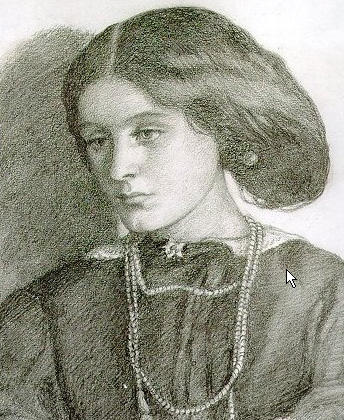
Dante Gabriel Rossetti's "Mrs. Burne Jones," a striking black and white drawing executed in 1860, transcends mere representation; it embodies the very essence of Pre-Raphaelite aesthetics—a movement that sought to recapture the spirit of medieval art and infuse it with Romantic idealism. This captivating image captures a woman gazing intently at the viewer, her expression conveying both solemn contemplation and subtle vulnerability. The drawing’s meticulous detail reveals an artist deeply attuned to capturing the nuances of human emotion and form.
Subject Matter and Composition
The portrait depicts Mrs. Burne Jones, wife of renowned Pre-Raphaelite sculptor Edward Coley Burne-Jones. Rossetti skillfully portrays her serene countenance against a softly rendered background, prioritizing psychological depth over literal accuracy. The woman’s gaze directs the viewer's attention inwards, inviting introspection and prompting consideration of inner thoughts and feelings—a hallmark of Romantic art’s preoccupation with subjective experience. Her posture exudes grace and composure, reflecting the idealized beauty championed by Rossetti and his contemporaries.
Style and Technique: Pre-Raphaelite Precision
Rossetti’s technique exemplifies the meticulous precision characteristic of the Pre-Raphaelite Brotherhood. Fine lines delineate the contours of Mrs. Burne Jones' face and neck, capturing subtle shading variations that contribute to a palpable sense of realism despite the monochrome palette. The artist employs hatching and crosshatching—a technique favored by Pre-Raphaelites—to build up tonal values with remarkable subtlety, creating an illusion of depth and texture. This painstaking attention to detail underscores Rossetti’s commitment to recreating the beauty he perceived in nature and human form with unwavering fidelity.
Historical Context: Aestheticism and Symbolism
“Mrs. Burne Jones” emerged during a period marked by burgeoning Aestheticism—a philosophical movement that prioritized art for its own sake, rejecting utilitarian concerns and embracing emotional expression as paramount. Rossetti’s work aligns perfectly with the broader aesthetic ideals of the time, reflecting a fascination with mythology, folklore, and medieval symbolism. The pearl necklace adorning Mrs. Burne Jones' neck serves as a potent visual metaphor—pearls symbolize purity, innocence, and spiritual enlightenment—further enriching the artwork’s symbolic significance.
Emotional Impact: A Window into Inner Beauty
Ultimately, “Mrs. Burne Jones” succeeds in conveying a profound sense of quiet beauty and contemplative emotion. Rossetti's masterful rendering captures not just physical likeness but also an intangible quality – a glimpse into the woman’s inner world—a testament to his ability to translate psychological states onto canvas. It invites viewers to pause, observe, and contemplate the complexities of human experience, cementing its place as a cornerstone of Pre-Raphaelite art and a timeless symbol of serene contemplation.