Explore the Pre-Raphaelite art of Dante Gabriel Rossetti (1828-1882). Discover his sensual paintings, symbolic poetry & medieval themes – a key figure in Aestheticism & Symbolism.
Explore the Hunterian Museum & Art Gallery's diverse collections – from ancient Egypt to zoology & art, spanning centuries of scientific and artistic discovery.
A Portrait of Romantic Idealism: Exploring Dante Gabriel Rossetti’s Regina Cordium
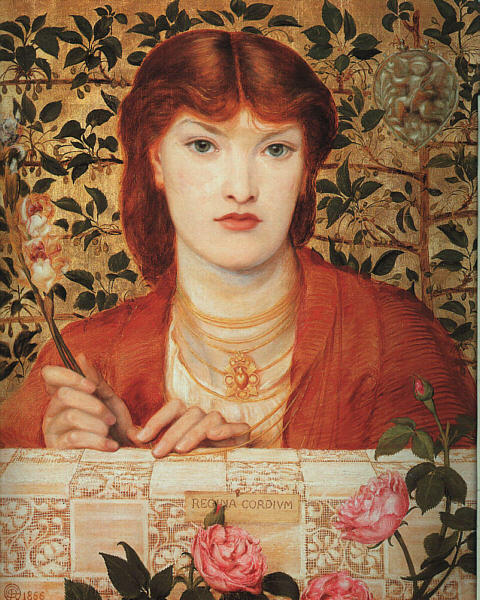
The painting “Regina Cordium,” completed in 1866 by Dante Gabriel Rossetti, stands as a quintessential emblem of Victorian Romanticism—a movement obsessed with beauty, emotion, and the exploration of inner psychological landscapes. More than just a depiction of a woman, it's an invitation into a realm where art strives to capture not merely what is seen but what is felt, reflecting the anxieties and aspirations of its era. Rossetti’s meticulous attention to detail and his masterful command of artistic technique elevate this portrait beyond mere representation, transforming it into a profound meditation on femininity and spiritual contemplation.
Subject Matter and Composition
At its core, “Regina Cordium,” Latin for ‘Queen of Sorrow,’ portrays Isabella Morpurgo, Rossetti’s muse and beloved wife. The subject is presented in a half-length pose, gazing directly at the viewer with an expression that conveys both serenity and melancholy. Her gaze isn't passive; it holds a quiet intensity—a suggestion of inner awareness—that draws the observer into her world. Beside her rests a rose, a symbol universally associated with love, beauty, and remembrance, while in her other hand she clutches a book, representing knowledge, intellect, and perhaps hinting at a yearning for spiritual enlightenment. The artist skillfully arranges these elements within a softly lit interior space dominated by a stylized tree—a motif frequently employed by Rossetti to symbolize resilience, growth, and the connection between humanity and nature.
Style and Technique: Pre-Raphaelite Sensibility
Rossetti’s artistic style is undeniably rooted in the Pre-Raphaelites, a group of British painters who rejected the academic conventions prevalent at the time and sought inspiration from medieval art and literature. Unlike their contemporaries, who favored idealized depictions of classical figures, Rossetti prioritized emotional truthfulness over stylistic imitation. He achieved this through painstaking brushwork—a hallmark of the movement—characterized by smooth gradations of color and an almost luminous quality that imbues the painting with a palpable sense of atmosphere. The artist’s use of encaustic paint—pigments fused with beeswax—further enhances the textural richness of the artwork, creating a surface that feels both tactile and ethereal. This technique contributes significantly to the overall impression of solemn beauty and reinforces the Pre-Raphaelite commitment to capturing the subtleties of human emotion.
Historical Context: Victorian Ideals of Womanhood
“Regina Cordium” emerged during a period marked by significant societal shifts—the burgeoning Industrial Revolution reshaping Britain’s economic landscape while simultaneously fostering anxieties about social morality and gender roles. The Victorian era championed ideals of feminine virtue, piety, and domestic tranquility, often portraying women as symbols of purity and grace. Rossetti's depiction of Isabella Morpurgo aligns perfectly with these prevailing sensibilities, presenting her as a woman embodying both strength and vulnerability—a figure capable of confronting sorrow yet retaining an unwavering faith in beauty and truth. The painting serves as a poignant reflection of the Victorian preoccupation with spiritual contemplation and underscores Rossetti’s desire to elevate his subject beyond mere physical appearance.
Symbolism: Beyond Surface Beauty
The symbolism woven throughout “Regina Cordium” transcends its immediate visual elements. As mentioned, the rose symbolizes love and remembrance, while the book represents intellectual pursuit and spiritual aspiration. However, the tree itself carries deeper significance—representing not just natural beauty but also resilience in the face of adversity. Its branches reaching upwards suggest a striving for transcendence, mirroring Isabella’s gaze and reinforcing the painting's overarching theme of inner contemplation. Rossetti skillfully employs these symbols to communicate profound ideas about human experience—the interplay between sorrow and joy, intellect and emotion—creating an artwork that resonates with viewers on multiple levels.