A Portrait of Intimacy and Sorrow: Dante Gabriel Rossetti’s “The Beloved”
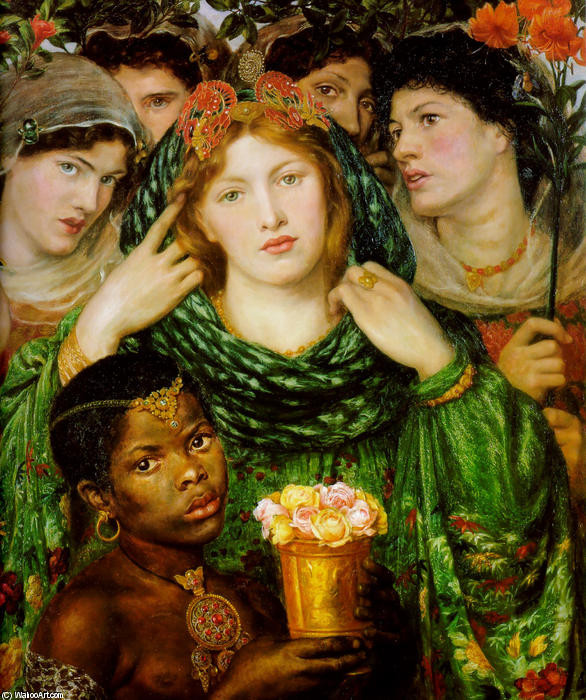
Dante Gabriel Rossetti's "The Beloved," painted in 1866, is more than a simple portrait; it’s a haunting meditation on love, loss, and the enduring weight of the past. This intimate scene captures a woman, seemingly lost in contemplation, surrounded by figures that hint at a complex narrative woven from Victorian sensibilities and Pre-Raphaelite ideals. The painting immediately draws the eye to its central figure – a woman with a delicate crown resting upon her head, an emblem suggesting both vulnerability and elevated status. Her gaze is directed off-camera, inviting us into her private world of thought, while she holds a vase—a potent symbol of beauty, fragility, and perhaps even mourning. The muted palette, dominated by rich browns, deep greens, and subtle blues, contributes to the painting’s melancholic atmosphere, creating an environment that feels both opulent and deeply sorrowful.
Rossetti's Pre-Raphaelite style is evident in every brushstroke. He meticulously renders textures – the velvet of her gown, the intricate details of the surrounding foliage, and the subtle sheen on the vase—demonstrating a commitment to realism rarely seen in contemporary art. The figures are depicted with an almost sculptural quality, their forms idealized yet imbued with a palpable sense of humanity. Notice the careful attention paid to light and shadow; Rossetti masterfully uses chiaroscuro to create depth and drama, guiding our eye through the composition and emphasizing the emotional weight of the scene. The background is deliberately blurred, further isolating the central figure and intensifying her introspective mood.
Echoes of Myth and Victorian Sentiment
“The Beloved” resonates deeply within the context of 19th-century England. The Pre-Raphaelite Brotherhood, founded by Rossetti himself, sought to revive the artistic conventions of the early Italian Renaissance, rejecting the academic rigidity of the Royal Academy. They drew inspiration from medieval literature and mythology, often exploring themes of love, loss, beauty, and mortality. This painting clearly reflects these influences. The crown suggests a connection to royalty or divinity, while the woman’s contemplative pose evokes the melancholic heroines of Romantic poetry. The inclusion of the potted plant adds another layer of symbolism—a reminder of life's fleeting beauty and the inevitability of decay.
Further research reveals that Rossetti was deeply influenced by his family history, particularly his father’s Italian heritage and his mother’s literary background. The painting can be viewed as a personal exploration of familial relationships and the burdens of inherited sorrow. The connection to John Roddam Spencer Stanhope, another key figure in the Pre-Raphaelite movement, is also noteworthy; Stanhope's mythological works often explored similar themes of beauty, loss, and the supernatural.
Symbolism and Emotional Resonance
Beyond its aesthetic qualities, “The Beloved” possesses a profound emotional resonance. The woman’s off-screen gaze suggests a longing for something lost or unattainable—perhaps a past love, a forgotten dream, or a connection to a higher power. The vase she holds could represent remembrance, offering a poignant reminder of what has been cherished and now mourned. The presence of the other figures hints at a complex social dynamic, suggesting that this woman is both admired and perhaps even burdened by her position within this gathering. It’s a scene ripe with unspoken narratives and subtle emotional cues.
Considering the broader context of Rossetti's life and work, “The Beloved” stands as a testament to his artistic vision—a poignant exploration of human emotion rendered with exquisite detail and technical skill. ArtsDot offers meticulously crafted hand-painted reproductions that faithfully capture the beauty and depth of this iconic Pre-Raphaelite masterpiece, allowing you to bring its evocative power into your own space.