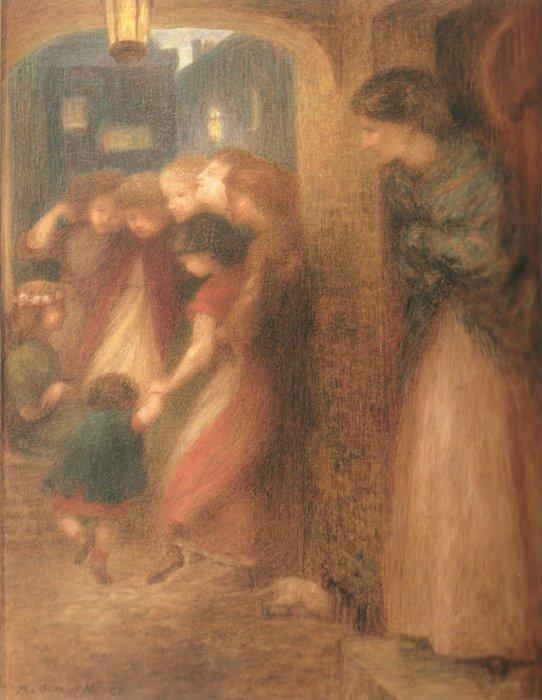
The Gate of Memory – A Pre-Raphaelite Echo of Remembrance
Dante Gabriel Rossetti’s “The Gate of Memory,” completed in 1864, stands as a cornerstone of the Symbolist movement while simultaneously embodying the enduring spirit of Pre-Raphaelitism. More than just a depiction of figures gathered near an arched doorway—a motif frequently explored by Rossetti—the painting operates on multiple levels, inviting contemplation about time, loss, and the elusive nature of recollection.
- Composition & Setting: The artwork’s central focus is undeniably the archway itself, serving as a visual anchor and framing device. Surrounding it are figures—likely women and children—clustered on one side, creating an interplay between intimacy and vulnerability. A solitary figure positioned to the right adds a poignant element of observation, suggesting a yearning for connection amidst the quietude of remembrance.
- Color Palette & Texture: Rossetti employs a muted palette dominated by warm earth tones – browns, oranges, and subtle reds—a characteristic choice that contributes to the painting’s melancholic atmosphere. The soft focus achieved through pastel or charcoal techniques lends an ethereal quality to the scene, mirroring the hazy recollections of memory itself. Textures appear velvety smooth, reinforcing this impression of dreamlike serenity.
- Style & Technique: “The Gate of Memory” firmly establishes Rossetti within the Pre-Raphaelite tradition. Like its predecessors, it prioritizes narrative and symbolism—elements crucial to conveying profound emotional truths. However, unlike many other Pre-Raphaelites, Rossetti eschews sharp delineation, favoring blurred lines and diffused colors to capture the fleeting essence of experience. The layering of pigments—likely watercolor washes combined with chalk—creates a luminous glow that enhances the painting’s evocative power.
- Symbolism & Emotional Impact: The title itself – “The Gate of Memory” – speaks volumes about Rossetti's artistic intent. It encapsulates themes of nostalgia, longing for the past, and the inevitable passage of time. The solitary figure embodies contemplation and introspection, prompting viewers to confront their own experiences of loss and remembrance. The overall mood is one of quiet sorrow mingled with tenderness—a testament to Rossetti’s ability to distill complex emotions into a visually arresting image.
- Historical Context & Further Research: Created during the Victorian era, “The Gate of Memory” reflects the broader preoccupation with spirituality and imagination prevalent at the time. Examining scholarly resources like The Rossetti Archive reveals insights into Rossetti’s artistic influences—particularly Shakespeare, Dickens, Scott, and Byron—and provides valuable information about the painting's provenance and exhibition history. You can also explore WikiArt for detailed analysis of its stylistic features and artistic significance.