A Whisper of Melancholy: Unveiling Rossetti’s “The Roseleaf”
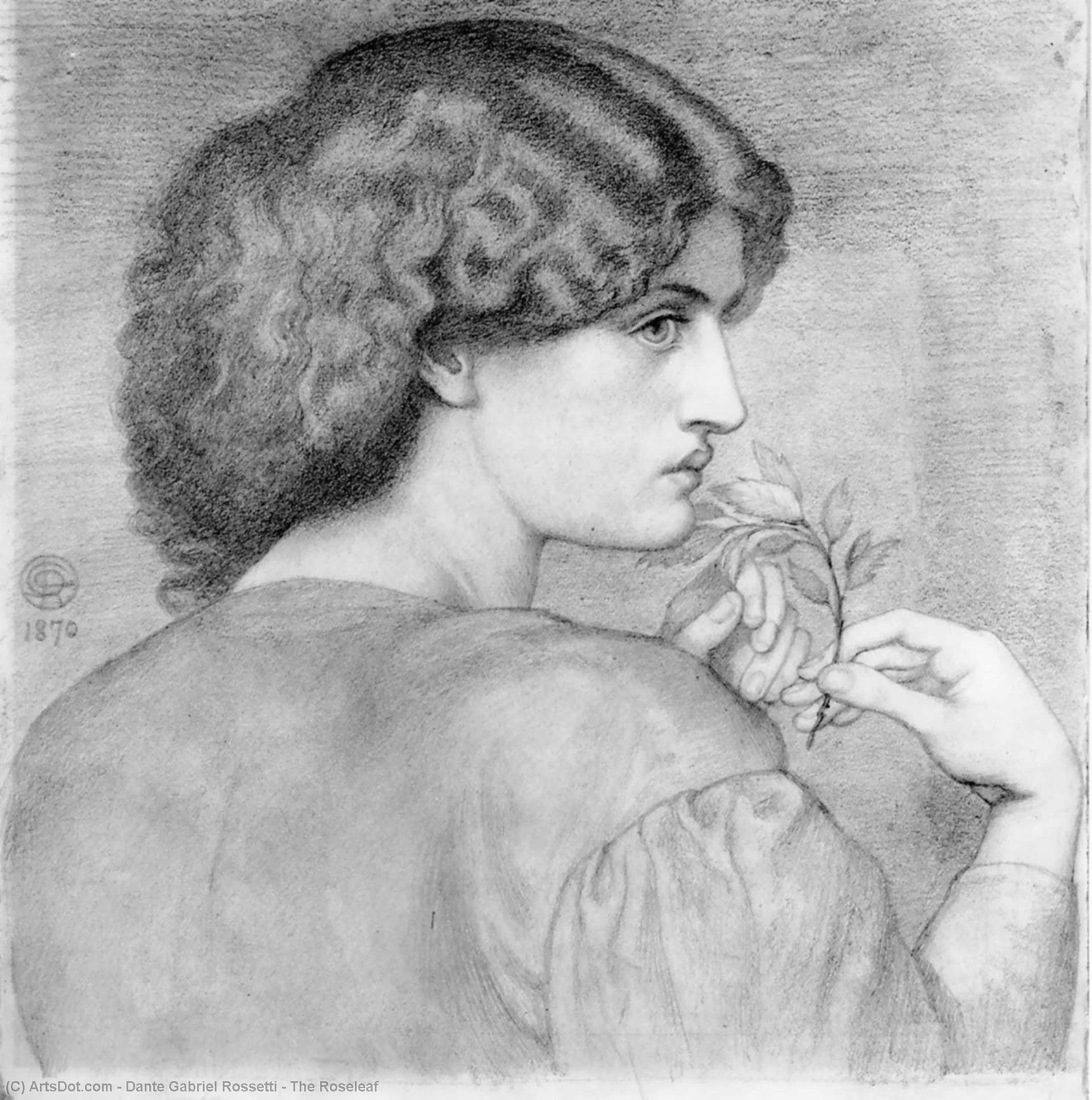
Dante Gabriel Rossetti's "The Roseleaf," created in 1865, is not merely a portrait; it’s an intimate study of feminine introspection and the delicate beauty tinged with melancholy that defines much of his Pre-Raphaelite work. Executed with meticulous detail in graphite pencil, the drawing presents a woman in profile, her face occupying the heart of the composition. She isn't gazing outward at the viewer, but inward, lost in contemplation as she gently holds a branch adorned with leaves – a subtle gesture that invites us to consider themes of nature, fragility, and perhaps, a yearning for something just beyond reach.
The Pre-Raphaelite Aesthetic & Rossetti’s Vision
To understand “The Roseleaf” is to understand the context of the Pre-Raphaelite Brotherhood, a revolutionary artistic movement Rossetti co-founded in 1848. Rejecting the academic conventions of their time, the Pre-Raphaelites sought inspiration in the art predating Raphael – hence the name – embracing vibrant colors, meticulous detail, and a commitment to naturalism. Rossetti, however, brought a unique sensibility to the group, infusing his work with poetic symbolism and an exploration of psychological states. He was deeply influenced by medieval Italian art, Shakespeare, Dickens, Scott, and Byron, all of which contributed to his romantic vision. This drawing exemplifies that aesthetic; it’s not simply *representing* beauty, but attempting to capture a fleeting emotional truth through precise observation and evocative imagery.
Technique & the Language of Graphite
The choice of graphite as a medium is significant. Unlike the bolder strokes of oil paint favored by some of his contemporaries, pencil lends itself to subtlety and nuance. Rossetti masterfully exploits this quality, building form through delicate hatching and cross-hatching that create a remarkable sense of depth and texture. Notice how he renders the woman’s hair – each strand meticulously defined yet flowing with natural movement. The soft gradations of tone across her skin suggest a gentle light source, enhancing the three-dimensionality of the figure. The monochromatic palette further emphasizes this focus on form and emotion; color would have been a distraction from the quiet intensity of her gaze and the symbolic weight of the roseleaf she holds. It’s a testament to Rossetti's skill that he achieves such richness and complexity with what appears, at first glance, to be a simple medium.
Symbolism & Emotional Resonance
The inclusion of the roseleaf is not accidental. In Victorian symbolism, roses often represented love, beauty, and transience – themes central to Rossetti’s artistic concerns. The woman's averted gaze and the overall melancholic atmosphere suggest a sense of longing or perhaps even sorrow. It’s worth noting that Rossetti frequently used his models as muses, imbuing them with personal significance. While the identity of the woman in “The Roseleaf” is debated – some believe it to be Jane Morris, wife of William Morris and a frequent subject of his art – her expression transcends specific portraiture, becoming an archetype of feminine vulnerability and quiet contemplation. “The Roseleaf” isn’t just a beautiful drawing; it's a poignant exploration of the human condition, rendered with exquisite skill and emotional depth.