The Quiet Drama of Domesticity: Unveiling Velázquez’s “Christ in the House of Martha and Mary”
Diego Rodríguez de Silva y Velázquez, a name synonymous with Spanish Baroque mastery, possessed an extraordinary ability to capture not just likeness but also the very essence of human experience. His painting, “Christ in the House of Martha and Mary,” completed around 1618-1619, is a profound meditation on faith, earthly duties, and the subtle tensions within domestic life – all rendered with his signature meticulous realism and masterful use of light. This isn’t merely a biblical scene; it's a snapshot of a moment, brimming with unspoken narratives and quietly observed details that invite endless interpretation.
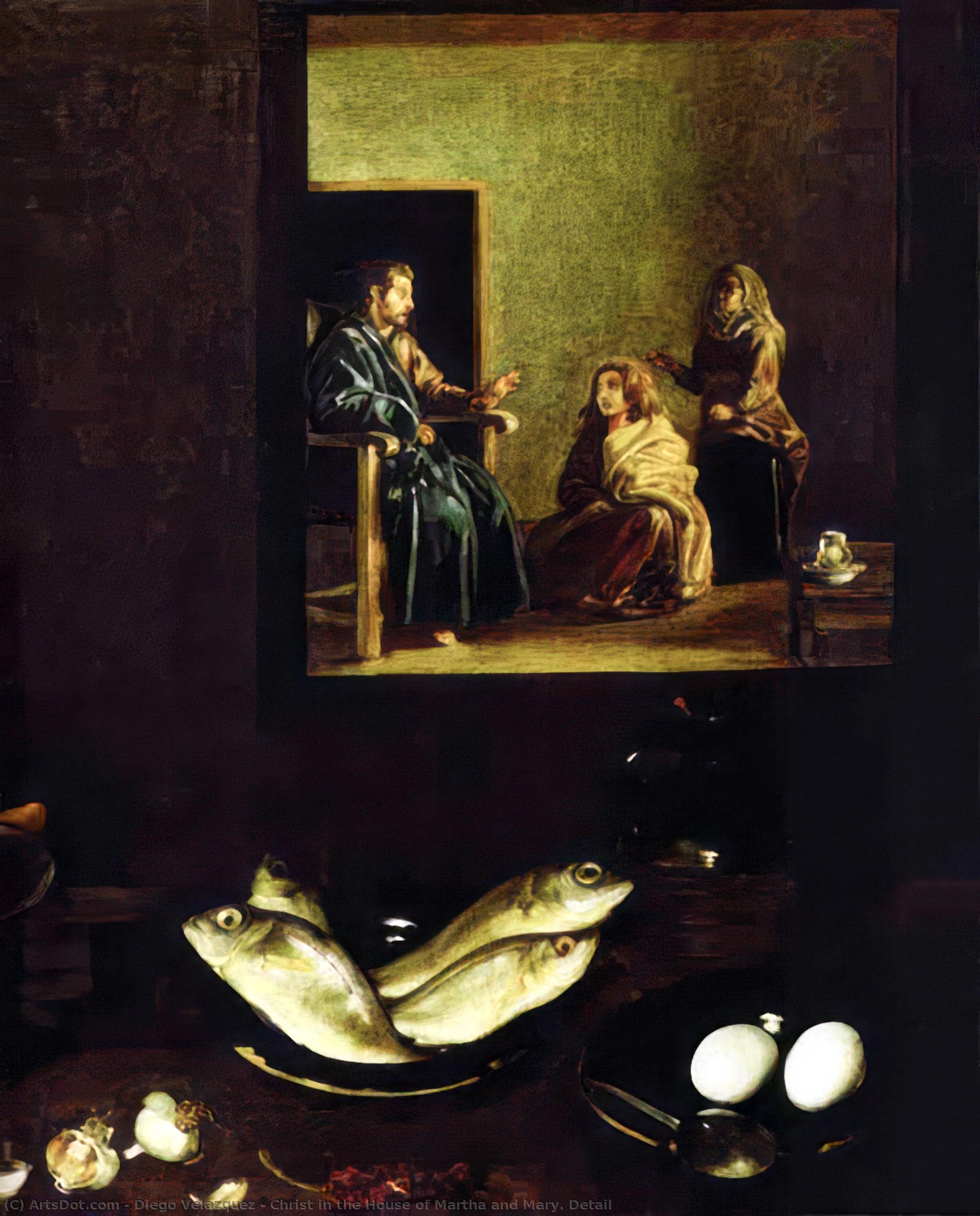
The painting immediately draws the eye to its central composition: Jesus seated at a table alongside Martha and Mary. The setting is a humble kitchen, bathed in a warm, diffused light – a key element of Velázquez’s technique, often referred to as “tenebrism,” where strong contrasts between light and shadow heighten drama and focus attention on specific areas. The figures are not idealized; they possess a palpable sense of humanity, their faces etched with emotion—a hint of exasperation in Martha's expression, a serene contemplation in Mary’s gaze. The inclusion of the elderly woman, likely a servant or relative, adds another layer to the scene, her presence suggesting the everyday realities of life within this household.
The Bodegone Style: A Window into 17th-Century Spain
Velázquez’s “Christ in the House of Martha and Mary” is a prime example of his pioneering use of the *bodegone* style. This genre, popular during his time, involved depicting scenes from contemporary Spanish life alongside religious subjects. Rather than presenting biblical narratives in grand, theatrical settings, Velázquez placed them within familiar domestic environments – kitchens, taverns, or workshops – creating a powerful juxtaposition between the sacred and the secular. The painting’s realism is striking; the food on the table—cups, bowls, an egg—appears remarkably authentic, likely drawn from Velázquez's own household, mirroring the meticulous detail found in his earlier works like “Old Woman Cooking Eggs.” This commitment to verisimilitude was revolutionary for its time and served to ground the religious subject matter in a tangible, relatable reality.
The inclusion of the elderly woman is particularly significant. She’s not simply a background figure; her posture and expression subtly mirror Martha's frustration, suggesting a commentary on the roles and expectations placed upon women within society. Her gesture—pointing towards the scene behind her—can be interpreted as a gentle rebuke or a reminder of the priorities that should guide one’s life.
A Masterclass in Technique: Light, Shadow, and Observation
Velázquez's skill is evident in every brushstroke. He employs a loose, painterly technique—a departure from the smooth, polished surfaces favored by some of his contemporaries—that lends the scene an immediacy and vitality. The light isn’t uniformly distributed; it pools on the faces of the figures, highlighting their expressions and creating a sense of depth. He meticulously observed the textures of fabrics, the sheen of metal, and the subtle variations in color, capturing the essence of each object with astonishing accuracy. This dedication to observation is what truly elevates “Christ in the House of Martha and Mary” from a simple depiction of a biblical scene to a profound exploration of human nature.
Beyond the Canvas: Velázquez’s Legacy
“Christ in the House of Martha and Mary” stands as one of Velázquez's most compelling works, showcasing his innovative approach to composition, his mastery of light and shadow, and his ability to infuse religious subjects with a sense of everyday realism. It is a painting that rewards repeated viewing, revealing new layers of meaning with each encounter. Alongside pieces like “Retrato de Don Sebastián García de Huerta” and “Saint John at Patmos,” this work exemplifies Velázquez’s remarkable versatility and enduring influence on the history of art. For those seeking to experience the brilliance of Diego Velázquez firsthand, ArtsDot offers meticulously crafted hand-painted reproductions that faithfully capture the spirit and artistry of this iconic masterpiece.