Diego Rodríguez de Silva y Velázquez: A Window into Baroque Dignity
Diego Rodríguez de Silva y Velázquez, born in Seville in 1599, stands as a towering figure in the history of Spanish art and indeed, Western painting. His life coincided with the Golden Age of Spain, a period of immense political power and cultural flourishing, and his artistry became inextricably linked to the grandeur and complexity of the Habsburg court. From humble beginnings, Velázquez rose to become not merely a painter, but a visual interpreter of an empire, capturing the essence and dignity of its rulers, courtiers, and everyday life with unparalleled realism and psychological depth. His journey began under the tutelage of Francisco de Herrera el Viejo and later, more significantly, with Francisco Pacheco, whose rigorous training instilled in Velázquez a foundation in technique, proportion, and classical learning. However, it was his innate talent – an extraordinary sensitivity to light, color, and texture – that distinguished him from his contemporaries and cemented his legacy as one of the greatest artists of all time.
The Subject: Juan de Pareja
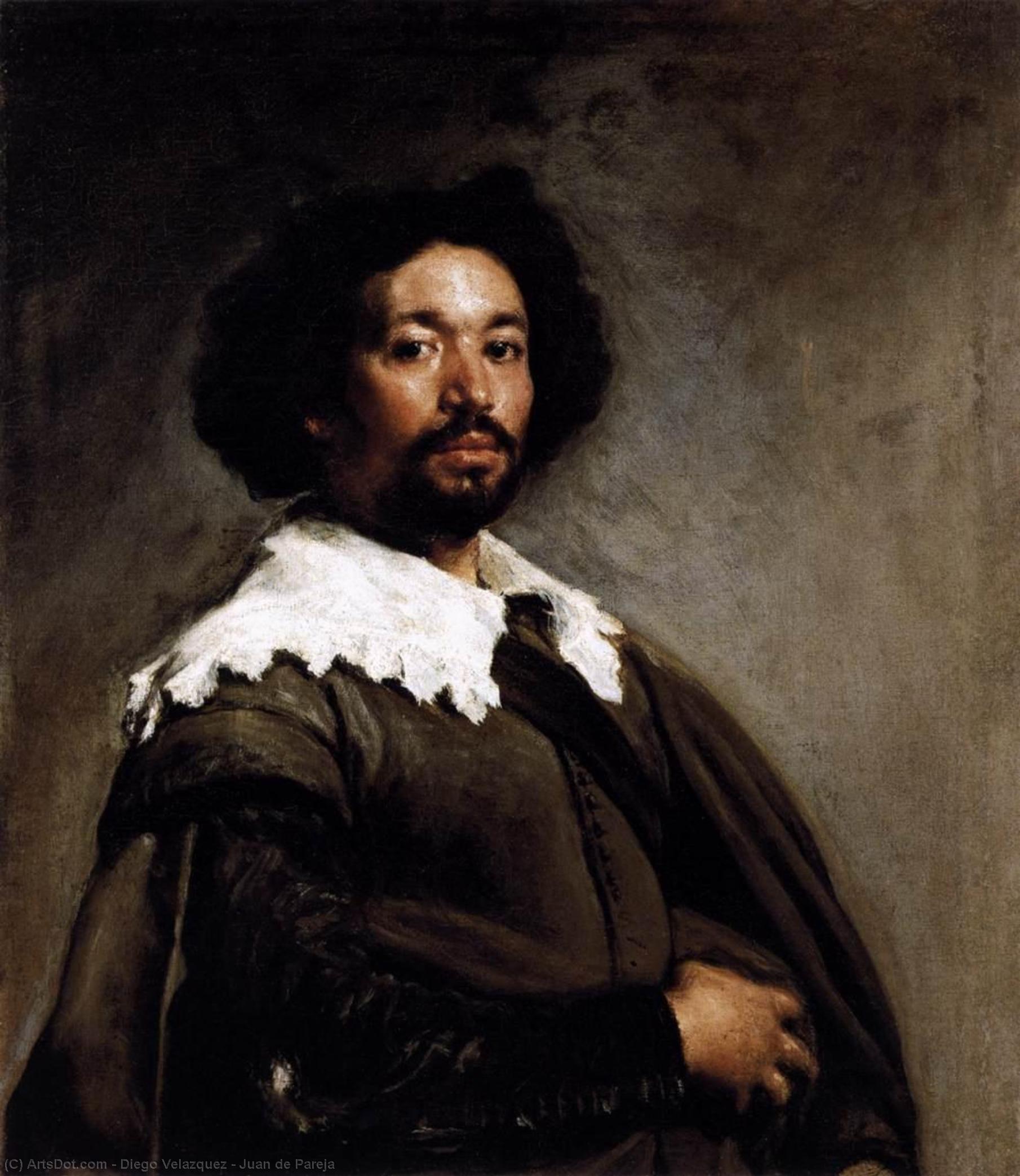
Diego Velázquez, one of the most renowned Spanish painters of the Baroque period, created a masterpiece that not only showcases his exceptional skill but also tells a story of an intriguing figure. The painting titled
Juan de Pareja is a testament to Velázquez's ability to capture the essence and dignity of his subjects. Juan de Pareja, born around 1606 in Antequera, Spain, was himself a painter and a member of Velázquez’s household. What makes this painting significant is that it is one of the earliest known portraits of a Spanish man of African descent. Pareja's life is intertwined with Velázquez’s, as he was enslaved by the artist until 1654. This seemingly simple depiction transcends mere likeness; it embodies Velázquez’s profound understanding of human character and his masterful manipulation of artistic conventions to convey empathy and respect for a marginalized individual.
The Painting
Painted in 1650 during Velázquez's journey to Italy,
Juan de Pareja stands out for its striking realism and the sense of intimacy it conveys. The subject is depicted wearing a white collar and a black coat, with his dark hair neatly styled. The background of the painting is blurred—a technique known as *sfumato*, perfected by Velázquez—which serves to focus the viewer’s attention on Juan de Pareja himself. This deliberate blurring creates an ethereal atmosphere, enhancing the solemnity of the portrait and subtly suggesting a contemplative mood. The artist skillfully utilizes chiaroscuro – the dramatic interplay between light and shadow – to sculpt the figure's form and imbue it with depth and volume.
Artistic Significance
This portrait was not just an exercise in capturing likeness; it was also a preparatory work for Velázquez’s official portrait of Pope Innocent X. The skill and detail with which Velázquez painted
Juan de Pareja demonstrate his mastery over the medium—oil paint on canvas—and solidify his reputation as a pioneer of Baroque painting. Velázquez’s innovative approach to portraiture challenged conventional norms and established a new standard for artistic excellence. He achieved this remarkable feat by meticulously observing his subject, painstakingly mixing pigments, and applying brushstrokes with unwavering precision.
Historical Context
The painting holds historical significance as it was one of the first to sell for more than £1,000,000. It is now part of the collection at the
Metropolitan Museum of Art in New York City, considered among the most important acquisitions in the museum’s history. Its inclusion in this prestigious collection underscores its enduring artistic merit and its contribution to the broader narrative of European art during the seventeenth century. The painting's provenance—spanning from Velázquez’s workshop to papal patronage—reflects the cultural currents of its time and speaks to the importance placed on artistic representation within the Habsburg court.
- Size: 81 x 69 cm
- Date: 1650
Relevance Today
Today,
Juan de Pareja continues to fascinate art lovers and historians alike. It is a powerful example of Velázquez’s ability to humanize his subjects, regardless of their social status or background. The painting serves as a bridge between the past and present, offering insights into the lives of those often overlooked in historical narratives. For those interested in exploring more works by Velázquez,
Infanta María Teresa is another notable piece that showcases his skill in capturing the essence of his subjects. To learn more about Diego Velázquez and his works, visit
Juan de Pareja on ArtsDot.