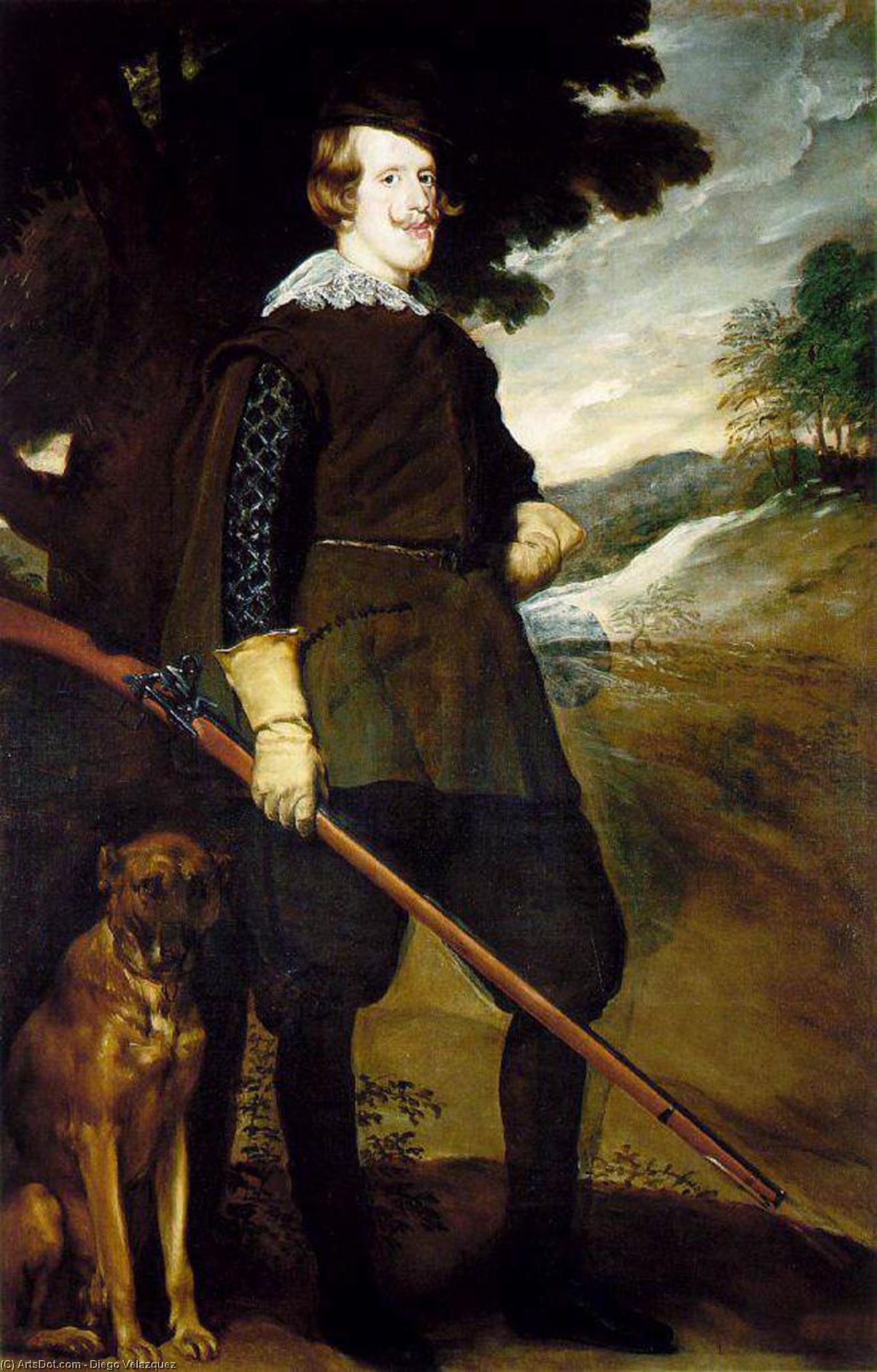
The Majesty of the Monarch: Unveiling “King Philip IV as a Huntsman”
Diego Velázquez’s “King Philip IV as a Huntsman,” painted in 1634, is more than just a portrait; it's a carefully constructed tableau vivant—a snapshot of power, leisure, and the evolving role of the Spanish monarchy. This masterpiece housed within the Museo del Prado in Madrid offers a rare glimpse into the private world of King Philip IV, revealing a ruler far removed from the battlefield and immersed in the pursuits of sport and nature. Velázquez, already establishing himself as one of Spain’s most significant artists, masterfully employs light, shadow, and subtle details to create an image that is both regal and remarkably human.
The painting immediately draws the eye to the central figure: King Philip IV himself. Dressed in a richly adorned hunting attire—a crimson jacket, a velvet waistcoat, and a feathered hat—he embodies the ideal of the noble huntsman. However, it’s not merely the opulent clothing that commands attention; it's Velázquez’s masterful use of chiaroscuro – the dramatic contrast between light and dark – which sculpts the king’s form and imbues the scene with an almost theatrical quality. The light seems to emanate from a hidden source, highlighting Philip IV’s face and torso while leaving the background shrouded in shadow, creating a sense of depth and mystery.
- Composition: The arrangement is meticulously balanced, drawing the viewer's eye through the scene. The king occupies the foreground, immediately followed by his loyal hunting dog, positioned close enough to appear almost engaged in conversation.
- Color Palette: Velázquez utilizes a restrained yet vibrant palette dominated by deep reds, browns, and golds, reflecting the wealth and status of the monarchy. Subtle variations in tone add richness and complexity to the painting’s surface.
- Technique: Noticeable brushstrokes reveal Velázquez's innovative approach – he often worked *alla prima*, applying paint directly to the canvas without extensive underpainting, resulting in a remarkably fresh and spontaneous feel.
A Window into 17th-Century Spain
“King Philip IV as a Huntsman” is deeply rooted in the historical context of its creation. The reign of Philip IV (1621-1665) was a period of significant political and cultural transformation for Spain, marked by both prosperity and internal strife. While he inherited a vast empire, Philip faced numerous challenges, including economic difficulties and religious tensions. This painting offers a counterpoint to the often turbulent realities of his rule—a moment of tranquility and leisure afforded to the king within the confines of his court.
The inclusion of the hunting dog is particularly significant. Hunting was not merely a pastime for Philip IV; it represented a connection with nature, a display of aristocratic prowess, and a means of asserting control over the wild. The dog’s direct gaze towards the viewer adds an element of intimacy and engagement, as if inviting us to share in this private moment.
Symbolism and Artistic Innovation
Beyond its immediate depiction of the king, “King Philip IV as a Huntsman” is rich in symbolic meaning. The hunting attire itself represents power, authority, and mastery—qualities that were highly valued by monarchs during this era. Velázquez’s decision to portray Philip IV *in situ*, engaged in an activity rather than seated on a throne, subtly challenges traditional notions of royal representation. He presents the king as a man of action, a participant in the world, rather than simply a symbol of divine right.
Furthermore, Velázquez’s innovative use of perspective and his ability to capture the texture of fabrics and animal fur demonstrate his mastery of technique. The subtle details—the folds of the king's clothing, the sheen of the dog’s coat, the shadows cast by the trees in the background—are rendered with remarkable precision and realism. This painting is considered a pivotal work in the development of Western art, influencing generations of artists with its innovative approach to portraiture and composition.
A Legacy of Royal Portraits
Velázquez’s “King Philip IV as a Huntsman” stands alongside other notable works by the artist, such as "The Count-Duke of Olivares on Horseback" and “The Surrender of Breda (detail),” showcasing his versatility and profound understanding of human psychology. These paintings collectively offer a compelling portrait of Spanish society during the 17th century—a period of both grandeur and complexity. For those seeking to experience this masterpiece firsthand, a visit to the Museo del Prado in Madrid is highly recommended. The reproduction available at ArtsDot.com offers an exceptional opportunity to bring this iconic work into your home or office.