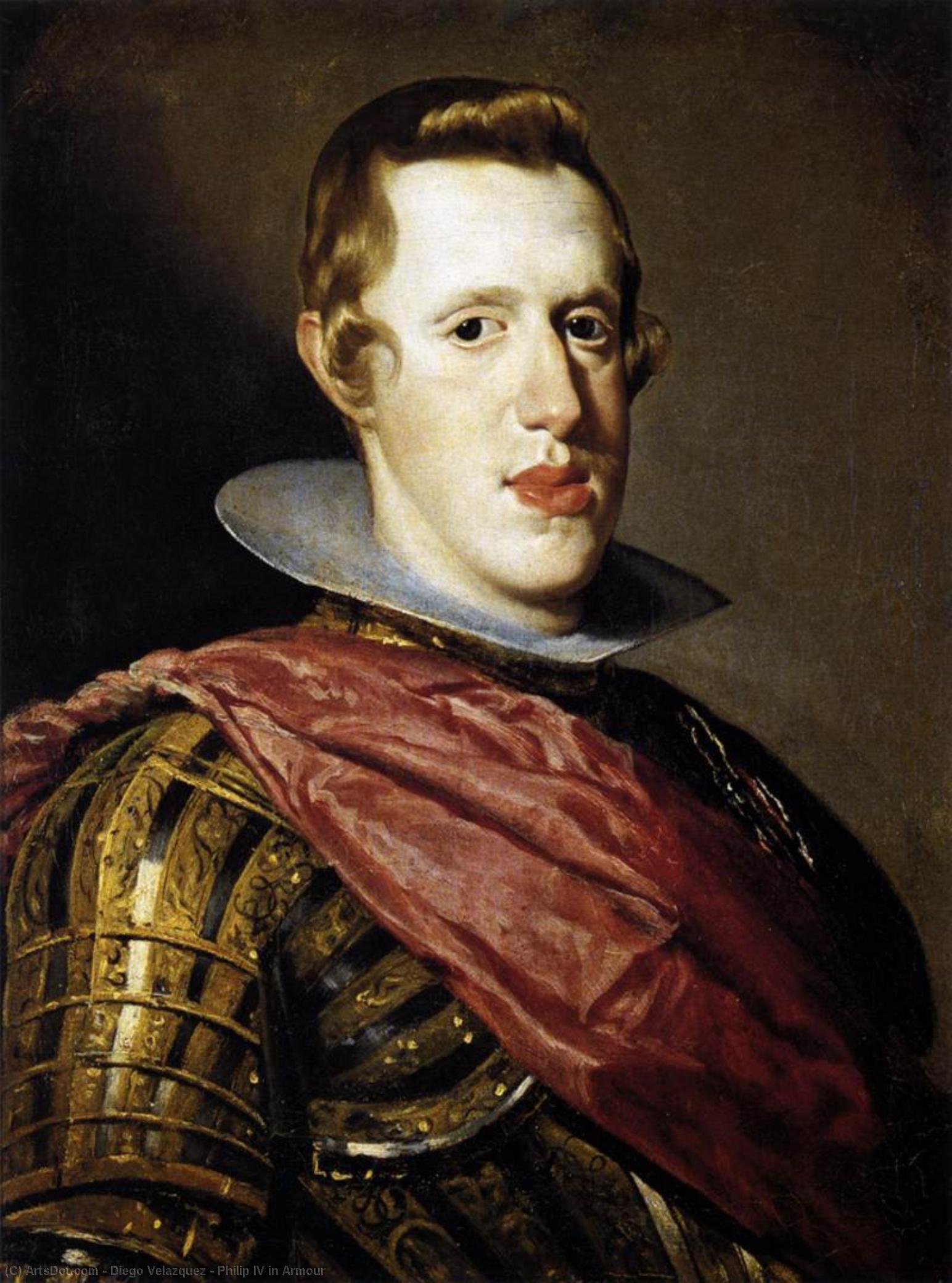
Philip IV in Armour: A Regal Portrait by Diego Velázquez
Diego Velázquez, one of the most renowned artists of the Baroque period, created a series of portraits that captured the essence and grandeur of Spanish royalty. Among these works, Philip IV in Armour, painted around 1628, stands out for its striking depiction of King Philip IV of Spain.
The Artistic Genius of Velázquez
Velázquez's skill in capturing the subtleties of human expression and his mastery over light and shadow are evident in this portrait. The king is portrayed in three-quarter profile, wearing elaborate golden armor that reflects the light, symbolizing power and nobility. The red cloak draped over his shoulder adds a touch of elegance and contrasts beautifully with the metallic sheen of the armor. Velázquez's use of impasto—thickly applied paint—creates texture and depth, bringing the king’s attire to life. The artist expertly uses chiaroscuro, the dramatic contrast between light and dark, to highlight Philip IV’s features and create a sense of volume.
Technique and Composition
The background of the painting is dark and unadorned, which serves to focus the viewer's attention on the king. This technique, characteristic of Baroque art, enhances the play of light and shadow across the composition, adding depth and volume to the subject. Velázquez's precise rendering of the king's features, such as his fair complexion and aristocratic nose, demonstrates his ability to create lifelike and individualistic portrayals. The armor itself is meticulously detailed, showcasing Velázquez’s technical prowess and attention to realism. The composition is carefully balanced, with the king’s gaze directed towards the viewer, establishing a direct connection and conveying authority.
Historical Context & Symbolism
Philip IV in Armour is housed in the Museo del Prado, Madrid, Spain, which is renowned for its extensive collection of European art. The painting was created during a period of significant political and economic change in Spain. Philip IV’s reign (1621-1665) was marked by wars, financial difficulties, and artistic flourishing. The armor itself symbolizes the king's role as a military leader and protector of his realm. The red cloak represents royal power and authority, while the overall somber tone reflects the gravity of the times. This portrait served not only as an image of the monarch but also as a statement of Spanish strength and prestige on the European stage.
Relevance to Art History & Velázquez’s Legacy
This painting is a significant example of Velázquez's work and the Baroque period's emphasis on realism, power, and grandeur. It captures not just the likeness but the essence of the Spanish monarch, reflecting the political and cultural climate of 17th-century Spain. Velázquez’s innovative approach to portraiture—his focus on capturing personality and psychological depth rather than simply physical resemblance—influenced generations of artists. His mastery of light, shadow, and brushwork continues to inspire awe and admiration today.
For those interested in acquiring high-quality reproductions of such masterpieces, ArtsDot offers hand-made oil paintings that capture the essence of these works.