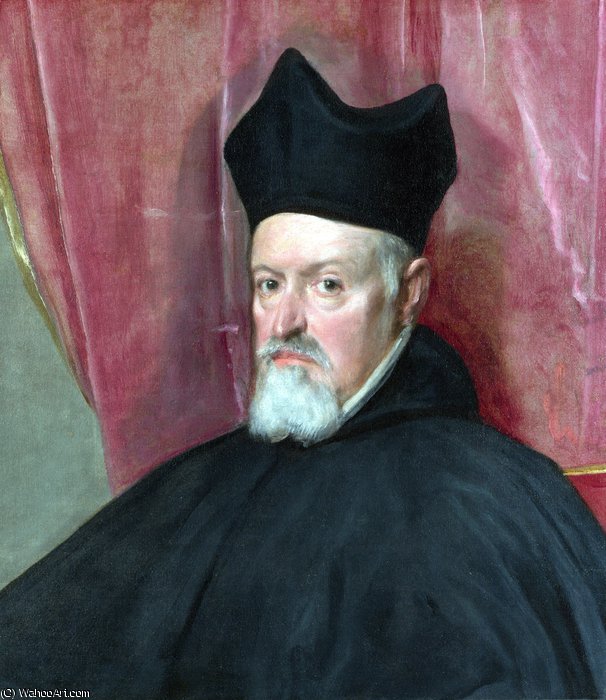
The Majesty of Authority: Unveiling Velázquez’s “Portrait of Archbishop Fernando de Valdés”
Diego Rodríguez de Silva y Velázquez, a name synonymous with the pinnacle of Spanish Baroque painting, gifted the world with an extraordinary ability to capture not just likeness but also the very essence of his subjects. Among his vast and celebrated oeuvre, the “Portrait of Archbishop Fernando de Valdés” (circa 1640-5) stands as a particularly compelling testament to his genius – a masterful study in power, dignity, and subtle psychological depth. This painting transcends mere portraiture; it’s an invitation into the heart of 17th-century Spanish society, offering a glimpse into the life of a prominent religious figure and the carefully constructed image he projected. The work resides today within the esteemed collection of the National Gallery in London, a testament to its enduring artistic merit.
The painting immediately commands attention through its masterful use of color and composition. Velázquez doesn’t simply depict Archbishop Fernando de Valdés; he sculpts him with light and shadow, creating an atmosphere of profound gravitas. The muted tones – predominantly deep reds, browns, and blacks – are expertly balanced to highlight the subject's features and the opulent details surrounding him. Notice how the rich crimson curtain, trimmed with gleaming gold, isn’t merely a decorative element; it acts as a visual anchor, drawing the eye towards the Archbishop and reinforcing his elevated status. The careful layering of textures—the velvet of the robe, the sheen of the fabric, the subtle folds in the drapery—demonstrates Velázquez's meticulous attention to detail, a hallmark of his technique.
At the heart of the composition lies the Archbishop himself. His posture is impeccable – erect and confident, radiating an aura of authority that speaks volumes about his position within the Church hierarchy. The direct gaze he casts upon the viewer isn’t confrontational; rather, it conveys a sense of quiet self-assurance and wisdom. Velázquez's skill in capturing psychological depth is particularly evident here. He doesn’t offer a static representation but instead imbues the Archbishop with a palpable sense of personality – a hint of melancholy beneath the surface, perhaps, or an underlying strength honed by years of leadership. The subtle lines around his eyes and mouth suggest experience and contemplation, adding layers of complexity to the portrait.
The historical context surrounding this painting is crucial to understanding its significance. Diego Velázquez served as court painter to King Philip IV of Spain during a period of immense political and religious upheaval. The Habsburg monarchy was at the height of its power, yet also grappling with internal challenges and external threats. Portraits like this one were not simply vanity projects; they were carefully crafted tools for projecting an image of stability, legitimacy, and divine favor. Archbishop Fernando de Valdés, as a prominent figure within the Church, represented the moral authority that underpinned the kingdom’s power. The painting, therefore, functions as both a personal tribute to the Archbishop and a symbolic affirmation of the alliance between the monarchy and the Church – a cornerstone of Spanish society at the time.
Beyond its historical importance, “Portrait of Archbishop Fernando de Valdés” is a remarkable example of Velázquez's innovative approach to portraiture. He moved beyond the traditional conventions of formal, idealized representations, opting instead for a more naturalistic style that captured the subject’s individual character and presence. His use of *sfumato* – a subtle blurring of edges and contours – creates an atmospheric effect, softening the details and lending the painting a sense of immediacy. Furthermore, Velázquez's masterful handling of light is truly exceptional; he uses it not just to illuminate the subject but also to shape his form and convey his mood. The interplay of light and shadow adds depth and drama to the composition, transforming a simple portrait into a captivating work of art.
- Key Features:
- Masterful use of color and composition to convey importance.
- Capturing psychological depth and personality within the subject’s gaze.
- The opulent red curtain, enhancing grandeur and status.
At ArtsDot.com, we are proud to offer meticulously crafted reproductions of this masterpiece on canvas or premium archival paper. Our hand-painted oil paintings faithfully recreate Velázquez's original techniques, capturing the subtle nuances of light, shadow, and texture that make this portrait so extraordinary. Whether you’re an art enthusiast seeking a stunning addition to your collection or an interior designer looking for a timeless piece to elevate a space, our reproduction offers an unparalleled opportunity to experience the beauty and power of Velázquez's vision. Explore more about Diego Velázquez at
https://ArtsDot.com/@/DiegoVelazquez.
Discover your perfect reproduction today!