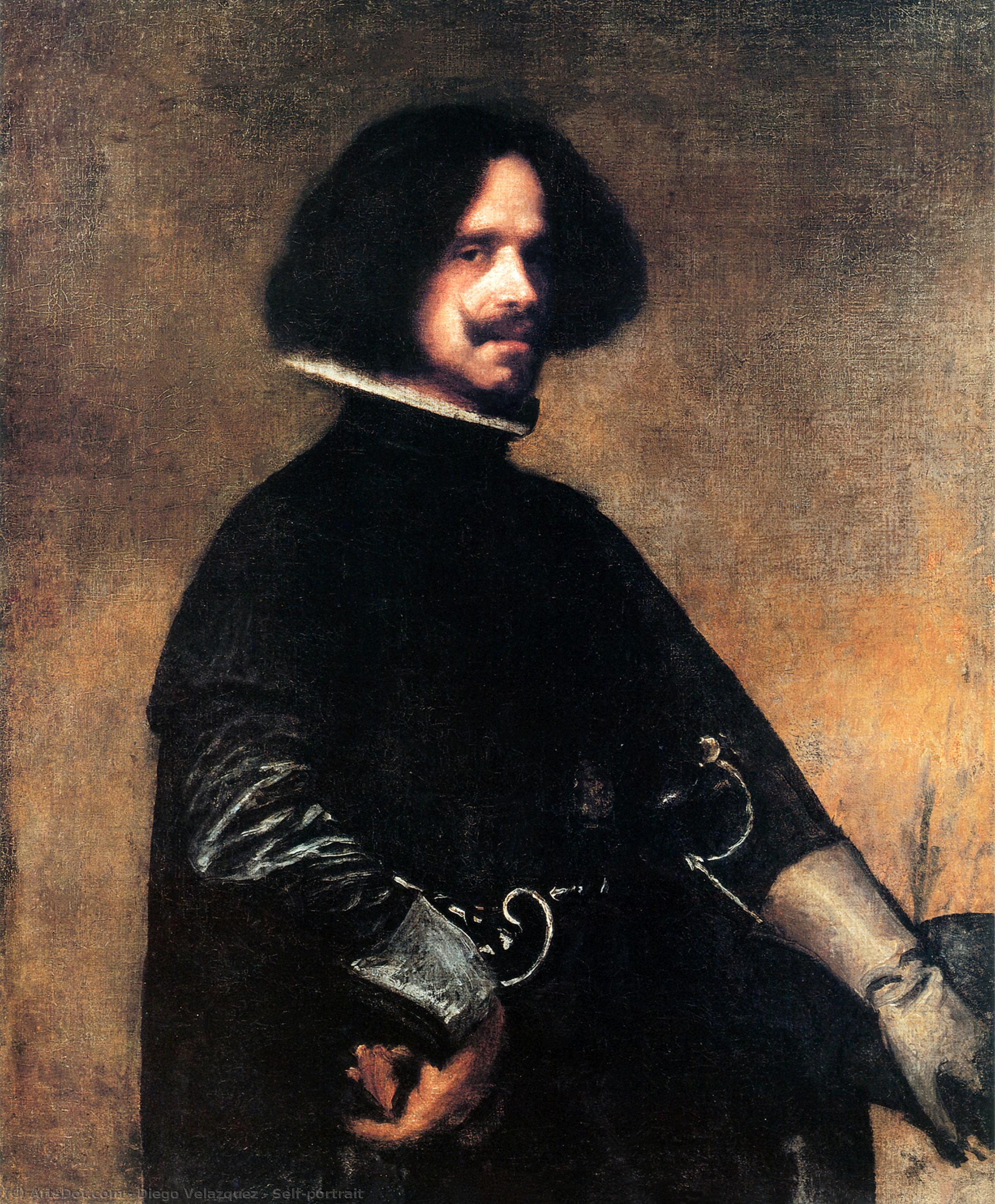
Diego Velázquez’s 1645 self-portrait, a Baroque masterpiece showcasing his ‘sprezzatura,’ captures the artist's aristocratic stance and intense gaze. Admire this iconic oil on canvas reproduction and bring Velázquez’s brilliance into your space.
Diego Velázquez, one of the most renowned Spanish painters of the Baroque period, created a captivating self-portrait in 1645. This oil on canvas painting, measuring 104 x 83 cm, is currently housed in the
Galleria degli Uffizi in Florence, Italy.
The Painter's Aristocratic Stance
Velázquez's self-portrait exudes an air of aristocracy and nonchalance, characteristic of his unique style. The painter's brushwork is notable for its 'sprezzatura,' or courtly elegance. This is evident in the few dry strokes used to depict his linen at the neck and the more charged brushstrokes employed for the sword hilt and belt.
Composition and Symbolism
The painting features Velázquez with long hair and a beard, wearing a black shirt and adorned with a chain around his neck. His intense gaze engages the viewer directly. In the background, two figures are visible, one on each side of the composition. A knife is also present near the bottom right corner of the image.
Artistic Significance
Velázquez's self-portrait is not only a reflection of his artistic skill but also a testament to his status as a prominent figure in the Spanish royal court. The painting showcases his mastery of light and shadow, as well as his ability to capture the essence of his subjects.
Other Notable Self-Portraits
The
Galleria degli Uffizi is home to several other notable self-portraits by renowned artists. These include:
Conclusion
Diego Velázquez's self-portrait is a masterpiece of Baroque art, showcasing his unique style and artistic prowess. The painting's presence in the
Galleria degli Uffizi underscores its significance in the history of art. For those interested in exploring more about the
Galleria degli Uffizi, visit
The Uffizi Gallery, Florence Italy on ArtsDot.