Diego Velázquez: A master of the Spanish Golden Age! Explore his stunning realism, court portraits & iconic works like ‘Las Meninas.’ Discover the legacy of a Baroque genius.
Explore the Museo Nacional del Prado in Madrid! Discover masterpieces by Velázquez, Goya & El Greco, spanning centuries of European art. A must-see cultural landmark!
A Tapestry of Myth and Mastery: Unveiling Velázquez’s “The Fable of Arachne”
Diego Rodríguez de Silva y Velázquez, born in Seville in 1599, stands as an unparalleled figure within the annals of European art—a titan whose groundbreaking innovations reverberated across centuries. More than simply a painter of his time, he fundamentally reshaped artistic perception, elevating realism to new heights while simultaneously embedding it within layers of profound psychological insight. His life coincided with Spain’s Golden Age, a period characterized by imperial ambition and an explosion of cultural creativity, forging an inextricible bond between Velázquez's oeuvre and the opulent grandeur of the Habsburg court. From humble beginnings—a son of a drapery merchant—he ascended to become a royal artist, capturing not just portraits but also the very essence of power and societal life with breathtaking accuracy.
His artistic journey commenced under the tutelage of Francisco de Herrera el Viejo and, crucially, with Francisco Pacheco, whose rigorous training instilled in him a bedrock of classical learning alongside masterful technical skills. Pacheco’s influence ensured Velázquez possessed an understanding of proportion, perspective, and idealized beauty—elements that would inform his distinctive approach to representation. Yet, it was Velázquez's innate genius—a singular sensitivity to light and color—that truly distinguished him from his contemporaries. He achieved a luminosity rarely seen before, capturing the subtle nuances of human emotion and transforming ordinary subjects into embodiments of artistic brilliance.
The Mythological Narrative Embodied
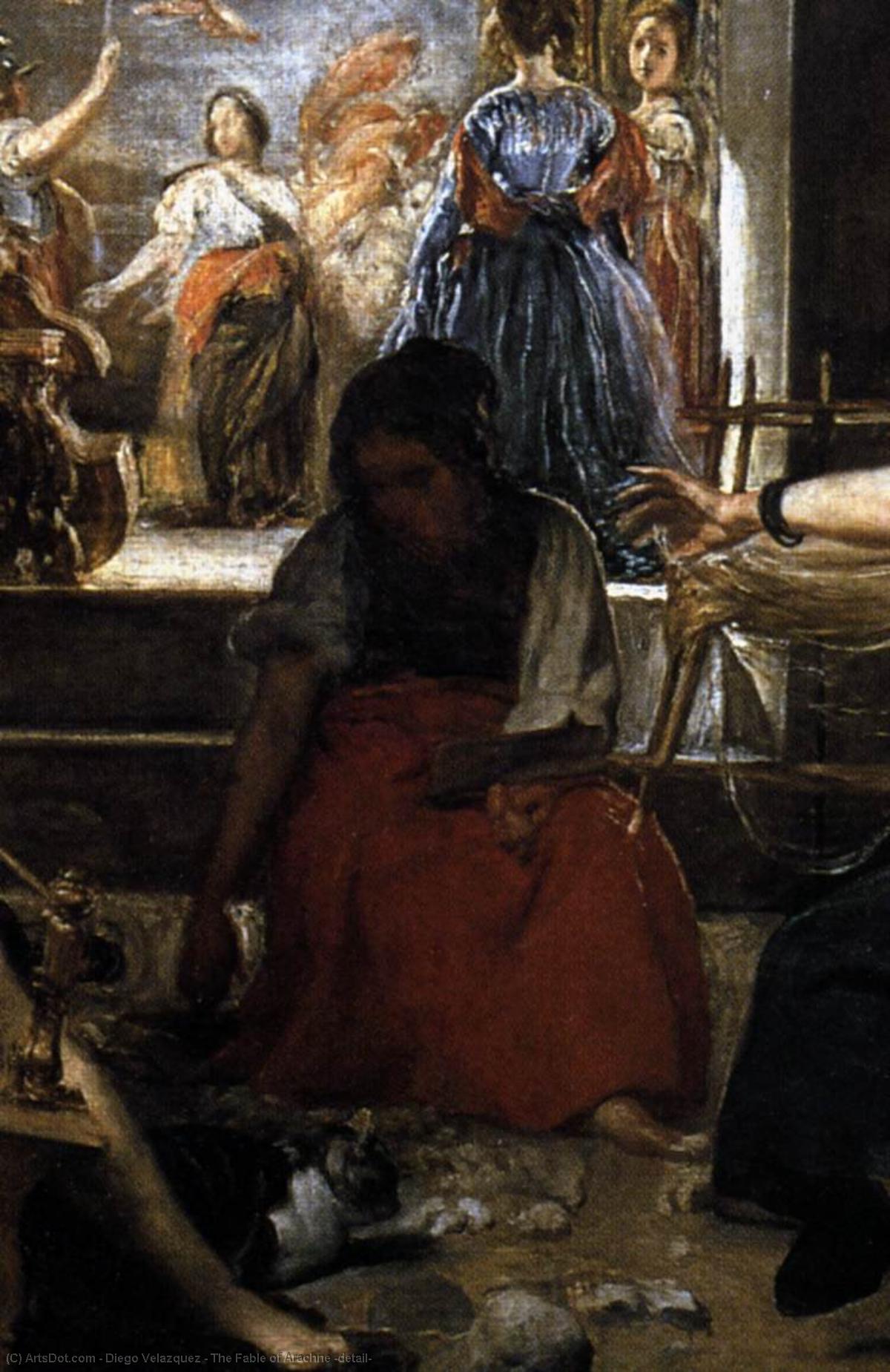
“The Fable of Arachne,” painted in 1657, transcends mere visual depiction; it’s an eloquent retelling of Homer's epic poem concerning Arachne, a weaver who dared to challenge Athena—the goddess of wisdom and crafts—in a contest of skill. Velázquez brilliantly translates the myth onto canvas, presenting a scene brimming with symbolic resonance. The central figure, a woman adorned in crimson robes and draped with white linen, embodies both pride and vulnerability. Her gaze is fixed upward, confronting Athena’s judgment, symbolizing defiance against authority and questioning established dogma—themes prevalent throughout Baroque art.
Technique and Artistic Innovation
Velázquez's mastery of technique is evident in every brushstroke. Employing a masterful chiaroscuro – the dramatic interplay between light and shadow – he achieves an astonishing level of realism, capturing textures and nuances that would inspire artists for generations to come. The meticulous detail with which he renders fabrics, skin tones, and facial expressions speaks volumes about his dedication to observation and artistic precision. He utilized glazing techniques—applying thin layers of translucent paint over underlying colors—to create depth and luminosity, mirroring the atmospheric effects characteristic of Baroque landscapes. This innovative approach distinguishes “The Fable of Arachne” from earlier portraits, establishing Velázquez as a pioneer in capturing psychological complexity.
A Reflection of Habsburg Majesty
“The Fable of Arachne” is not merely an artistic triumph; it’s also a window into the cultural landscape of Spain during Philip IV's reign. The setting—a richly furnished room populated by distinguished gentlemen—reflects the splendor and sophistication of the Habsburg court, demonstrating Velázquez’s ability to portray aristocratic life with unflinching honesty. The inclusion of a clock serves as a subtle reminder of time’s relentless march, juxtaposed against the timeless drama unfolding before the viewer's eyes. This juxtaposition underscores Velázquez’s profound understanding of artistic symbolism and his capacity to convey complex ideas within a single image.
Emotional Resonance: A Portrait of Humility Amidst Glory
Ultimately, “The Fable of Arachne” compels contemplation on themes of pride, humility, and divine retribution. Despite her confidence in her weaving prowess—a symbol of creative achievement—the woman’s posture conveys a palpable sense of apprehension as she awaits Athena's verdict. Velázquez captures this emotional vulnerability with remarkable sensitivity, reminding us that even the most accomplished individuals are susceptible to judgment and that true greatness lies not merely in skill but also in acknowledging one's limitations. This enduring image continues to inspire artists and collectors alike, securing its place as a cornerstone of Baroque art history.