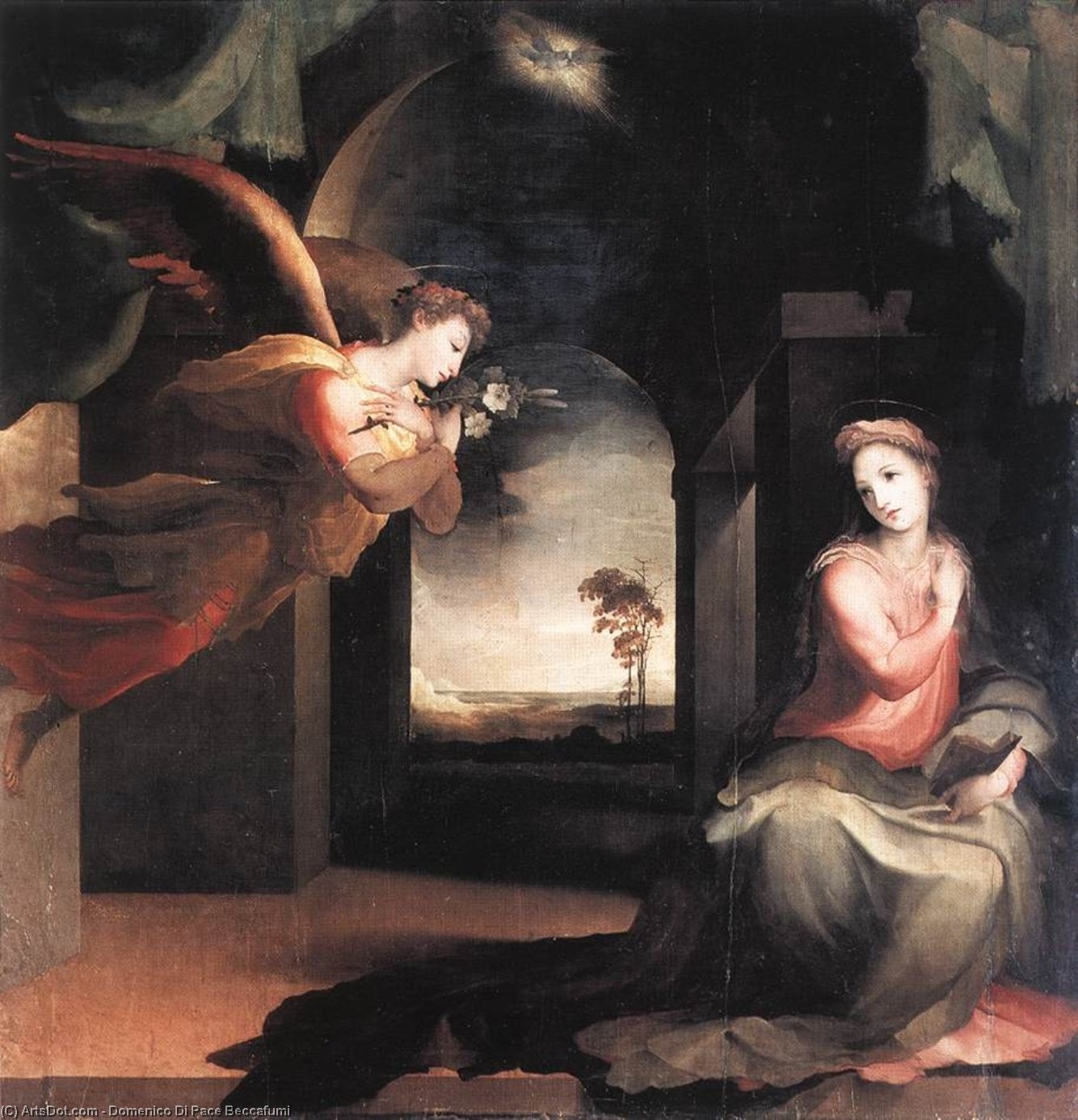
Domenico Beccafumi’s Annunciation: A Sienese Bridge Between Worlds
Domenico di Pace Beccafumi, a name often overshadowed by the titans of Florence, nevertheless stands as a crucial figure in the evolution of Italian Renaissance art. Born around 1486 in Montaperto, near Siena, his artistic journey reveals a fascinating synthesis of Sienese tradition and burgeoning Mannerist influences – a testament to his unique vision and enduring legacy. This Annunciation, painted circa 1545, offers a particularly compelling glimpse into this transitional period, showcasing the artist’s distinctive approach to religious subject matter and his masterful command of color and composition.
The painting immediately draws the eye with its atmospheric quality – a deliberate departure from the crisp clarity favored by earlier Renaissance masters. Beccafumi employs a hazy, almost dreamlike effect, achieved through layered glazes of paint that soften edges and create an ethereal sense of space. The setting is not a meticulously rendered architectural space but rather a subtly defined interior, imbued with a quiet reverence. The arched doorway framing the distant landscape hints at a world beyond, suggesting both the divine mystery of the Annunciation and the earthly context of Mary’s life.
A Symphony of Color and Line
The color palette is restrained yet profoundly evocative. Dominated by muted earth tones – browns, creams, and pale yellows – it avoids the vibrant hues characteristic of later Mannerism. Instead, Beccafumi utilizes subtle shifts in tone to create depth and atmosphere. The delicate pinks and blues used for Mary’s garments and the angel’s skin add a touch of luminosity without overwhelming the overall mood. The strong lines of the architecture—the stone wall, the arched doorway, and the simple bench-like structure beneath Mary – provide a grounding element, contrasting with the flowing curves of the drapery and the angel's wings. This interplay between geometric precision and organic form is a hallmark of Beccafumi’s style.
Symbolism and Spiritual Depth
The Annunciation itself is rendered with a remarkable degree of intimacy and emotional resonance. The angel, hovering gracefully above Mary, extends his hand offering the lily – a potent symbol of purity and innocence. Mary's posture conveys humility and acceptance, her clasped hands suggesting both reverence and a profound sense of trust. The distant landscape glimpsed through the doorway is not merely a backdrop but a symbolic representation of the divine realm, hinting at the vastness of God’s plan for humanity. The painting isn’t simply depicting an event; it's conveying a feeling—a quiet moment of grace and anticipation.
A Masterpiece Bridging Eras
Domenico Beccafumi’s Annunciation stands as a remarkable bridge between the High Renaissance and the emerging complexities of Mannerism. While rooted in Sienese artistic traditions, he embraces innovative techniques and expressive gestures that foreshadow the stylistic developments of the 16th century. His work reflects a deeply personal vision—a sensitivity to color, line, and composition combined with an acute awareness of spiritual depth. This painting is not just a beautiful depiction of a biblical event; it’s a testament to the enduring power of art to evoke emotion, inspire contemplation, and connect us to something larger than ourselves.