The Genesis of a Vision: Domenico Beccafumi's Trinity
Domenico di Pace Beccafumi, a name often overshadowed by the titans of Florence, nevertheless stands as a crucial bridge between the High Renaissance and the burgeoning complexities of Mannerism. Born in the modest Tuscan town of Montaperto around 1486, his artistic journey was one defined not just by technical skill but by an intensely individual vision—a deeply rooted sensibility informed by the traditions of Siena yet boldly reaching towards new expressive possibilities. His story is a testament to how regional artistry could simultaneously embrace and subtly transform broader stylistic trends, culminating in works of profound emotional resonance.
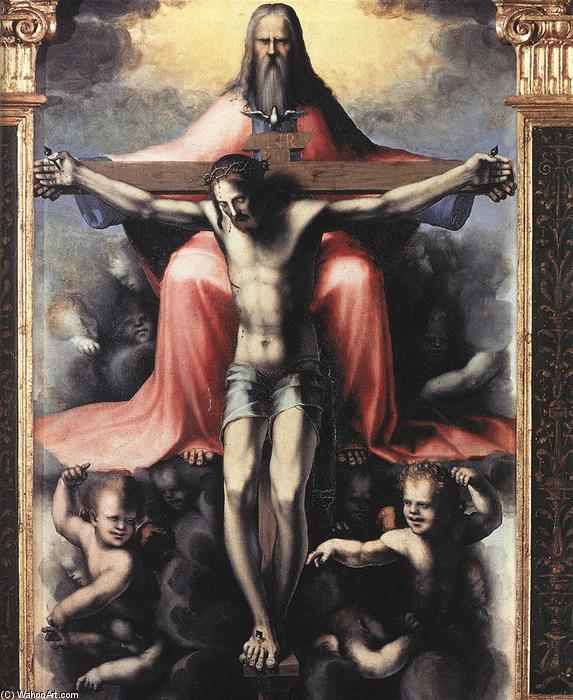
The “Trinity,” painted circa 1513, offers an immediate glimpse into this unique perspective. Commissioned for the Cappella del Manto within the venerable Santa Maria della Scala hospital complex in Siena – a space steeped in history and dedicated to healing – the altarpiece transcends mere devotional representation; it becomes a carefully constructed meditation on faith, sacrifice, and divine presence. Beccafumi’s decision to depict Jesus Christ on the cross as a young man, rather than the more conventional aged figure, immediately establishes a dynamic tension within the composition, injecting a palpable sense of vulnerability and nascent power into the scene.
A Synthesis of Influences: Style and Technique
Beccafumi’s style is remarkably complex, a skillful synthesis of influences from Siena, Florence, and Rome. He inherited the Sienese tradition's emphasis on rich color palettes, dramatic lighting, and a heightened sense of emotional intensity – qualities evident in his masterful use of chiaroscuro to sculpt form and draw the viewer’s eye towards the central figure. Yet, he was also deeply influenced by the Florentine artists who had recently returned from Rome, absorbing their innovations in perspective, anatomical accuracy, and a more dynamic approach to composition. The subtle distortions of figures, particularly in the depiction of the angels, hint at the emerging Mannerist aesthetic – a deliberate departure from the idealized forms of the High Renaissance.
Technically, Beccafumi demonstrates remarkable control over his medium. The oil paint is applied with meticulous detail, creating a surface texture that is both luminous and tactile. The layering of colors—the deep blues and purples of the background contrasted against the vibrant reds and golds of the garments—further enhances the sense of depth and drama. Note also the intricate detailing in the drapery, which flows with an almost sculptural quality, adding to the overall dynamism of the scene.
Symbolism and Spiritual Depth
The “Trinity” is rich in symbolic meaning. The central image of Christ on the cross represents sacrifice and redemption—the core tenets of Christian theology. Above him, the figures of God the Father and the Holy Spirit are rendered with a subtle elegance, suggesting a divine hierarchy while simultaneously conveying a sense of profound unity. The inclusion of two cherubs in the foreground adds an element of innocence and hope, anchoring the scene within a narrative of salvation. The choice of saints flanking Christ—Cosmas and Damian, known for their healing abilities – further reinforces the altarpiece’s connection to the hospital complex where it was originally displayed.
Interestingly, the composition echoes elements found in Raphael's “Foligno Madonna,” suggesting a conscious engagement with contemporary artistic trends. However, Beccafumi transcends mere imitation; he imbues the scene with his own distinctive emotional intensity and spiritual depth. The restless movement of figures, the dramatic lighting, and the carefully orchestrated symbolism all contribute to a powerful and unforgettable visual experience.
A Legacy of Dramatic Emotion
Domenico Beccafumi’s “Trinity” is more than just a religious painting; it's a profound exploration of faith, sacrifice, and the human condition. It stands as a testament to his unique artistic vision—a synthesis of Sienese tradition, Florentine innovation, and personal expression. The work’s enduring appeal lies in its ability to evoke a powerful emotional response, inviting viewers to contemplate the mysteries of life, death, and redemption. Reproductions of this masterpiece capture not only its visual splendor but also the spirit of its creator—a true Sienese visionary who left an indelible mark on the history of Italian Renaissance art.